Borinqueneers
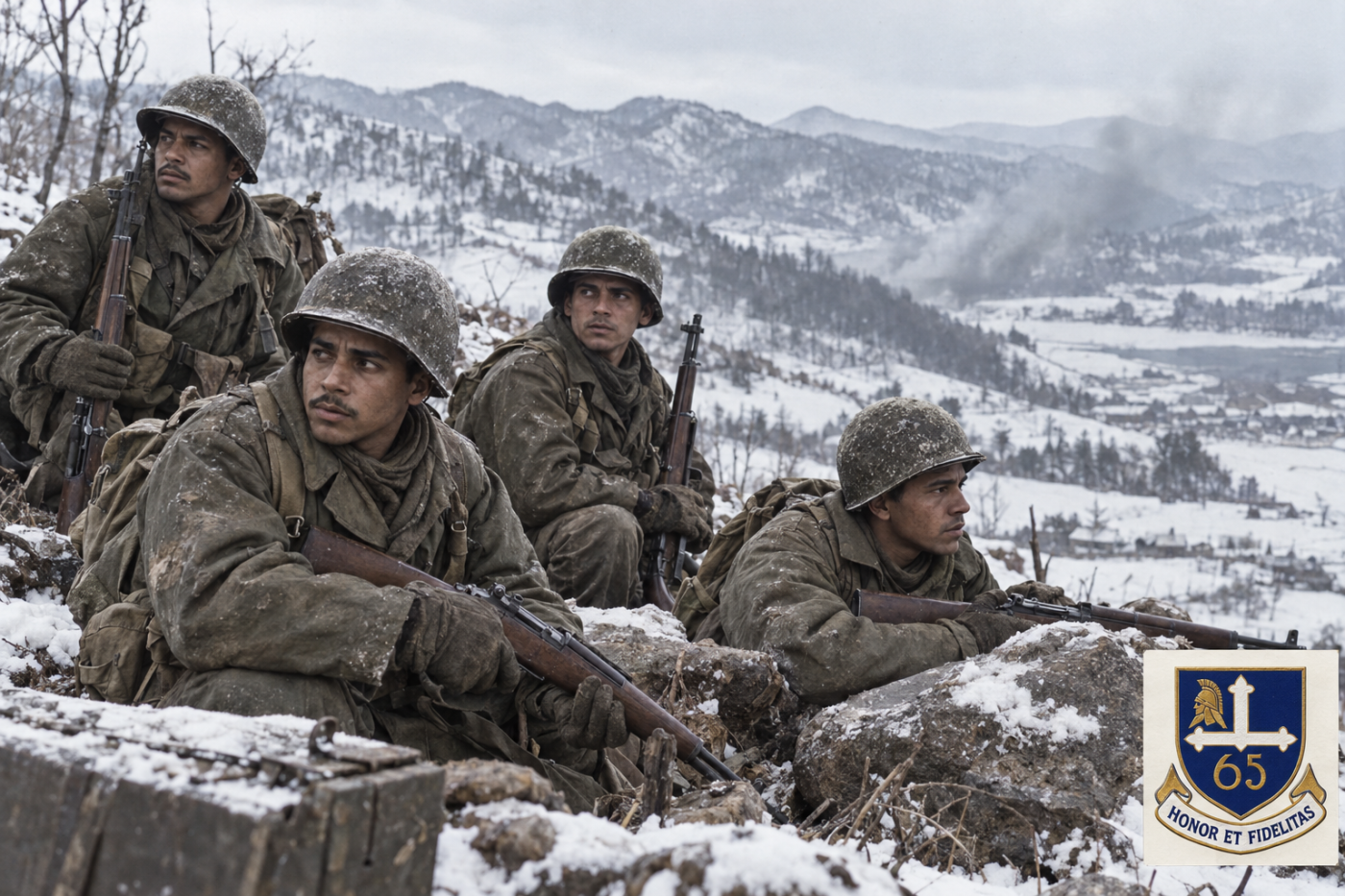
The Borinqueneers were the soldiers of the United States Army’s 65th Infantry Regiment, a predominantly Puerto Rican unit whose history stretched from the aftermath of the Spanish-American War through both world wars and into the bitter fighting of the Korean War. They served a country that did not always treat them as equals, overcoming racial discrimination, language barriers and poor leadership while establishing a remarkable reputation for courage, loyalty and determination. Their nickname came from Borinquen, the Indigenous Taíno name for Puerto Rico, combined with the English word “Buccaneers”. The regiment’s motto, “Honor et Fidelitas”, meaning “Honour and Fidelity”, perfectly reflected the spirit of men who repeatedly proved their loyalty under some of the most difficult conditions faced by American troops.
The unit’s story began after Spain ceded Puerto Rico to the United States in 1898. On 2 March 1899, the Puerto Rico Regiment of Volunteer Infantry was created, with its first battalion organised at San Juan later that month and a mounted second battalion following in 1900. Most of its soldiers were Puerto Rican, although its senior officers and first sergeants were initially white Americans from the mainland, known locally as “Continentals”. Puerto Rican officers gradually began receiving commissions, but discrimination remained a feature of military life for decades. In 1908, the regiment became part of the Regular United States Army and was renamed the Puerto Rico Regiment of Infantry.
When America entered the First World War in April 1917, Puerto Ricans had only recently been granted United States citizenship under the Jones-Shafroth Act. Thousands were called into military service, while the regiment was expanded with a third battalion, machine-gun company and supply company. The men were not sent to the trenches of France but were deployed to the Panama Canal Zone, where they guarded one of the most strategically important waterways in the world. Protecting the canal was vital because it allowed American warships and military supplies to move rapidly between the Atlantic and Pacific. Although the assignment offered few opportunities for battlefield glory, it was an essential wartime responsibility carried out in a difficult tropical environment.
On 14 September 1920, the unit received the designation by which it would become famous: the 65th Infantry Regiment. During the interwar years it remained closely associated with Puerto Rico, training generations of island soldiers and developing a powerful sense of identity and regimental pride. During the Second World War, it again began its service guarding the Panama Canal Zone, remaining there from January 1943 until January 1944. In March 1944 the regiment sailed from the United States for overseas service, arriving in North Africa the following month. Its 3rd Battalion was sent to Corsica, attached to the United States Twelfth Air Force and later entered combat in the Maritime Alps, receiving campaign credit for the Rome-Arno campaign in Italy.
Other parts of the regiment protected the headquarters of the Seventh United States Army and 6th Army Group. The 65th later served in France and Germany, earning campaign participation credit for the Rhineland, Ardennes-Alsace and Central Europe campaigns. Its soldiers carried out security duties, guarded supply routes and installations, conducted patrols and entered areas abandoned by the retreating German Army. After victory in Europe, the regiment served with the occupation forces in Germany before returning to Puerto Rico in November 1945. Despite this service, the 65th remained a segregated unit whose enlisted ranks were overwhelmingly Puerto Rican. President Harry Truman ordered the desegregation of the United States armed forces in 1948, but change was slow, and when war broke out in Korea in June 1950 the regiment still consisted mainly of Spanish-speaking Puerto Rican soldiers commanded by a mixture of Puerto Rican and mainland American officers.
Shortly before the Korean War, the regiment demonstrated its abilities during Exercise PORTREX on the Puerto Rican island of Vieques. Acting as the defending force, the heavily outnumbered 65th stopped elements of the 3rd Infantry Division on the beaches, inflicted simulated heavy losses upon troops of the 82nd Airborne Division and launched counter-attacks that nearly drove the attacking force back into the sea. The exercise helped persuade American commanders that the regiment was ready for combat. The 65th Regimental Combat Team left Puerto Rico in August 1950 and reached Korea during September. With supporting artillery, tanks, engineers and other units, it numbered approximately 6,000 men. The soldiers began calling themselves the Borinqueneers during their voyage across the Pacific, transforming an old name for their homeland into a proud regimental identity.
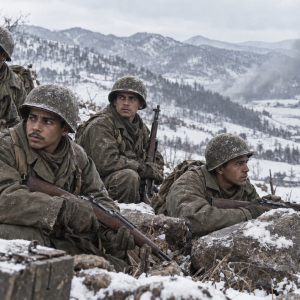
They entered action almost immediately, attacking North Korean positions and helping to cut off enemy soldiers retreating after the United Nations breakout from the Pusan Perimeter. The regiment conducted anti-guerrilla operations, protected important routes and advanced northwards as part of the United Nations offensive. When Chinese forces entered the war in overwhelming numbers, the Borinqueneers were thrown into one of the most dangerous periods of the campaign. Many had arrived without adequate cold-weather clothing and were forced to endure temperatures far below anything normally experienced in Puerto Rico. Frostbite, frozen weapons and exhaustion became almost as dangerous as enemy fire.
In December 1950, the regiment helped cover the withdrawal of United Nations forces from north-eastern Korea. Its 2nd Battalion formed the core of Task Force Dog, which protected the route used by United States Marines withdrawing from the Chosin Reservoir. The Borinqueneers later acted as a blocking force and rearguard during the evacuation of Hungnam, remaining among the last troops to leave the port and helping save exhausted American and allied soldiers from encirclement. During the renewed United Nations advance in early 1951, the 65th took part in Operations Thunderbolt, Killer and Ripper. On 2 February, men of its 1st and 2nd Battalions fixed bayonets and stormed Chinese-held hill positions after several days of hard fighting. The assault drove the defenders from the heights and earned praise from General Douglas MacArthur. The regiment later fought through the Uijongbu Corridor, spearheaded the capture of Hill 717 in the Iron Triangle and resisted repeated Chinese attacks.
One of its most celebrated soldiers was Master Sergeant Juan E. Negrón. On 28 April 1951, near Kalma-Eri, he remained in an exposed position while his company withdrew under a powerful enemy attack. Using hand grenades at close range, he held back the attackers throughout the night and was credited with killing fifteen enemy soldiers. He originally received the Distinguished Service Cross, but following a review of awards given to Hispanic and Jewish servicemen, his decoration was upgraded to the Medal of Honor in 2014.
By 1952, the regiment was being weakened by a disastrous replacement system. Experienced bilingual officers and non-commissioned officers were rotated home without enough trained men being sent to replace them. Newly arrived soldiers were sometimes led by mainland officers who spoke little or no Spanish, while ammunition shortages, constant casualties and repeated attacks against strongly fortified positions further damaged the unit’s effectiveness. The crisis became clear during the fighting for Outpost Kelly in September 1952. Chinese forces captured the position, and repeated attempts to retake it produced hundreds of casualties. The following month the regiment suffered further losses at Jackson Heights, where companies were exposed to intense artillery, mortar and machine-gun fire. Positions became surrounded, communications broke down and several officers were killed.
The failures were followed by one of the most controversial episodes in American military history. The regiment’s Puerto Rican commander, Colonel Juan César Cordero Dávila, was relieved, and a new mainland commander imposed humiliating restrictions upon the men. Soldiers were ordered to shave their traditional moustaches, discouraged or punished for speaking Spanish and denied familiar rice-and-bean rations. The name Borinqueneers was also discouraged. As morale collapsed, groups of exhausted soldiers refused orders to continue attacks they believed would lead to certain death. More than 160 men were arrested, 95 were court-martialled and 91 were convicted, receiving sentences that included years of hard labour. The trials caused outrage in Puerto Rico, where relatives, veterans, politicians and newspapers demanded an investigation.
The Secretary of the Army later granted clemency or pardons to all the convicted soldiers. A detailed Army review released in 2001 concluded that the regiment’s difficulties had been caused by shortages of experienced officers and NCOs, damaging rotation policies, ammunition problems, heavy casualties, unsuitable tactics and the language barrier. It also found evidence of unequal treatment, noting that white soldiers involved in comparable incidents had often escaped prosecution. The controversy should never be allowed to overshadow the regiment’s overall record. The reconstituted 65th returned to operational duties and fought successfully during the final months of the war. Its soldiers carried out raids, defended outposts, engaged in hand-to-hand fighting and helped hold Outpost Harry during the savage battles of June 1953. By the time the armistice came into effect on 27 July, the regiment had received credit for nine Korean War campaigns.
The Borinqueneers’ decorations reflected the scale of their service. The regiment and its companies received American, South Korean and Greek unit awards, including presidential unit citations. Individual soldiers were awarded the Medal of Honor, numerous Distinguished Service Crosses, approximately 250 Silver Stars, more than 600 Bronze Stars and 2,771 Purple Hearts. More than 60,000 Puerto Ricans served in the United States Army during the Korean War, and over 700 lost their lives.
The 65th left Korea in 1954 and was inactivated in Puerto Rico in April 1956, but its heritage did not disappear. In 1959 the regiment was transferred from the Regular Army to the Puerto Rico Army National Guard. Soldiers carrying its lineage later supported overseas missions, including deployments to Guantanamo Bay and Djibouti, as well as providing relief at home following disasters such as Hurricane Maria in 2017. President Barack Obama signed legislation awarding the Congressional Gold Medal to the 65th Infantry Regiment in 2014. The medal was formally presented on 13 April 2016 at the United States Capitol, placing the Borinqueneers among a small number of distinguished military units to receive one of America’s highest civilian honours. In 2021, 13 April was officially recognised as National Borinqueneers Day.
The regiment’s lineage remains alive today through the 1st Battalion, 65th Infantry Regiment of the Puerto Rico Army National Guard. As of 2026, its soldiers continue to train in Puerto Rico while serving in partnership with the California Army National Guard’s 79th Infantry Brigade Combat Team. The Borinqueneers fought for the United States while many people on the mainland knew little about Puerto Rico or the sacrifices being made by its soldiers. They guarded the Panama Canal during the First World War, served across the Mediterranean and Europe during the Second, and faced North Korean and Chinese forces in freezing mountains during the Korean War. They endured segregation, prejudice and injustice without surrendering their pride in their homeland or their regiment. Their story is not simply one of medals and victories, but of men who repeatedly had to prove that they belonged even after their courage had already been demonstrated in battle. The name Borinqueneers now represents generations of Puerto Rican soldiers whose honour, fidelity and sacrifice earned them a permanent place in American military history.