On this day in military history…
On 21 August 1991, one of the most extraordinary military and political confrontations of the Cold War came to an abrupt end on the streets of Moscow. Tanks and armoured personnel carriers had entered the Soviet capital, thousands of civilians had constructed barricades around the Russian parliament, soldiers were being ordered to confront their own people and the president of the Soviet Union was effectively a prisoner hundreds of miles away in Crimea. Yet within three days the coup intended to save the Soviet Union had collapsed. Instead of preserving communist power, its failure helped destroy it.
The events of August 1991 were the culmination of years of growing crisis inside the Soviet Union. Since becoming Soviet leader in 1985, Mikhail Gorbachev had attempted to reform a political and economic system that was increasingly unable to compete with the West or provide adequately for its own population. His policies of perestroika, or restructuring, and glasnost, greater openness, loosened the Communist Party's control over Soviet society. Censorship was relaxed, previously forbidden subjects could be discussed publicly and elections became increasingly competitive. Gorbachev hoped these reforms would revitalise socialism, but instead they exposed decades of economic failure, corruption, political repression and ethnic tensions which Moscow had previously been able to suppress.
Across the Soviet Union nationalist movements grew rapidly. Lithuania declared the restoration of its independence in March 1990, followed by increasing demands for sovereignty elsewhere. Estonia, Latvia, Georgia, Ukraine and other Soviet republics were moving steadily away from Moscow's control. Even Russia itself was challenging the authority of the Soviet government. At the centre of that challenge was Boris Yeltsin. Once a senior Communist Party official, Yeltsin had become one of Gorbachev's most formidable political rivals. In June 1991 he was elected president of the Russian Soviet Federative Socialist Republic by popular vote, giving him a democratic legitimacy that many senior Soviet officials lacked.
For Communist hardliners, military commanders and senior security officials, the situation appeared catastrophic. They believed Gorbachev's reforms were dismantling the state their generation had spent its life defending. The final trigger was a proposed new Union Treaty due to be signed on 20 August 1991. It would have transferred considerable power from Moscow to the Soviet republics and transformed the USSR into a much looser federation. Hardliners feared that once signed, the Soviet Union could no longer be held together.
They decided to act. On 18 August, while Gorbachev was staying at his presidential holiday residence at Foros in Crimea, a delegation of senior officials arrived and demanded that he declare a state of emergency or transfer his powers to them. Gorbachev refused. His communications were cut and he and his family were effectively placed under house arrest.
The following morning, 19 August, Soviet citizens awoke to an extraordinary announcement. State television declared that Gorbachev was unable to perform his presidential duties because of ill health. Vice-President Gennady Yanayev announced that he had assumed the powers of acting president. Behind him stood a group of eight senior officials calling themselves the State Committee for the State of Emergency, generally known by its Russian initials GKChP. Among the conspirators were some of the most powerful men in the Soviet Union, including KGB chairman Vladimir Kryuchkov, Defence Minister Dmitry Yazov and Interior Minister Boris Pugo.
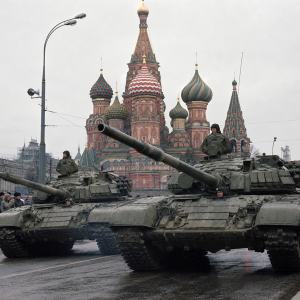
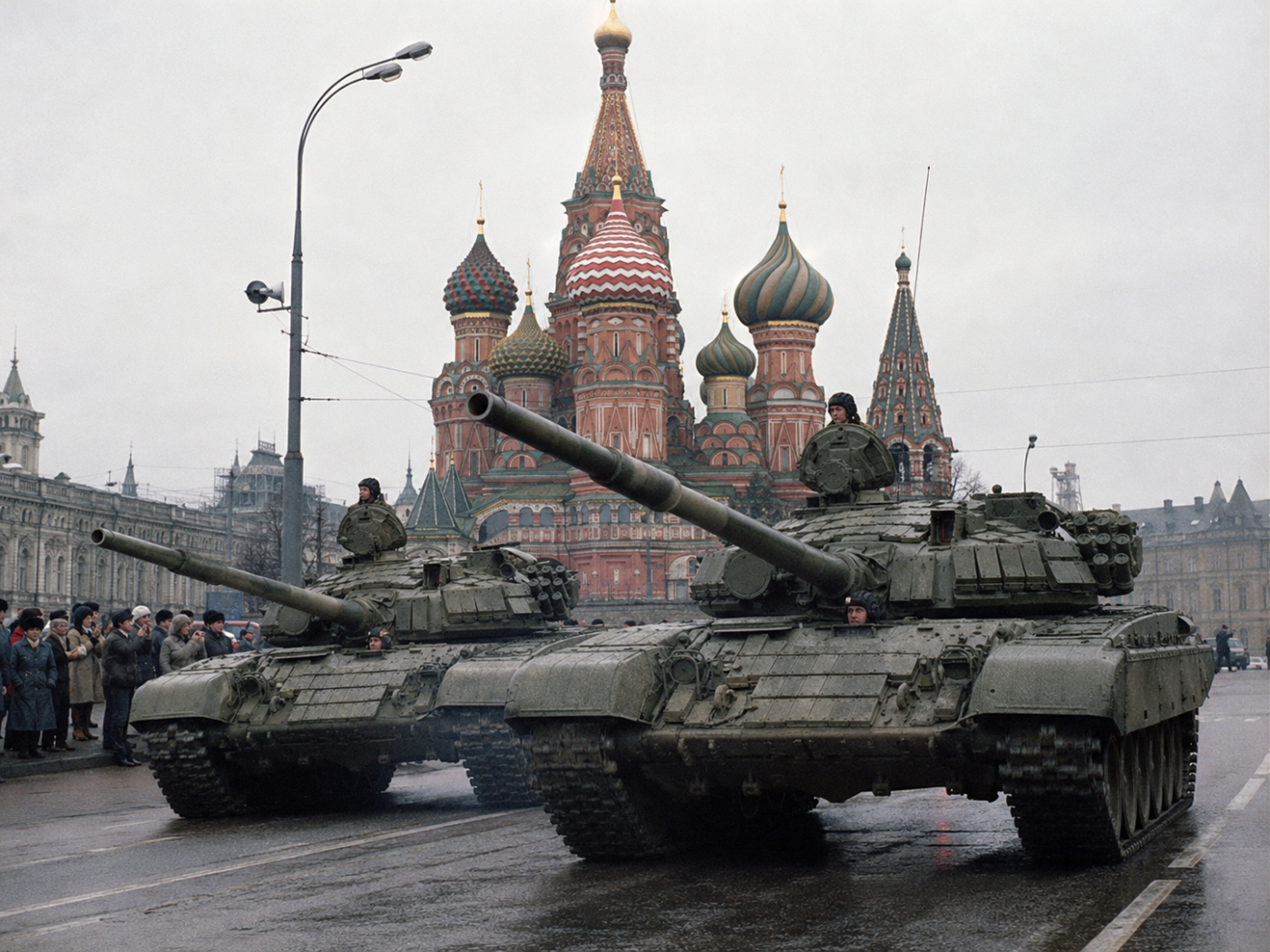
They controlled enormous military and security forces. On paper, the coup should have been almost impossible to resist. Thousands of troops were ordered into Moscow. Tanks from the elite Tamanskaya Division and armoured vehicles from other formations appeared on the city's streets. Bridges and important junctions were occupied. Armoured personnel carriers moved along major avenues while columns of military vehicles surrounded key government buildings. For people who had lived through decades of Soviet rule, the symbolism was unmistakable. The old state was attempting to reassert itself by force.
But the conspirators made a crucial mistake. They failed to arrest Boris Yeltsin. On the morning of 19 August, Yeltsin reached the Russian parliament building on the banks of the Moscow River, the huge government complex that became universally known as the White House. The building quickly became the centre of resistance.
Then came the defining image of the coup. At approximately 1pm, Yeltsin walked outside, approached one of the tanks positioned near the White House and climbed onto it. Standing on the armoured vehicle, surrounded by soldiers, journalists and increasingly large crowds of civilians, Yeltsin denounced the seizure of power as unconstitutional and called for a general strike and mass resistance. Photographs and television footage of Yeltsin standing on the tank travelled around the world and became one of the most remarkable images produced during the final years of the Cold War.
More importantly, the soldiers beneath him did not arrest him. Some military units were already becoming reluctant to obey the coup leaders. Tank crews around the White House increasingly spoke with civilians. Protesters climbed onto armoured vehicles, handed soldiers food and cigarettes and urged them not to fire on their own people. The coup leaders possessed tanks, aircraft, the KGB and much of the Soviet government machinery, yet they were discovering that issuing an order and persuading men to carry it out were two very different things.
Thousands of Muscovites began gathering around the White House. Barricades appeared across surrounding streets. Buses, trucks, construction materials, pieces of concrete and anything else available were dragged into position. Volunteers prepared themselves for the possibility that Soviet troops would attempt to storm the building. Inside the White House, Yeltsin and the Russian leadership continued organising resistance while outside civilians waited for an assault many believed could come at any moment.
As darkness fell on 20 August, rumours spread that an attack was imminent. The possibility was entirely real. Elite KGB Alpha Group special forces had been associated with plans for an operation against the White House, while military formations were manoeuvring through Moscow. The building's defenders knew that if armoured forces attacked seriously, their makeshift barricades would provide little protection. Some defenders carried weapons, others prepared improvised incendiary devices and thousands simply remained in position.
During the night of 20–21 August, a military column approached the barricades near the White House and the confrontation became violent. Crowds attempted to prevent armoured vehicles passing through a tunnel and surrounding streets. In the confusion, three young men – Dmitry Komar, Ilya Krichevsky and Vladimir Usov – were killed. One was crushed during the confrontation while others suffered fatal injuries as protesters struggled with the military vehicles. An armoured personnel carrier was set on fire and for a few terrifying moments it appeared that Moscow could be sliding towards open fighting between troops and civilians.
But the military column withdrew. There was no full-scale assault on the White House. It was the decisive moment. Military commanders were increasingly unwilling to order their soldiers to attack Russian civilians in the centre of Moscow. Units began withdrawing or declaring their neutrality, while some troops openly sided with Yeltsin's government. The coup leaders had lost control of events.
By the morning of 21 August, tanks and armoured vehicles began leaving Moscow. The feared attack on the White House never came. Crowds who had spent the night expecting an assault suddenly realised that the balance had shifted. The coup was collapsing.
The conspirators attempted desperately to salvage their position. Several members travelled to Crimea hoping to meet Gorbachev, but the Soviet president refused to legitimise what they had done. Communications with Gorbachev were restored and that evening he left Crimea and returned to Moscow. The men who had attempted to seize control of one of the world's two superpowers were arrested or placed under investigation. Interior Minister Boris Pugo committed suicide shortly afterwards.
On the surface, Gorbachev had survived. In reality, his political position had been shattered. The man emerging victorious from the crisis was Boris Yeltsin. Throughout the coup Yeltsin had remained visibly in Moscow while Gorbachev had been isolated in Crimea. Yeltsin had stood on the tank, rallied the crowds and become internationally identified with resistance to the hardliners. When Gorbachev returned, the political balance of power had changed dramatically.
The Communist Party itself was discredited by the involvement of senior party and government figures in the attempted coup. Yeltsin moved rapidly against Communist institutions in Russia and the authority of the central Soviet government began disintegrating. Even the symbols of the old regime were attacked. On 22 August enormous crowds gathered in Moscow. Outside the headquarters of the KGB in Lubyanka Square stood the massive statue of Felix Dzerzhinsky, founder of the Bolshevik secret police. To generations of Soviet citizens, Dzerzhinsky symbolised the security apparatus that had grown through the Cheka, NKVD and eventually the KGB. The statue was pulled down.
It was an extraordinarily powerful image. An institution that had once terrified millions of Soviet citizens had been unable to save the system that created it. Above the crowds another symbol was appearing – the old Russian white, blue and red tricolour, which would replace the Soviet red flag as Russia's national flag.
The attempted coup had lasted barely three days, but its consequences were enormous. The hardliners had launched the coup because they feared the Soviet Union was breaking apart. Their actions accelerated exactly that process. Across the Soviet republics, leaders understood that the central government could no longer guarantee stability. Independence movements gathered momentum with extraordinary speed. Ukraine declared independence on 24 August, other republics followed or strengthened declarations already made, and the Baltic states consolidated the independence Moscow had attempted to prevent.
Gorbachev continued formally as president of the Soviet Union, but increasingly he was president of a state that was disappearing beneath him. The decisive moment came in December. On 8 December 1991, the leaders of Russia, Ukraine and Belarus met at a government residence in the Belovezh Forest in Belarus. Boris Yeltsin, Ukrainian leader Leonid Kravchuk and Belarusian leader Stanislav Shushkevich declared that the Soviet Union had effectively ceased to exist and announced the creation of the Commonwealth of Independent States.
Gorbachev could do little to prevent it. On Christmas Day, 25 December 1991, he resigned as president of the Soviet Union. That evening the red Soviet flag was lowered from above the Kremlin for the final time and replaced by the Russian tricolour. The following day the Soviet Union formally ceased to exist.
A superpower that had emerged from the Russian Revolution, survived Stalin's terror, defeated Nazi Germany, occupied Eastern Europe, developed nuclear weapons, sent the first man into space and confronted the United States throughout more than four decades of Cold War rivalry had disappeared. Its final destruction had occurred astonishingly quickly.
The August coup did not alone destroy the Soviet Union. Economic decline, nationalism, political reform, the weakening of Communist authority and disputes between Moscow and the republics had been tearing the state apart for years. But the coup was the catalyst. Perhaps the greatest irony was that the men behind it had acted because they wanted to save the USSR. Instead they demonstrated that the Soviet government could no longer rely automatically upon its own army, its own security forces or even its own population.
Tanks had entered Moscow expecting to intimidate resistance. Instead civilians climbed onto them. Soldiers had been ordered to enforce emergency rule. Many refused to fire. The conspirators had removed Gorbachev hoping to restore Communist authority. Instead they transformed Boris Yeltsin into the dominant political figure in Russia.
Three civilians lost their lives during the confrontation around the White House, but the enormous bloodshed many feared never came. The fact that Soviet military units ultimately refused to carry out a major attack was crucial to the coup's failure. Photographs from Moscow remain some of the most memorable images of the twentieth century: Soviet tanks parked beneath the buildings of the capital, civilians constructing barricades around the White House, protesters talking to young conscript soldiers and Boris Yeltsin standing defiantly on the armour of a tank while demanding resistance.
For almost half a century Soviet tanks had represented Moscow's ability to impose its will. They had crushed the Hungarian uprising in 1956 and rolled into Czechoslovakia in 1968. In Moscow in August 1991, however, the tanks stopped. On 21 August they began withdrawing. Four months later, the Soviet Union itself was gone.