On this day in military history…
By September 1917 Britain was confronting a frightening new form of warfare. German aircraft were no longer simply reconnaissance machines or small tactical bombers operating above the Western Front. Large twin-engined Gotha bombers were crossing the North Sea and attacking targets deep inside Britain. On the night of 2–3 September 1917 the German air service launched what the Royal Air Force Museum records as the first heavy night bombing raid on Britain by Gotha bombers, targeting the Dover area. It marked the beginning of a new and more sinister phase of the German strategic bombing campaign.
The Gothas were not completely new to British skies. German Gotha G.IV bombers had begun large-scale daylight attacks against Britain on 25 May 1917, when a force intended for London was forced by poor weather to attack Folkestone and the nearby military camp at Shorncliffe instead. On 13 June eighteen Gothas attacked London in daylight, killing 162 people and causing hundreds of other casualties. Further raids followed during the summer, but British defences were becoming increasingly effective. Fighter squadrons were strengthened, anti-aircraft guns improved their organisation and the London Air Defence Area was established to coordinate aircraft, guns, observers and searchlights.
The daylight raids were becoming costly for the Germans. Gothas were large aircraft, with wingspans of more than 23 metres, normally carrying a crew of three and capable of carrying several hundred kilograms of bombs. Although formidable by the standards of 1917, they were vulnerable when intercepted by determined British fighter pilots. During the raid of 22 August three Gothas were destroyed, and the mounting losses persuaded the German commanders that continuing daylight operations over Britain was becoming increasingly dangerous. The solution was simple in theory but extremely demanding in practice: the bombers would begin operating at night. The 22 August attack proved to be the final daylight Gotha raid against Britain during the First World War.
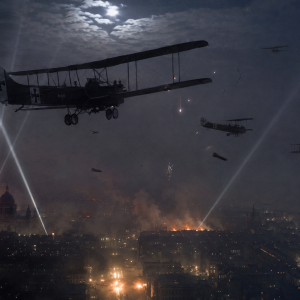
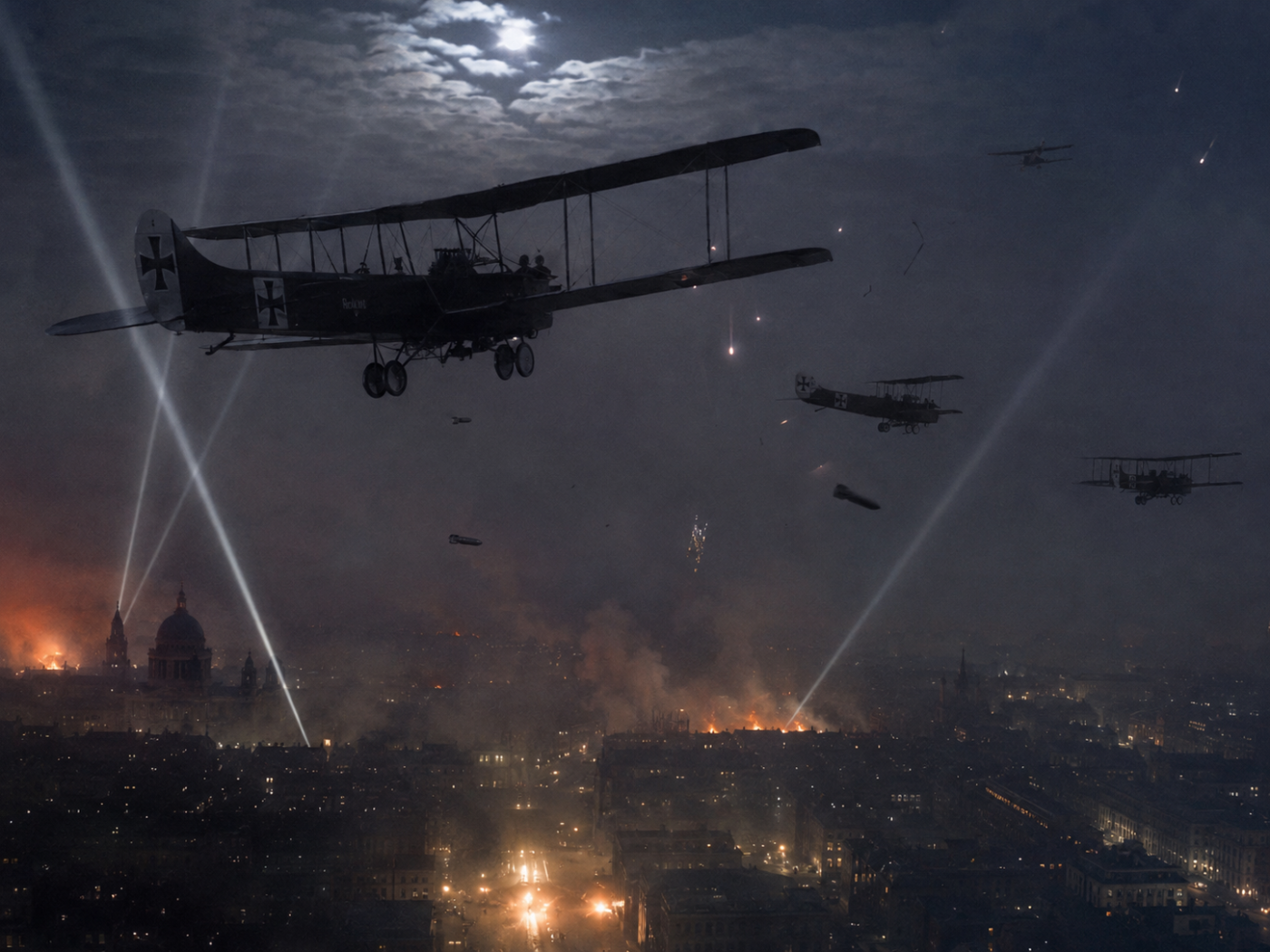
During the night of 2–3 September the Gothas returned across the Channel under cover of darkness. Dover was the principal target in what became the first heavy Gotha night raid on Britain. For people below, the experience was very different from the daylight attacks. Aircraft could be heard approaching but were often almost impossible to see. Searchlights struggled to find them, anti-aircraft gunners had difficulty judging their height and speed, while British fighter pilots faced the extremely hazardous task of taking off, navigating and landing in darkness in aircraft never designed as specialised night fighters.
The Germans quickly discovered that darkness offered considerable protection. Navigation was far less accurate and bombing results were unpredictable, but the chances of interception were greatly reduced. Britain possessed nothing resembling the sophisticated radar-directed night fighter system that would exist during the Second World War. In 1917 defence relied upon observers, searchlights, sound detection, anti-aircraft guns and aircraft patrols coordinated through an increasingly organised command structure. Britain was effectively learning how to create an integrated air-defence system while enemy bombers were already attacking its cities. Historic England describes the London Air Defence Area created during this period as the world's first integrated air-defence system of reporting, fighters, guns, searchlights and other detection methods.
The following night demonstrated just how deadly the new campaign could become. On 3–4 September Gothas again crossed into Britain, this time attacking Chatham in Kent. Three Sopwith Camels of No. 44 Squadron were sent up against the raiders, representing some of the earliest attempts to use single-seat fighters operationally at night. They failed to intercept the bombers, but the flights demonstrated that fighters such as the Camel could at least operate after darkness had fallen.
At Chatham the consequences were catastrophic. Bombs fell around the important naval installations and one struck accommodation occupied by Royal Navy personnel, causing one of the worst single losses of life inflicted by an air raid in Britain during the First World War. Imperial War Museums records numerous sailors as having been killed during the Gotha bombing raid on Chatham on 3 September 1917.
The raids of early September therefore represented much more than another series of German bombing attacks. They signalled the beginning of sustained heavy night bombing by aeroplanes against Britain. The Gothas had already demonstrated that bombers could cross the Channel in formation and strike London in daylight; now darkness allowed them to continue the campaign despite improving British defences. Civilians who had previously believed that the Royal Navy and the English Channel provided protection from enemy armies were discovering that aircraft had made geography far less important.
The psychological effect was considerable. Air-raid warnings, searchlights sweeping across darkened skies, anti-aircraft shells exploding overhead and the distant sound of heavy aero engines created a type of warfare Britain had never previously experienced. Factories could be disrupted, railway traffic interrupted and thousands of civilians forced into shelters even when only a handful of aircraft were overhead. The military significance of the physical destruction was limited compared with the gigantic bombing campaigns that would come twenty-five years later, but the principle of strategic bombing had been firmly established.
The Gotha campaign also influenced the future of British military aviation. The need to defend Britain and retaliate against targets inside Germany strengthened arguments for an independent air service. During 1917 the Smuts Committee recommended the creation of an Air Ministry and a unified air force, warning that aerial warfare might eventually become one of the principal forms of military operations. The Royal Air Force would consequently be created on 1 April 1918.
The night of 2–3 September 1917 can therefore be regarded as an important moment in the development of aerial warfare. It was not the first time German aircraft had bombed Britain—the Gothas had been carrying out daylight attacks since May—but it marked the beginning of their heavy night-bombing campaign. The raids that followed showed that cities, naval bases and industrial centres far behind the battlefield were now part of the front line. The familiar image of German bombers crossing the darkness to attack Britain, normally associated with the Blitz of the Second World War, had in fact begun more than two decades earlier, in the skies of the First World War.