On this day in military history…
On 4 September 1944, British troops swept into Antwerp and liberated one of the most important cities in north-west Europe. The capture came during the rapid Allied advance that followed the collapse of the German position in Normandy. In just a few weeks, the armies that had fought through the Normandy bocage were racing across France and Belgium, and the British 11th Armoured Division reached a prize that could potentially solve one of the greatest logistical problems facing the Allies — the enormous port of Antwerp.
Antwerp had been under German occupation since May 1940. By September 1944, German forces in western Europe were retreating rapidly under pressure from British, Canadian, American and Polish troops. The speed of the advance was remarkable. The 11th Armoured Division, known by its Black Bull insignia, had fought through Normandy before joining the pursuit across northern France. On 1 September it reached Amiens after advancing around 60 miles in a single day, and only three days later its troops were entering Antwerp.
The city’s importance went far beyond its population or symbolic value. Antwerp contained one of Europe’s largest deep-water ports, and since the Normandy landings the Allied armies had relied heavily on supplies brought through invasion beaches and smaller captured ports. Every gallon of fuel, artillery shell, ration, vehicle and spare part had to be transported ever greater distances as the front moved hundreds of miles from Normandy, making logistics increasingly strained. Capturing Antwerp intact offered a potential solution, as its vast docks, warehouses, cranes and rail links could handle enormous volumes of supplies and make it one of the most valuable objectives in the campaign.
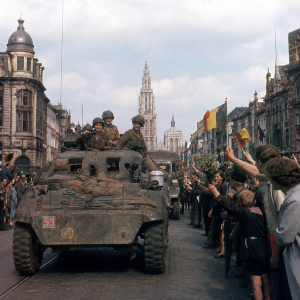
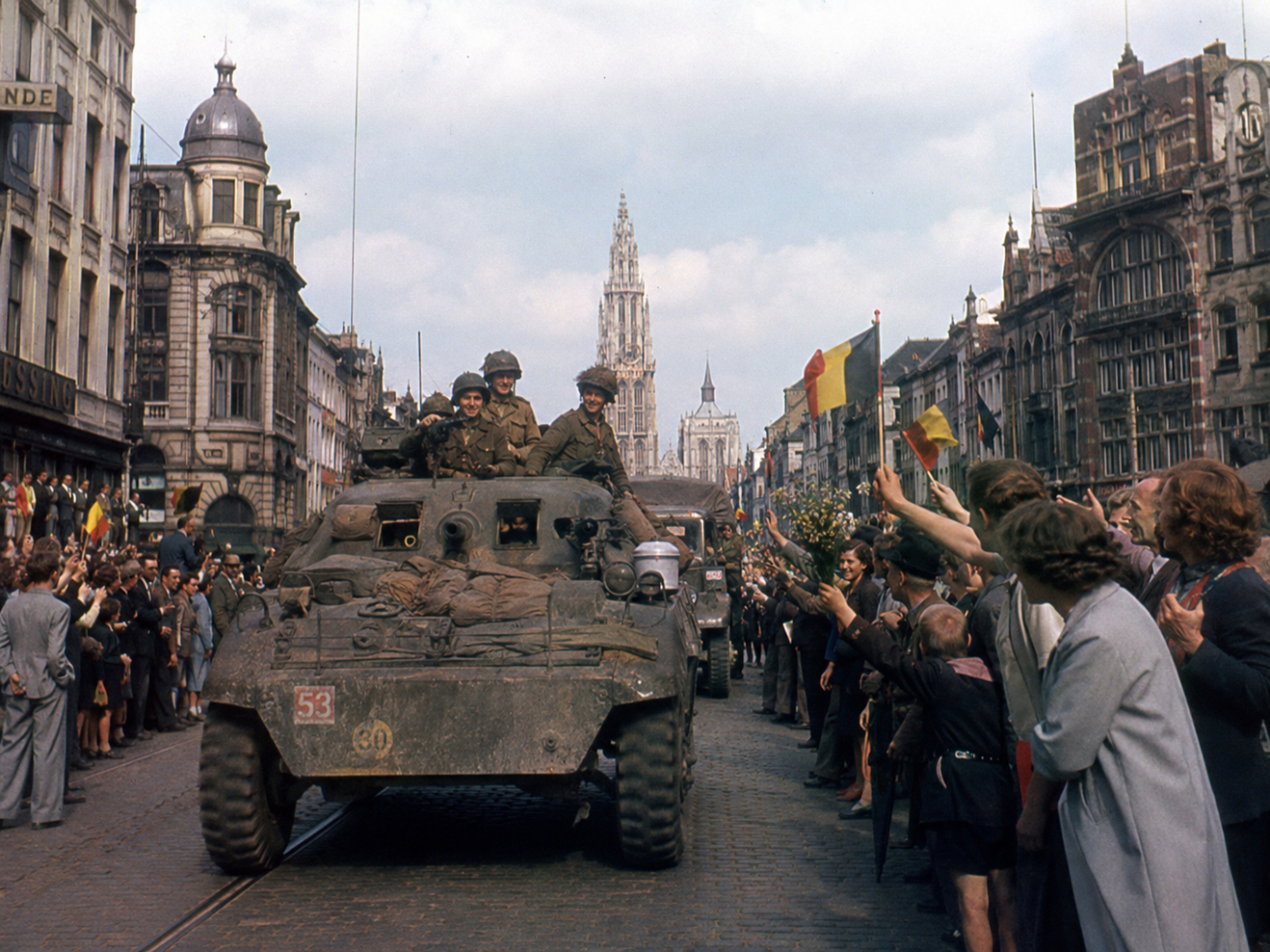
On 4 September, elements of the 11th Armoured Division advanced into the city with the help of Belgian resistance fighters, who provided vital local knowledge and helped prevent widespread German demolitions in the harbour area. As British tanks, armoured cars and infantry entered Antwerp, they were met with scenes of intense emotion. After more than four years of occupation, civilians flooded the streets, waving Belgian flags, surrounding vehicles, and greeting soldiers with flowers and embraces. However, the liberation was not entirely peaceful, as German troops still held parts of the city and docks, forcing continued fighting.
Units including the 4th Battalion King’s Shropshire Light Infantry and the 8th Battalion Rifle Brigade took part in the operation. Street fighting developed as British forces cleared the city and port area, capturing large numbers of German soldiers as resistance collapsed. By the end of the day, Antwerp was effectively in Allied hands, and crucially, the port had been captured largely intact. German demolition plans had been only partially carried out, thanks to the speed of the advance and the actions of the resistance, leaving much of the harbour infrastructure usable.
Despite this success, a major problem remained. Antwerp lies far inland along the Scheldt estuary, and access from the North Sea required control of both banks of the waterway. Although the city had been liberated, German forces still held strong positions along the Scheldt, including heavily fortified areas near its mouth. As a result, Allied ships could not yet reach the port. Coastal guns, mines, and entrenched German positions made the estuary impassable, meaning the Allies had captured a vital port that was effectively unusable.
This situation became one of the most controversial strategic issues of the campaign in north-west Europe. The rapid Allied advance had created expectations of a possible German collapse by the end of 1944, shifting attention towards pushing into the Netherlands and Germany rather than immediately clearing the Scheldt. However, the consequences soon became clear. Supply lines stretched back to Normandy, fuel shortages worsened, and vast quantities of material had to be moved forward by road using thousands of vehicles, including those of the Red Ball Express and British supply columns supporting the Second Army.
The Germans quickly recognised the importance of the Scheldt and strengthened their defensive positions as retreating units withdrew northwards. This allowed them to turn the approaches to Antwerp into a heavily fortified defensive zone. The task of opening the port eventually fell to the First Canadian Army, which, alongside British and Polish forces, fought a series of extremely difficult battles in October and November 1944 to clear the estuary. Flooded terrain, mud, mines, dykes and strong German fortifications made the Scheldt campaign one of the most demanding operations of the final phase of the war in north-west Europe.
Fierce fighting took place around Breskens, South Beveland and Walcheren. Allied aircraft bombed sea defences on Walcheren, deliberately flooding parts of the island to isolate German positions. British Commandos and Canadian infantry then fought through remaining strongpoints, after which minesweepers could begin clearing a safe channel through the estuary. The Scheldt was finally opened in November, and on 28 November 1944 the first Allied convoy entered Antwerp, nearly three months after its liberation. From that moment, the port became a crucial supply hub for the advance into Germany.
The Germans responded with sustained attacks using V-1 flying bombs and V-2 rockets, targeting Antwerp in an effort to disrupt Allied logistics and destroy the port. The city and its civilians suffered heavily under this bombardment during the final months of the war. The liberation of Antwerp therefore stands as both a major British success and a key lesson of the campaign: capturing a port was not enough if its sea approaches remained in enemy hands.
What had seemed on 4 September to be a decisive breakthrough instead became the beginning of another costly struggle. The cheering crowds who greeted the Black Bull Division could not have known that thousands more soldiers would have to fight and die before Antwerp could finally fulfil its role as one of the most important supply ports in the Allied advance into Germany.