On this day in military history…
On 5th September 1970, soldiers of the United States Army’s 101st Airborne Division began Operation Jefferson Glen in South Vietnam, a campaign that would continue for more than a year and become the division’s final major combat operation of the Vietnam War. Conducted alongside the Army of the Republic of Vietnam’s 1st Infantry Division, the operation took place principally in Thừa Thiên Province around Huế and the mountainous approaches to the A Sầu Valley. It came at a crucial stage of the war when the United States was steadily reducing its ground forces and transferring increasing responsibility for combat operations to the South Vietnamese under President Richard Nixon’s policy of “Vietnamization.”
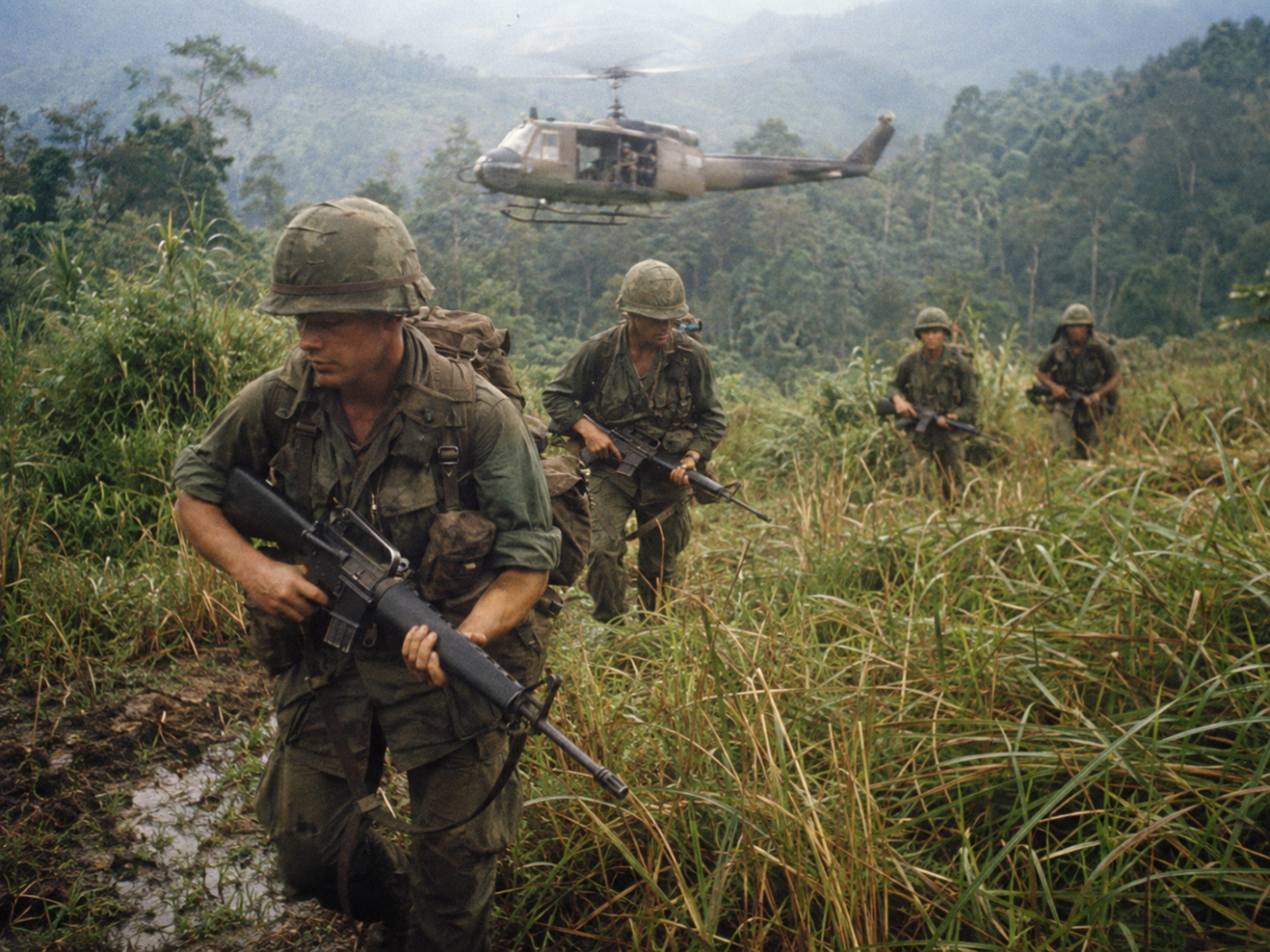
The 101st Airborne Division had already endured years of hard fighting in this region. Although still carrying its famous Airborne title, by this point the division operated primarily as an airmobile force, using helicopters to move infantry rapidly across the difficult terrain of northern South Vietnam. Its soldiers had fought at Huế during the Tet Offensive, in the A Sầu Valley, and at places such as Hamburger Hill and Firebase Ripcord. By September 1970, however, the American military situation was changing. Large search-and-destroy operations were becoming less common, and American formations were increasingly expected to protect key areas while preparing South Vietnamese units to take over the fighting themselves.
Operation Jefferson Glen followed directly after Operation Texas Star and was designed in part around the approaching monsoon season. Its principal purpose was to prevent North Vietnamese Army and Viet Cong forces from infiltrating through the mountains and establishing positions from which they could threaten the populated coastal plain. Of particular concern were the so-called “rocket belts” west of Huế and along the approaches towards Da Nang. From concealed positions in the foothills and jungle, communist forces could fire rockets at military bases, airfields, supply installations, and towns before withdrawing back into the mountains. The 101st therefore established fire-support bases while infantry patrols, reconnaissance teams, and helicopters continually searched likely infiltration routes.
Jefferson Glen was not a single battle fought around one objective. It became a long campaign of patrols, ambushes, reconnaissance missions, helicopter assaults, and clashes with relatively small enemy formations scattered across a vast area. American soldiers might spend days moving through thick jungle without contact before suddenly encountering an enemy bunker complex, supply route, or concealed position. Artillery and helicopter gunships would then be brought in while infantry attempted to locate and destroy enemy forces before they disappeared back into the jungle.
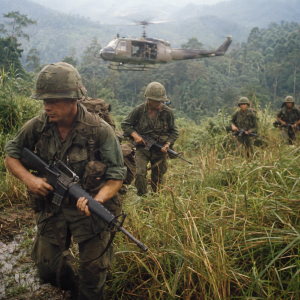
Helicopters were central to virtually every aspect of the operation. The division’s aviation units carried troops, ammunition, food, and water to isolated positions, evacuated casualties, and provided aerial reconnaissance and fire support. The 2nd Squadron, 17th Cavalry Regiment was particularly active, its observation helicopters and gunships searching valleys and mountain routes for North Vietnamese movement. During September 1970 alone, its aircraft located enemy troops, vehicles, and positions on numerous occasions. Crews often flew at extremely low altitude, deliberately exposing themselves to small-arms and heavy machine-gun fire in order to locate concealed enemy positions.
The dangers were considerable. North Vietnamese forces had learned how effectively American helicopters could dominate the battlefield and positioned heavy anti-aircraft weapons along key infiltration routes. Aircraft operating over the A Sầu Valley encountered .51-calibre machine guns and later heavier anti-aircraft weapons. Helicopters were repeatedly hit, and some were shot down, leading to dangerous recovery missions in which other aircrews and infantry were sent into hostile territory to rescue survivors or recover wreckage and bodies.
Ground fighting was equally exhausting. Infantrymen moved through steep mountains covered in dense vegetation where visibility could sometimes be measured in metres. Booby traps, mines, and carefully concealed bunkers posed a constant threat. Tropical heat alternated with torrential monsoon rain, while soldiers carried ammunition, water, radios, Claymore mines, and other equipment through terrain that made even short movements punishing. Fire-support bases scattered throughout the region provided artillery coverage and temporary security, but many remained within range of enemy mortars, rockets, and ground attack.
One of Jefferson Glen’s most important aspects was its partnership with the South Vietnamese 1st Infantry Division. Rather than simply fighting alongside ARVN troops, American commanders increasingly sought to improve their ability to conduct operations independently. The intention was that positions, patrol areas, and responsibilities previously held by the 101st would gradually be transferred to South Vietnamese forces. Contemporary planning recognised that ARVN formations still required significant assistance in aviation, artillery, communications, and logistics, making Jefferson Glen both a combat operation and part of the wider process of preparing South Vietnam for the withdrawal of American ground forces.
The Hắc Báo, or “Black Panther,” reconnaissance company of the South Vietnamese 1st Division also operated with American aviation support. On 18th September 1970, for example, helicopters from the 2nd Squadron, 17th Cavalry inserted Hắc Báo troops during operations against North Vietnamese forces. Such missions increasingly reflected the changing character of the war, with American helicopters, artillery, and advisers supporting South Vietnamese troops who were expected to take a greater role in ground combat.
The campaign continued through the closing months of 1970 and into 1971. American cavalry helicopters located and attacked trucks, bunkers, weapons positions, and supply installations concealed along routes leading towards the coastal plain. On 24th October 1970, troops from the 2nd Squadron, 17th Cavalry discovered and destroyed approximately fifty boxes containing 122mm rocket warheads, the type of weapon intended for use against American and South Vietnamese installations around Huế.
During 1971, Jefferson Glen overlapped with other major operations. Aviation elements of the 101st supported South Vietnamese forces during Operation Lam Son 719, the controversial February–March 1971 offensive into Laos intended to disrupt the Ho Chi Minh Trail. Although American ground forces were prohibited from crossing the border, American helicopters and aircraft provided extensive support and suffered heavily from North Vietnamese anti-aircraft fire. Jefferson Glen nevertheless continued inside South Vietnam as the 101st maintained pressure on enemy infiltration routes.
As the months passed, American involvement steadily diminished. Positions that had previously required substantial numbers of U.S. troops were increasingly handed over to South Vietnamese units. It was a very different style of warfare from the major American offensives of 1967, 1968, and 1969. The objective was no longer simply to seek decisive battlefield victory but to prevent North Vietnamese forces from disrupting the transfer of responsibility while American formations prepared to leave the country.
Nevertheless, combat remained deadly. Helicopters continued to be lost to ground fire, and American soldiers continued to die on patrols and aircraft-recovery missions. During April and May 1971, several helicopters belonging to the 2nd Squadron, 17th Cavalry were shot down or badly damaged. On 10th April, a command-and-control helicopter was struck by heavy anti-aircraft fire, killing the commander of Troop B. On 9th May, an aero-rifle platoon inserted into the A Sầu Valley to destroy a North Vietnamese communications network became engaged and suffered a fatality before reinforcements arrived. Later that month, another observation helicopter was hit and exploded over the valley, leaving both crewmen missing.
The fighting illustrated a difficult reality. Even as political announcements increasingly spoke of American withdrawal, the men still flying helicopters and patrolling the jungles of I Corps were fighting an enemy that remained heavily armed, disciplined, and capable of inflicting serious casualties.
By mid-1971, the transformation of the American role was unmistakable. U.S. troop numbers throughout Vietnam were falling rapidly, and South Vietnamese forces increasingly occupied bases and areas once held by American units. Patrols by the 101st therefore served two purposes: suppressing enemy activity and buying time for the ARVN to assume responsibility for defending the region.
After approximately thirteen months, Operation Jefferson Glen formally concluded on 8th October 1971. U.S. Army historical records describe it as the last major combat operation in Vietnam involving American ground forces. Allied forces claimed that more than 2,000 North Vietnamese and Viet Cong personnel had been killed during the campaign, although, as with many Vietnam War body-count figures, such statistics should be treated cautiously rather than as precise measures of success.
Its importance lies less in casualty totals than in what Jefferson Glen represented. When the operation began in September 1970, the 101st Airborne was still an experienced American combat division controlling substantial areas of northern South Vietnam. By the time it ended thirteen months later, much of that responsibility had been transferred to South Vietnamese forces, and the division itself was preparing to stand down.
Following the end of Jefferson Glen, the 101st began its withdrawal procedures. The division that had fought through Normandy, Holland, and Bastogne during the Second World War, and later built another formidable combat reputation in Vietnam, was finally preparing to leave Southeast Asia. U.S. Army historical accounts record that the 101st was the last American division to depart Vietnam.
For the Screaming Eagles, Jefferson Glen therefore occupies a distinctive place in their history. There was no dramatic final charge and no single battlefield marking its end. Instead, their last major campaign was defined by isolated firebases, helicopter assaults, jungle patrols, and a gradual handover of the battlefield to South Vietnamese troops.
On 5th September 1970, the men of the 101st Airborne Division could not have known exactly how the following thirteen months would unfold, but Operation Jefferson Glen would become the closing chapter of their long combat deployment in Vietnam. After years of bitter fighting from the coastal plains around Huế to the mountains of the A Sầu Valley, the Screaming Eagles were approaching the end of their war.