On this day in military history…
On the evening of 8 September 1944, London entered a terrifying new era of warfare. Without warning, an enormous explosion tore through Staveley Road in Chiswick, west London. There had been no air-raid sirens, no aircraft overhead and none of the distinctive buzzing sound associated with the German V-1 flying bomb. The weapon had arrived faster than the speed of sound. Only after it had exploded could those nearby hear the distant rumble created by its passage through the atmosphere. Britain had suffered its first attack by the German V-2 ballistic missile.
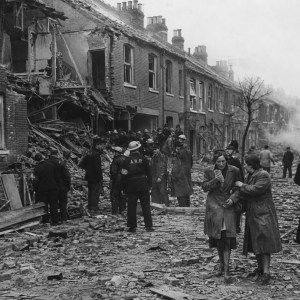
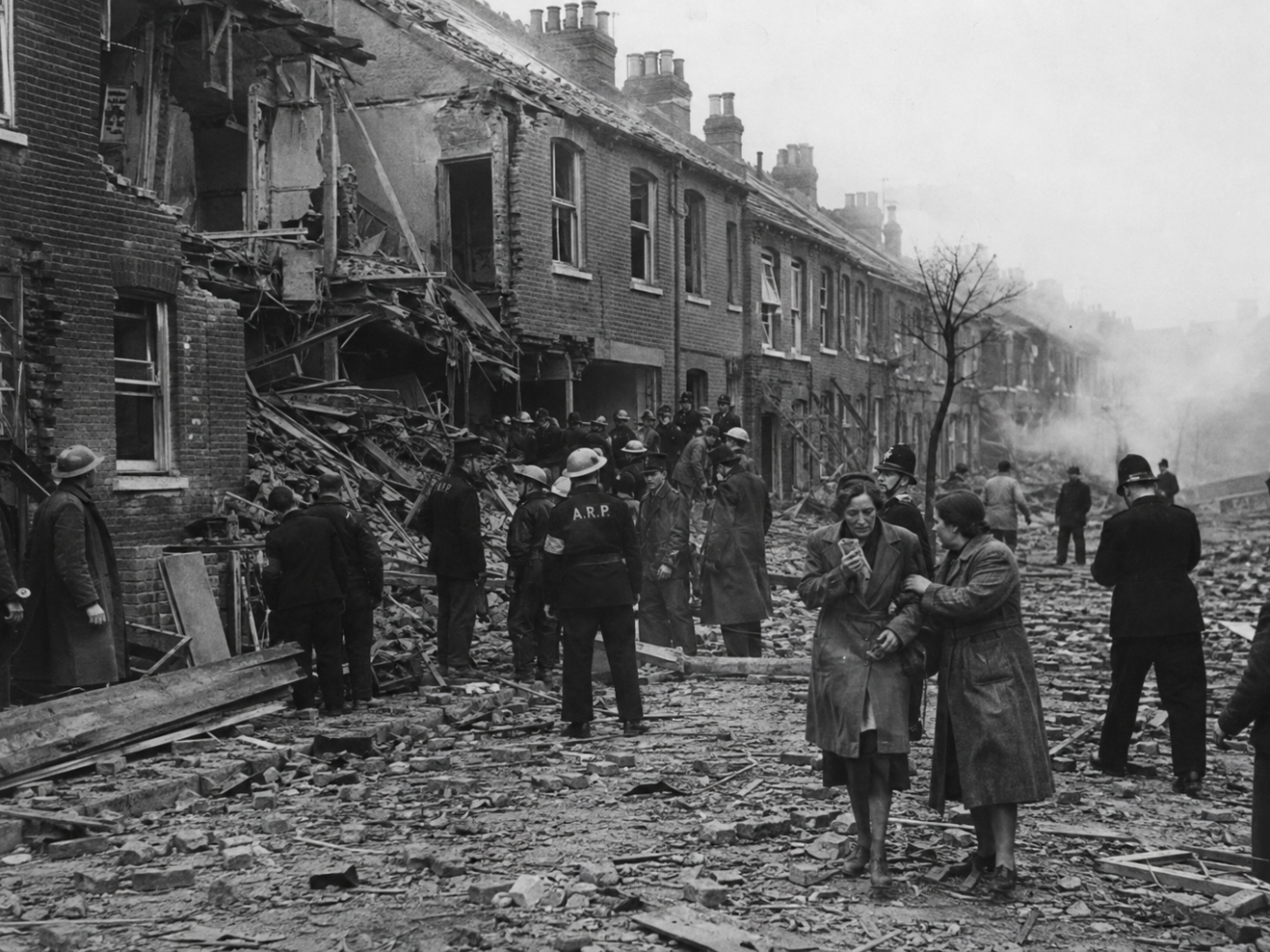
The rocket struck Staveley Road close to its junction with Burlington Lane at approximately 6.44 pm. The explosion blasted a huge crater into the road, destroyed houses and hurled masonry, roof tiles, timber and glass across the surrounding neighbourhood. Contemporary local records state that three people were killed and 22 injured. Eleven houses were so badly damaged that they later had to be demolished, while more than 550 properties suffered some degree of damage.
For Londoners who had already endured almost five years of war, the explosion was initially a mystery. The Blitz had brought German bombers over the capital night after night, while more recently the V-1 flying bomb had become a familiar and feared sight over southern England. The V-2 was completely different. There was no opportunity to hear it approaching and virtually no possibility of taking shelter once it had begun its final descent. Travelling at several times the speed of sound, the missile reached its target before the noise of its arrival.
The weapon responsible was officially known to the Germans as the Aggregat 4, or A4, but Nazi propaganda renamed it the Vergeltungswaffe 2 — “Vengeance Weapon 2”. Standing roughly the height of a four-storey building, the V-2 was the world's first operational long-range ballistic missile. Its liquid-fuelled rocket engine propelled it high above the atmosphere before gravity brought it back towards the Earth at tremendous speed. The technology behind it was extraordinarily advanced for the period and would later influence both Cold War ballistic missile development and the space programmes of the United States and Soviet Union.
Its development had taken place principally at the German rocket research centre at Peenemünde on the Baltic coast under a team that included Wernher von Braun. British intelligence had gradually become aware that Germany was developing a large rocket weapon, and the RAF launched Operation Hydra against Peenemünde during the night of 17–18 August 1943 in an attempt to disrupt the programme. The bombing caused considerable destruction and delayed aspects of development, but it could not eliminate the threat.
As Allied armies advanced across France and Belgium during the summer of 1944, Germany lost many of the fixed sites originally intended for launching its new weapons. The V-2, however, did not require elaborate permanent launch installations. Mobile units could transport the rocket, erect it, fuel it, prepare its guidance system and launch it from relatively simple sites before moving away. This mobility made the weapon extremely difficult for Allied air forces to locate and destroy.
By early September 1944, German mobile rocket units operating in the Netherlands were finally ready to begin attacks against Britain. London remained the primary symbolic target. It had survived the Blitz and the V-1 campaign, but Hitler and the Nazi leadership hoped that a new weapon arriving without warning might once again terrorise the British population.
Earlier on 8 September, the first operational V-2 attack of the war had been directed against Paris. Later that day rockets were launched towards London from the Netherlands. One descended on Staveley Road in Chiswick, while another fell near Epping in Essex shortly afterwards. The attack demonstrated that even though Allied armies were rapidly advancing towards Germany, London remained within reach of German weapons.
The scene in Chiswick was devastating. Residents described an enormous explosion followed by debris falling through clouds of dust and smoke. One eyewitness later recalled seeing a towering column of black smoke rising above the neighbourhood before bricks and tiles began raining down. The crater cut across the road and surrounding pavements, while the fronts of nearby houses were ripped apart.
Yet almost immediately the British authorities attempted to conceal what had happened. The official explanation circulated locally was that a gas main had exploded. The government was reluctant to confirm that Germany possessed a new rocket capable of striking Britain without warning, partly because giving detailed information about the impacts could assist German intelligence in assessing the accuracy of the weapon. For weeks the true cause of the mysterious explosions was officially suppressed.
The secrecy inevitably produced rumours. Londoners quickly realised that unusual explosions were occurring without aircraft being present. Reports circulated of unexplained blasts followed by a distinctive double sound, as the explosion was sometimes heard before the sonic noise produced by the incoming rocket. Foreign newspapers also began reporting that Germany was using a new weapon against Britain.
The British government finally publicly acknowledged the rocket attacks in November 1944. By then it was impossible to disguise what was happening. V-2s were falling increasingly frequently on London and other targets, causing sudden and often catastrophic destruction.
Unlike the V-1, against which Britain had developed effective countermeasures using fighter aircraft, anti-aircraft guns and barrage balloons, there was essentially no direct defence against the V-2. Once launched, it travelled too fast and too high to intercept with the technology available in 1944. The only realistic methods of combating the threat were to destroy manufacturing facilities, attack transport networks and storage areas, bomb suspected launch zones and capture the territory from which the rockets were being fired.
The psychological effect was considerable. With the V-1 there was at least some warning. Londoners could hear the distinctive pulse-jet engine approaching, and when its engine stopped they knew the bomb was about to fall. The V-2 offered nothing. The first indication of an attack might simply be a building disappearing in an enormous explosion.
The rockets were also highly inaccurate. Although technically remarkable, they could not reliably strike individual military installations. Cities therefore became their principal targets. London, Antwerp and other heavily populated areas were attacked in an attempt to cause disruption, casualties and fear rather than to destroy precise military objectives.
There was another, darker aspect to the V-2 programme. Although the rocket represented an extraordinary technological achievement, its manufacture depended heavily upon forced labour under horrific conditions. After Allied bombing threatened Peenemünde, much of the production was moved underground to the Mittelwerk complex near Nordhausen. Thousands of prisoners from the nearby Mittelbau-Dora concentration camp were forced to manufacture rockets while suffering starvation, disease, beatings, executions and appalling working conditions. The human cost of producing the V-2 was therefore immense even before the weapons were launched.
The attacks continued throughout the winter of 1944–45. Hundreds of rockets struck the London area, killing more than 2,000 civilians there alone. One of the most devastating incidents occurred at Woolworths in New Cross on 25 November 1944, where a V-2 explosion killed 168 people and injured many more. Antwerp also suffered heavily because its enormous port had become essential to supplying Allied armies advancing towards Germany.
The campaign could only truly be stopped by the Allied advance. As British, American and Canadian forces pushed deeper into the Netherlands and Germany, German rocket units were gradually forced out of positions capable of striking Britain. The final V-2 to cause fatalities in Britain fell on 27 March 1945, only weeks before the collapse of Nazi Germany.
The explosion in Staveley Road on 8 September 1944 therefore represented far more than another bombing incident. For the first time in history, civilians in a major city had been attacked by a long-range ballistic missile descending from the edge of space at supersonic speed. There was no pilot, no bomber aircraft and effectively no warning.
A memorial now stands near the site in Chiswick where the first V-2 struck London, recording the date and remembering the three people killed. The houses were eventually rebuilt and ordinary life returned to Staveley Road, but the event remains an important milestone in military history.
The technology that terrified London in September 1944 did not disappear with the end of the Second World War. German rocket engineers, research and captured V-2 equipment were taken by both the Western Allies and the Soviet Union. Within little more than a decade, increasingly powerful ballistic missiles capable of carrying nuclear warheads had become central to the Cold War. At the same time, the engineering principles pioneered by the V-2 helped provide the foundations for rockets that would eventually launch satellites and human beings into space.
For the residents of Chiswick on that September evening, however, none of that future significance mattered. At approximately 6.44 pm there had simply been a sudden, violent explosion in an ordinary London street. Three people were dead, homes were destroyed and Britain had discovered that Nazi Germany possessed a weapon unlike anything civilians had faced before.
The age of the ballistic missile had begun.