On this day in military history…
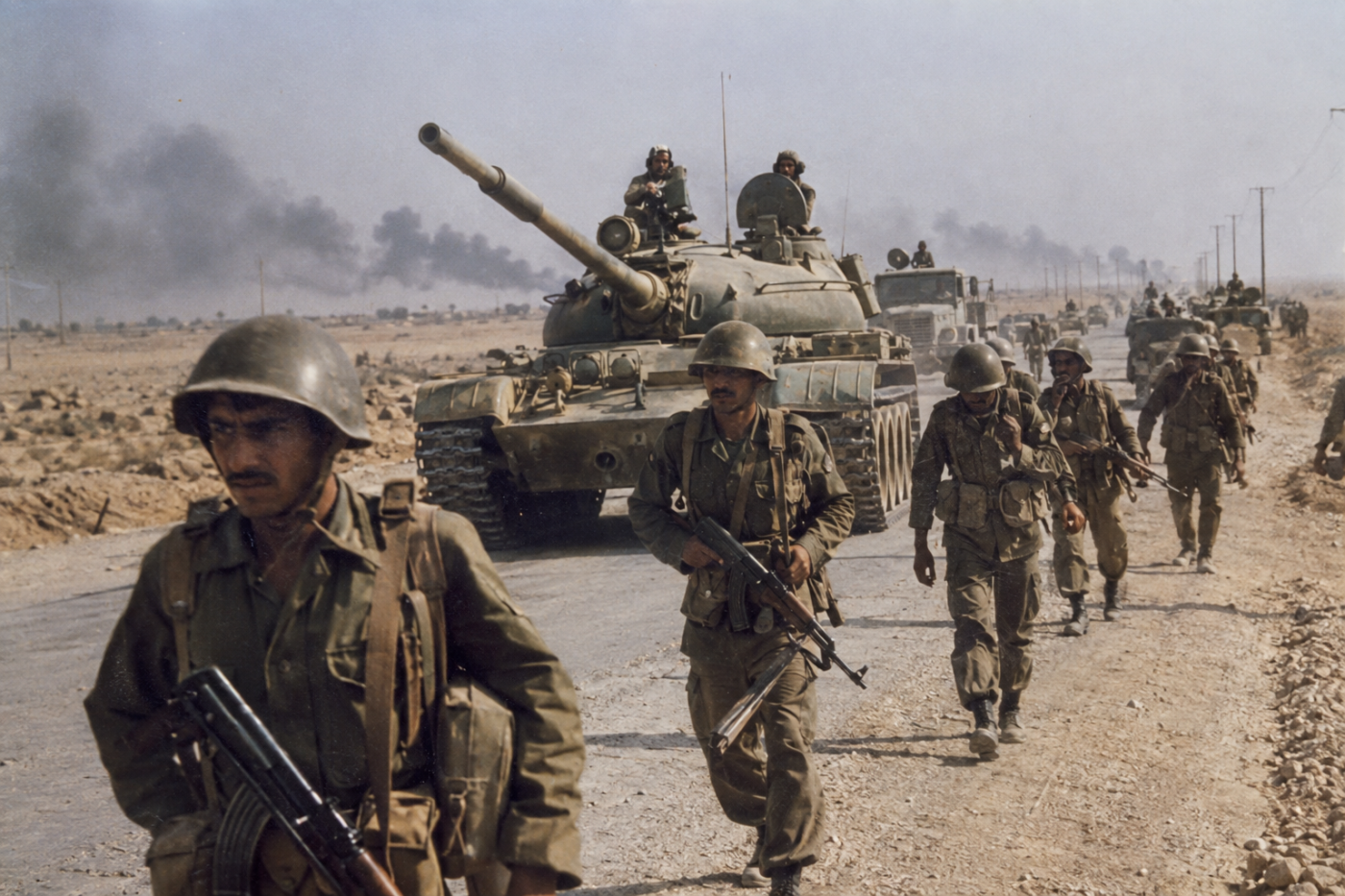
On 22 September 1980, Iraqi aircraft swept across the border to attack Iranian airfields, beginning a war that would last for almost eight years and become one of the bloodiest conflicts of the late twentieth century. Within hours, Saddam Hussein’s army launched a major ground invasion along a broad front, sending armoured columns into western Iran and towards the oil-rich province of Khuzestan. Iraqi leaders expected a short and decisive campaign, but instead began a brutal struggle that would claim hundreds of thousands of lives and leave both countries devastated.
Relations between Iran and Iraq had long been troubled by territorial, political and religious divisions. One of the main disputes concerned control of the Shatt al-Arab waterway, the strategically important channel formed by the Tigris and Euphrates rivers as they flow towards the Persian Gulf. The border had been revised under the 1975 Algiers Agreement, but Saddam Hussein later argued that Iraq had been forced into accepting unfavourable terms. On 17 September 1980, he publicly cancelled the agreement and declared Iraqi sovereignty over the entire waterway.
The Iranian Revolution of 1979 had overthrown Shah Mohammad Reza Pahlavi and brought Ayatollah Ruhollah Khomeini to power. Iran’s armed forces had been weakened by purges, desertions and the imprisonment or execution of many experienced officers. Supplies of spare parts for its largely American and British-built equipment had also been disrupted. Saddam believed Iran was divided, vulnerable and incapable of mounting an effective defence. He also feared that Iran’s new Islamic revolutionary government would encourage Iraq’s Shia majority to rise against his Sunni-dominated Ba’athist regime.
Iraq hoped to secure the Shatt al-Arab, occupy parts of Khuzestan and establish itself as the leading military power in the Persian Gulf. The opening Iraqi air attacks were intended to destroy the Iranian Air Force on the ground in a similar manner to Israel’s devastating strikes at the beginning of the Six-Day War in 1967. The operation failed, however, because many Iranian aircraft were protected inside hardened shelters. Iran responded the following day with large-scale air raids against Iraqi bases, refineries and military installations.
Iraqi ground forces initially advanced into Iranian territory, capturing several border positions and surrounding the important port of Khorramshahr. Its defenders, including regular soldiers, Revolutionary Guards, police officers and armed civilians, resisted for more than a month in savage street fighting. The city eventually fell on 24 October, but the unexpectedly determined defence delayed the Iraqi advance and cost both sides heavily. Iraqi forces also attempted to capture Abadan and its enormous oil refinery, but Iran continued to hold part of the city and prevented Iraq from securing a complete victory.
Saddam had expected Iran’s government to collapse or quickly accept peace, yet the invasion instead united much of the Iranian population behind the defence of the country. The Iraqi offensive gradually lost momentum as its forces outran their supplies and encountered increasingly organised resistance. Iran mobilised the regular army alongside the Islamic Revolutionary Guard Corps and large numbers of Basij volunteers. By 1981, Iranian forces were beginning to counterattack, and in May 1982 they recaptured Khorramshahr. Most Iraqi troops were driven back across the border, but Ayatollah Khomeini rejected offers to end the fighting and ordered the war to continue inside Iraq.
What had begun as an Iraqi invasion became a prolonged war of trenches, artillery bombardments, minefields and repeated infantry assaults. Some sections of the front resembled the battlefields of the First World War. Both countries attacked towns and cities with aircraft and ballistic missiles, while oil tankers and commercial shipping in the Persian Gulf became targets. Iraq made extensive use of chemical weapons, including mustard gas and nerve agents, against Iranian troops and later against Kurdish civilians. Despite growing evidence of these attacks, the international response remained limited.
The conflict drew in the interests of many foreign powers. Iraq received financial and military assistance from several Arab states and obtained weapons or technology from the Soviet Union, France and other countries. Iran also acquired arms through a variety of sources despite international restrictions. The United States eventually increased its naval presence in the Persian Gulf to protect shipping, bringing American forces into direct confrontation with Iran during the final stages of the war.
Neither side achieved the decisive victory it sought. Iran failed to overthrow Saddam Hussein, while Iraq failed to seize lasting control of Iranian territory or destroy the revolutionary government. Exhausted and facing renewed Iraqi offensives, Iran finally accepted a United Nations-sponsored ceasefire. The fighting officially ended on 20 August 1988, leaving the border largely where it had been before the invasion.
The exact human cost remains disputed, but hundreds of thousands of soldiers and civilians were killed, with many more wounded, displaced or permanently affected by chemical weapons. Cities, oil facilities and entire communities had been shattered, while both countries were left burdened by enormous debts and ruined economies. The war that Saddam Hussein had expected to win within weeks instead continued for nearly eight years and ended without a clear victor. Its consequences destabilised the region for decades and helped create the conditions that would lead Iraq into another disastrous conflict following its invasion of Kuwait in 1990.