On this day in military history…
By Sunday 24 September 1944, the Battle of Arnhem had entered its eighth day. The survivors of the British 1st Airborne Division were trapped inside a shrinking defensive perimeter around Oosterbeek, where exhausted paratroopers, glider troops, engineers and Polish reinforcements were fighting almost continuously against increasingly powerful German forces. Ammunition, food, water and medical supplies were running dangerously low, while hundreds of wounded men lay crowded into houses, cellars, hotels and makeshift dressing stations. Operation Market Garden had expected the airborne troops to hold the Arnhem road bridge for only two or three days before being relieved by XXX Corps. Instead, Lieutenant-Colonel John Frost’s force at the bridge had been overwhelmed, while the remainder of the division became encircled several miles to the west. German tanks, self-propelled guns, mortars and infantry steadily compressed the Oosterbeek perimeter, which the Germans grimly named the “Hexenkessel” — the Witches’ Cauldron.
The division’s medical services were overwhelmed. The Schoonoord Hotel, Tafelberg Hotel and nearby houses had been converted into dressing stations, but many stood dangerously close to the front line. Shells and mortar bombs continued to fall around buildings clearly marked with Red Cross flags, while some aid stations changed hands several times, leaving British, German and Dutch medical personnel caring for casualties from both sides. Short local ceasefires had already taken place during the battle, with stretcher-bearers occasionally emerging under improvised white flags to collect wounded men lying between the opposing positions. These brief acts of humanity provided only temporary relief, however, and by 24 September the number of seriously injured soldiers inside the perimeter had become impossible to manage.
Colonel Graeme Warrack, the senior medical officer of the 1st Airborne Division, believed that hundreds would die unless they could be moved to proper hospitals. He approached Major-General Roy Urquhart and asked for permission to negotiate with the Germans. Urquhart agreed but made it clear that Warrack was to speak solely as a medical officer, with no authority to discuss the division’s surrender or any wider military agreement. Carrying a white flag, Warrack crossed the German lines and was taken to meet senior officers, including SS-Obergruppenführer Wilhelm Bittrich, commander of II SS Panzer Corps. Bittrich understood the desperate medical situation and agreed to a temporary truce, with the Germans also offering medical supplies and assistance in removing casualties from the battlefield.
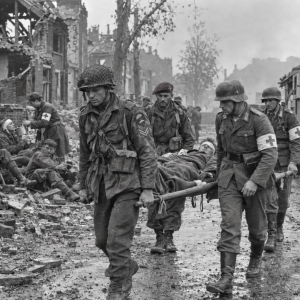
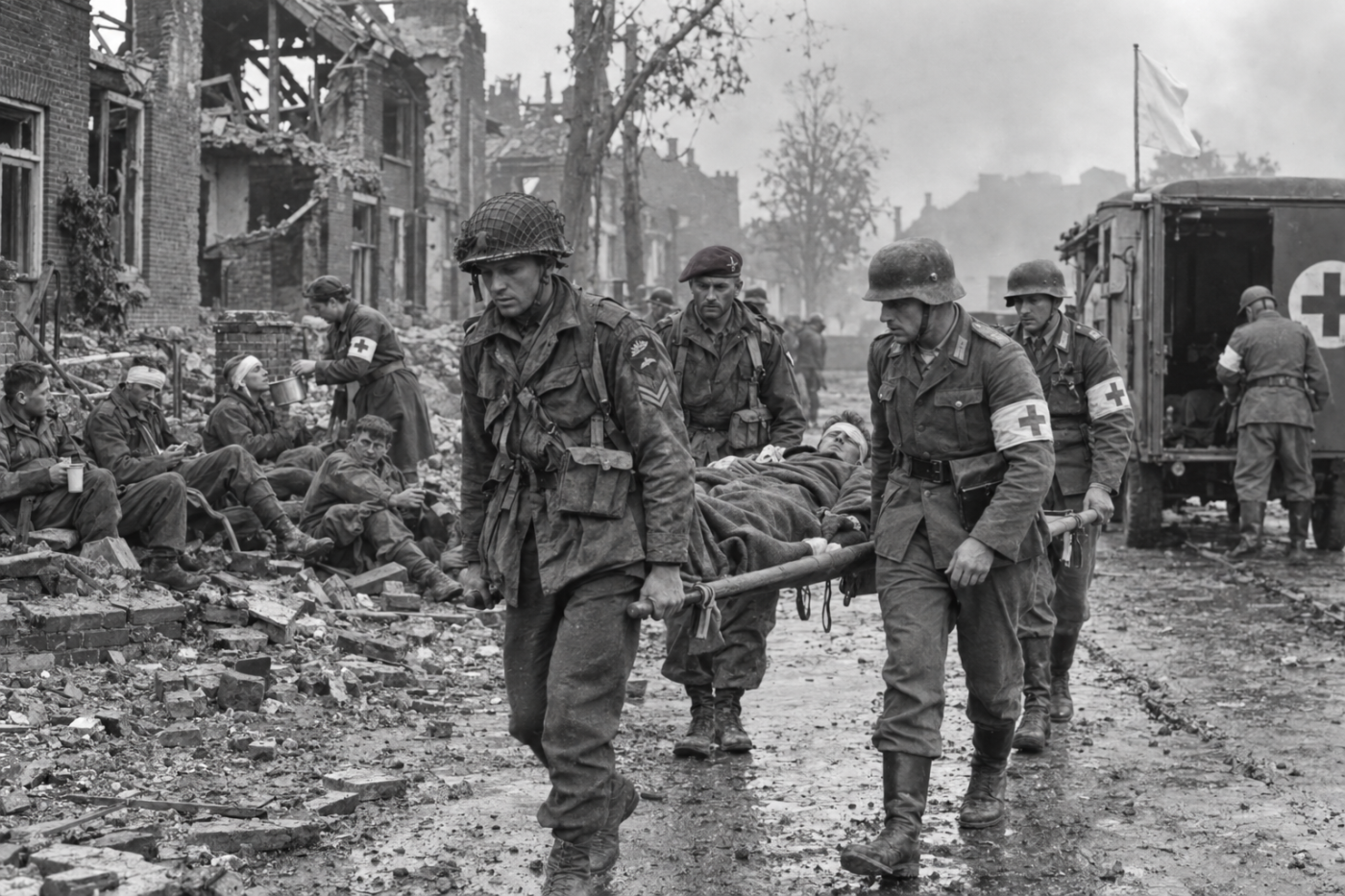
A ceasefire was arranged from approximately 3 p.m. until 5 p.m. on 24 September. As the firing fell silent, British and German medical personnel, stretcher-bearers and vehicles moved through the shattered streets and gardens of Oosterbeek. Wounded soldiers
were carried from overcrowded dressing stations and positions that had endured almost constant shellfire. For two extraordinary hours, men who had been trying to kill one another worked side by side to save lives. Approximately 450 British wounded were evacuated during the truce, although accounts generally place the number between 400 and 450. The most seriously injured were taken to St Elisabeth Hospital in Arnhem, while others were transported to German medical centres and prisoner-of-war facilities farther east.
Once they passed into German hands, the wounded became prisoners of war, but this was a medical evacuation rather than a formal prisoner exchange. The British did not receive German prisoners in return, and the agreement did not amount to the surrender of the Oosterbeek garrison. Among those evacuated was Brigadier John “Shan” Hackett, commander of the 4th Parachute Brigade, who had suffered severe abdominal wounds. A German doctor operated on him at St Elisabeth Hospital and saved his life. Hackett was later hidden by members of the Dutch Resistance and eventually escaped across the Rhine to Allied territory.
At approximately 5 p.m. the truce ended and the fighting resumed. The evacuation had provided only temporary relief, and the remaining airborne troops continued holding their positions through another night of artillery fire and German attacks. Their situation was now hopeless, and on the following night the survivors began withdrawing across the Lower Rhine during Operation Berlin. Around 2,400 British and Polish troops escaped across the river, but thousands more were dead, wounded or captured. Twenty-five British doctors and approximately 400 members of the Royal Army Medical Corps remained behind voluntarily to care for wounded men who could not be moved.
The truce of 24 September was one of the most remarkable moments of the Battle of Arnhem. Amid the destruction, bitterness and desperate close-quarter fighting, both sides briefly recognised a duty greater than the battle itself. For approximately 450 casualties, those brief hours of humanity offered their only chance of survival.