Devon & Dorsets Regiments
The Devonshire and Dorset Regiment was one of the British Army’s proud West Country infantry regiments, carrying traditions and battle honours stretching back more than 270 years. Known affectionately as the “Devon and Dorsets,” it was officially formed on 17 May 1958 through the amalgamation of the Devonshire Regiment and the Dorset Regiment. Both battalions were serving at Minden in West Germany when they came together, creating a new regiment whose traditional recruiting area covered Devon and Dorset.
Although the combined regiment dated from 1958, its ancestry reached back to the seventeenth century. The Devonshire Regiment descended from a unit raised by Henry Somerset, Duke of Beaufort, in 1685 during the rebellion of the Duke of Monmouth. It later became the 11th Regiment of Foot and was associated with North Devon from 1782 before receiving the title Devonshire Regiment in 1881. Its soldiers became known as the “Bloody Eleventh,” a nickname traditionally associated with their stubborn fighting qualities and the heavy casualties suffered during earlier battles.
The Dorset side descended principally from the 39th Regiment of Foot, raised in 1702, and the 54th Regiment of Foot, raised in 1755. These became the 1st and 2nd Battalions of the Dorsetshire Regiment during the Army reforms of 1881. The title was shortened to the Dorset Regiment in 1951. The old 39th Foot was the first regular regiment of the Crown to serve in India, arriving there in 1754, and this distinction produced the famous motto Primus in Indis, meaning “First in India.”
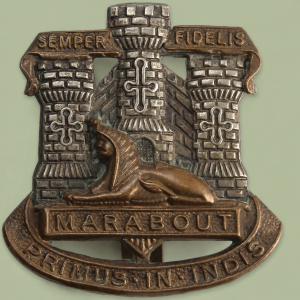
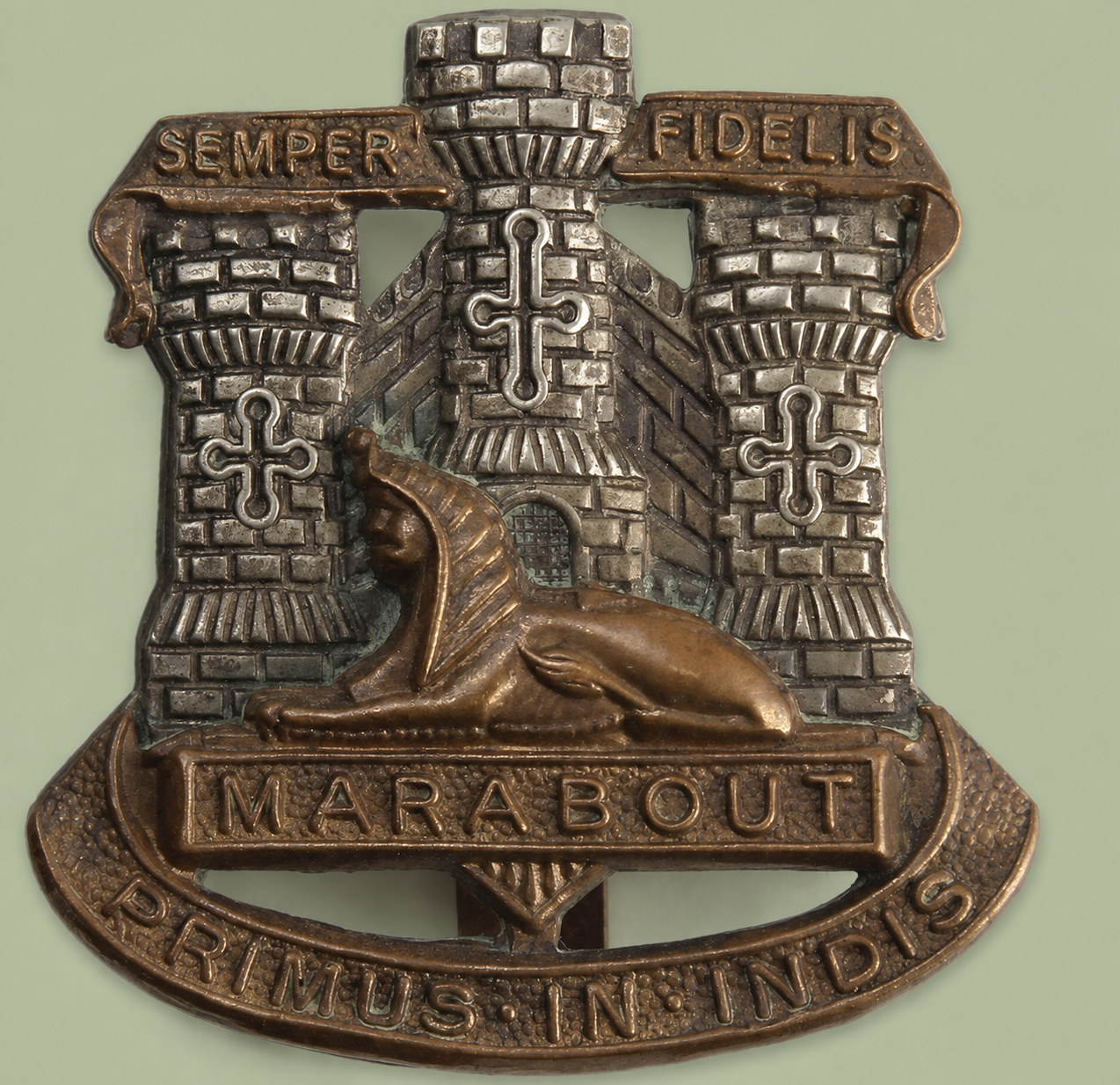
The cap badge of the Devon and Dorsets brought together the histories of both county regiments. It displayed a Sphinx and the battle honour Marabout above Exeter Castle, together with the motto Semper Fidelis, meaning “Always Faithful,” inherited from the Devons, and Primus in Indis from the Dorsets. The Sphinx and Marabout commemorated the 54th Foot’s service in Egypt in 1801, while the castle represented Exeter and the regiment’s connection with the defence of Gibraltar. The badge was effectively a miniature history of the regiment, displaying distinctions earned across several continents and more than two centuries of campaigning.
The regiment inherited an exceptional collection of battle honours from its predecessors. Those earned before the First World War included Dettingen, Plassey, Gibraltar 1779–83, Marabout, Egypt, Salamanca, Albuhera, Vittoria, Pyrenees, Nivelle, Nive, Orthes, Toulouse, Peninsula, Maharajpore, Sevastopol, Afghanistan 1879–80, Tirah, Defence of Ladysmith, Relief of Ladysmith and South Africa 1899–1902. These names recalled service during the War of the Austrian Succession, the Seven Years’ War, the Great Siege of Gibraltar, the Napoleonic Wars, campaigns in India and Afghanistan, the Crimean War and the Boer War.
Plassey was especially important to the Dorset tradition. On 23 June 1757 the 39th Foot fought with Robert Clive’s army at the Battle of Plassey, a victory which helped establish British power in Bengal. The anniversary was remembered as Plassey Day, while Primus in Indis remained one of the most distinctive mottos in the British Army.
During the First World War the Devonshire and Dorset Regiments raised dozens of battalions and fought on the Western Front, at Gallipoli, in Macedonia, Italy, Palestine and Mesopotamia. Their combined honours included Mons, Le Cateau, Retreat from Mons, Marne 1914, Aisne, La Bassée, Armentières, Neuve Chapelle, Hill 60, Ypres, Loos, the Somme, Albert, Delville Wood, Thiepval, Arras, Vimy, Messines, Passchendaele, Amiens, the Hindenburg Line, Cambrai, Vittorio Veneto, Doiran, Gaza, Jerusalem, Megiddo, Suvla, Kut al Amara, Baghdad and Mesopotamia.
One of the most moving episodes in Devonshire history occurred on 1 July 1916, the first day of the Battle of the Somme. Men of the 8th and 9th Battalions attacked near Mametz and suffered terrible losses. Many of their dead were afterwards buried in the trench from which they had begun their advance. The entrance to the Devonshire Cemetery still bears the unforgettable inscription: “The Devonshires held this trench. The Devonshires hold it still.”
Another remarkable stand took place at Bois des Buttes on 27 May 1918. The 2nd Battalion, Devonshire Regiment, was overwhelmed while attempting to delay a major German offensive. The battalion suffered devastating casualties but bought valuable time for other Allied formations to reorganise. Its courage was recognised by the award of the French Croix de Guerre with palm, and Bois des Buttes became one of the regiment’s most sacred anniversaries.
The Second World War added another distinguished series of honours, including St Omer–La Bassée, Malta 1940–42, the Normandy Landing, Port-en-Bessin, Villers-Bocage, Tilly-sur-Seulles, Caen, Mont Pinçon, Arnhem, Nederrijn, the Rhine and North-West Europe 1940 and 1944–45. In the Mediterranean and Far East the regiments earned honours for the landings in Sicily and Italy, together with Imphal, Kohima, Mandalay, Mount Popa and Burma.
Men of the Devonshire Regiment landed in Normandy on D-Day and fought around Port-en-Bessin, Caen and through North-West Europe. Battalions of the Dorsets also landed in Normandy and later fought during Operation Market Garden and the crossing of the Rhine. In Burma, men of both regiments endured some of the hardest jungle fighting experienced by the British Army. The Dorset honour Kohima commemorated one of the decisive battles against the Japanese advance into India, while the Devon honours Imphal and Shenam Pass recalled equally determined fighting in the same campaign.
Following the amalgamation in 1958, the new regiment quickly entered active service. Only six months after its formation, the battalion was sent to Cyprus during the campaign against the EOKA organisation and remained on the island for almost four years. It later served in Plymouth, Northern Ireland and British Guiana, now Guyana, where troops helped restore order during serious civil unrest in 1964.
In 1966 the regiment joined the British Army of the Rhine in West Germany. A year later it deployed to Libya during unrest associated with the Arab-Israeli War. After service in Malta, the regiment began a long series of operational tours in Northern Ireland, completing numerous deployments during the Troubles. These tours placed its soldiers in an extremely difficult environment where restraint, professionalism and constant vigilance were essential. The regiment also served in Belize, Cyprus, the Falkland Islands and West Berlin, where it formed part of the Allied garrison during the Cold War.
In 1987 the regiment raised its own Territorial Army formation, the 4th Battalion, with companies located across Devon and Dorset. This strengthened its connection with the counties and allowed reservists to serve alongside the regular battalion. The regiment was also granted the freedom of several West Country towns and cities, reflecting the close relationship between its soldiers and the communities from which they came.
In 1995 the Devon and Dorsets deployed to Bosnia as part of the United Nations peacekeeping force, operating amid the aftermath of a brutal civil war. Its final posting in Germany ended in 1998, and in 2004 it completed its last operational tour of Northern Ireland.
In 2005 the regiment transferred to the Light Division, was equipped and trained for the light-infantry role and received the new title Devonshire and Dorset Light Infantry. Its last independent operational deployment came in 2006 when the battalion served for eight months in Iraq during Operation Telic. Its soldiers carried out security patrols, vehicle checkpoints and other demanding duties around Umm Qasr and southern Iraq.
On 1 February 2007 the regiment’s separate existence came to an end during another major reorganisation of the British infantry. The Devonshire and Dorset Light Infantry joined with the Royal Gloucestershire, Berkshire and Wiltshire Regiment, the Light Infantry and the Royal Green Jackets to form The Rifles. The Devon and Dorsets became part of 1st Battalion, The Rifles, ensuring that their traditions, battle honours and West Country connections continued within the new regiment.
The Devonshire and Dorset Regiment has therefore not disappeared. Its lineage survives in The Rifles, while the Regimental Association continues to maintain comradeship between former members and preserve the memory of those who served. Its colours, memorials, uniforms, medals and archives are cared for at the Keep Military Museum in Dorchester, while important Devonshire memorials and old colours can also be found in Exeter Cathedral.
From Plassey, Gibraltar and Salamanca to the Somme, Normandy, Kohima, Northern Ireland, Bosnia and Iraq, the story of the Devonshire and Dorset Regiment covers almost the entire span of Britain’s modern military history. Its combined name existed for less than fifty years, but the traditions placed in its care had been earned over centuries. Those traditions continue through The Rifles and through generations of former soldiers who remain proud to have served beneath the Sphinx and Exeter Castle and under the enduring motto Semper Fidelis – Always Faithful.