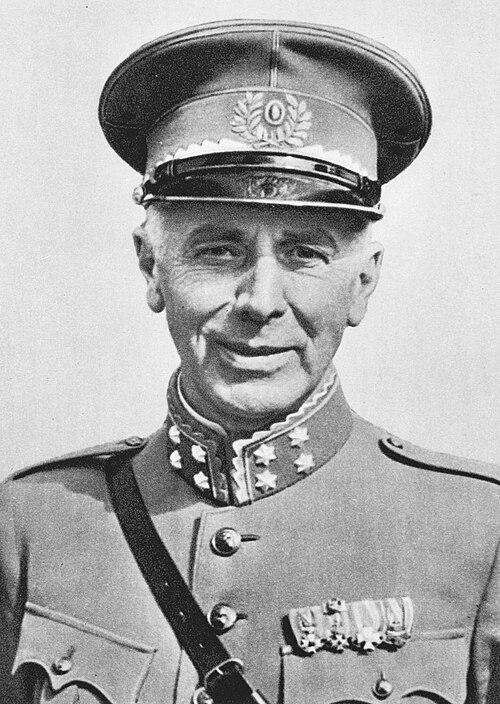
General Hendrik Alexander Seyffardt
Hendrik Alexander Seyffardt was born in Breda on 1 November 1872 into a family with strong ties to the Dutch military and political establishment. His father, August Lodewijk Willem Seyffardt, was an army officer who later entered parliament as a Liberal and served as Minister of War from 1891 to 1894. He entered the Royal Military Academy in Breda, chose the fortress artillery and returned to the academy as an instructor in 1900. After completing the higher staff course, he moved into General Staff work. In 1928 he took command of the 1st Division, a year later became Chief of the General Staff, and in 1930 was promoted to lieutenant-general.
His political views gradually moved towards the authoritarian right. By 1933 Seyffardt supported the Verbond voor Nationaal Herstel, which called for stronger government and stronger armed forces. Retirement in May 1934 gave him more time for politics. He was hostile to pacifism, increasingly critical of parliamentary democracy and deeply anti-communist. His opposition to sanctions against Fascist Italy after Mussolini’s invasion of Ethiopia showed how far his sympathies had moved towards authoritarian politics. In the spring of 1937 Seyffardt joined Anton Mussert’s Nationaal-Socialistische Beweging, the NSB, and contributed to Volk en Vaderland. His first period inside the movement was brief. By the autumn he had left again, frustrated by factional struggles. Mussert wanted a distinctly Dutch movement under his own leadership, while Meinoud Rost van Tonningen represented a more radical, German-oriented current. Seyffardt’s authoritarian ideas, however, had grown out of the older world of the Dutch officer corps rather than the revolutionary politics of younger SS activists.
The German invasion of May 1940 changed the situation completely. After the defeat and occupation of the Netherlands, Seyffardt moved openly into pro-German circles associated with De Waag. His admiration for military order, hostility towards parliamentary politics and intense anti-communism now pointed in the same direction. Germany’s early victories also seemed to make a German-dominated Europe a realistic prospect.
On 22 June 1941 Hitler launched Operation Barbarossa, the invasion of the Soviet Union. For men such as Seyffardt, the campaign offered a military cause that matched their political convictions. German propaganda portrayed the war in the East as a European crusade against Bolshevism. In the Netherlands, Reich Commissioner Arthur Seyss-Inquart encouraged the creation of a Dutch volunteer formation for the Eastern Front.Seyffardt was approached in early July 1941 and asked to lead what became known as the Nederlandsch Vrijwilligerslegioen, or Dutch Volunteer Legion. Seyss-Inquart received him on 8 July, and the formation was publicly announced two days later. Seyffardt was useful to the occupation authorities. He was sixty-eight, a retired lieutenant-general and a former Chief of the General Staff. His name carried military prestige well beyond the NSB. A familiar Dutch general in uniform could make the Legion appear to be a national military undertaking rather than simply another arm of German SS recruitment.
Seyffardt believed that Dutch participation in the war against the Soviet Union served both Dutch and wider European interests, but he also expected the Legion to retain a clearly Dutch character. He wanted Dutch officers, national colours and Dutch distinctions, even if the men trained under German supervision and wore German uniforms. When German officials removed references to Dutch colours and officers from one of his recruitment appeals, he insisted that they be restored. It was an early sign that his idea of the Legion differed from that of the Germans.
Berlin had already decided where the real authority would lie. The Legion would serve within the Waffen-SS, while German authorities controlled its training, command and deployment. Recruitment and selection passed through the SS system, leaving Seyffardt’s headquarters largely responsible for publicity and welfare work. The general whose name stood at the head of the organisation therefore had little authority over the soldiers recruited in his name.
Recruitment initially produced impressive figures. By the end of September 1941 around 3,000 men had applied. Some were committed National Socialists or anti-communists, while others were attracted by military adventure. For many, the reality became clear only at the training camp at Arys in East Prussia. The Dutch character promised during recruitment proved much weaker than expected, and the men found themselves being absorbed into the Waffen-SS. Of roughly 1,200 Legionaries at Arys, around half initially wanted to return home. More than 250 were eventually allowed to leave, while some later refused to swear the required oath to Adolf Hitler.
Those who remained were sent east. In early 1942 the Legion fought near Leningrad and the Volkhov. Whatever language had been used to attract volunteers, they were now serving in Germany’s war in the Soviet Union, a war of conquest accompanied by racial domination, exploitation and mass murder. Seyffardt remained in the Netherlands, but his role in recruiting and promoting the Legion tied his military reputation directly to that war.
His relationship with the German authorities became increasingly strained. Seyffardt protested against German interference in recruitment and the loss of welfare responsibilities. In March 1942, after his position had been reduced from commander to head of the Sonderstab Werbung und Fürsorge and his decisions were made subject to Rauter’s approval, Seyffardt asked to be released from his position. His request was refused, and he remained in place. He continued to serve German recruitment.
By early 1943, that association brought him into the sights of the Dutch resistance. After Hitler recognised Mussert as ‘Leader of the Dutch People’ in December 1942, the occupation authorities allowed him to establish a State Secretariat. On 4 February 1943 Seyffardt was appointed Mussert’s representative for the Dutch Legion. The office carried little real governing power, but some resistance members feared these appointments might be the first step towards a Dutch collaborationist government. There was also concern that Seyffardt might eventually help impose compulsory military service for Germany.
The Amsterdam resistance group CS-6 had meanwhile moved from sabotage and intelligence work towards the assassination of prominent collaborators. Seyffardt became one of its targets. Gerrit Kastein organised the attack, and the strongest evidence identifies Jan Verleun as the gunman. On the evening of 5 February 1943, two men arrived at Seyffardt’s home in The Hague. After confirming his identity, Verleun shot the seventy-year-old general twice in the abdomen. Seyffardt survived the initial attack but died the following day. Before his death, he reportedly described the attackers as students and asked that no hostages should be shot in retaliation.
The German response came quickly. On 6 February police arrested around 600 male students in Amsterdam, Delft, Utrecht and Wageningen and sent them to Vught concentration camp. Further raids on 9 and 10 February seized around 1,200 young men aged eighteen to twenty-five as part of a broader plan to arrest thousands for forced labour.
The assassination also exposed deep disagreements within the resistance. Was killing a collaborator a legitimate act of war, or did such attacks invite reprisals against innocent civilians? The Dutch government in London warned against individuals taking justice into their own hands, while Trouw rejected the assassination as an unlawful act of punishment. Other resistance newspapers defended it as legitimate under occupation. During 1943, resistance and repression both intensified, and the later Aktion Silbertanne killings developed within this broader cycle of violence and retaliation.
Seyffardt’s importance to the Germans rested less on the power he possessed than on the reputation he had built during decades of service to the Dutch state. He had once stood at the top of the Royal Netherlands Army, and that made his support for the Dutch Legion valuable propaganda. His authoritarian politics and fierce anti-communism had carried him from the pre-war military establishment towards collaboration with Nazi Germany. He discovered that the supposedly Dutch force he represented was firmly controlled by the Waffen-SS and clashed with the Germans over that loss of independence. Yet when his attempt to leave was refused, he remained in place. By staying publicly associated with the Legion, Seyffardt continued to lend the prestige of a former Chief of the General Staff to Dutch recruitment for Hitler’s war in the East.
Author Credit: Tom Dankers, Historian - Arnhem Oorlogsmuseum
Photo Attribution: Public domain, via Wikipedia Commons