Italian Paratroopers
During the Second World War, Italy created an airborne force that was comparatively small beside the German Fallschirmjäger or the airborne armies eventually fielded by Britain and the United States, yet its paratroopers developed a formidable reputation. The best known were the men of the 185th Parachute Division “Folgore”, whose defence of the southern end of the Axis line at El Alamein in 1942 became one of the most celebrated episodes in the history of the Italian Army. Alongside Folgore came the 184th Parachute Division “Nembo”, while a third division, “Ciclone”, was still being formed when Italy’s armistice in September 1943 brought its development to an abrupt end.
Italy's experiments with military parachuting actually began before the war. On 20 March 1938 a parachute school was established at Castel Benito airfield near Tripoli in Italian Libya. Two Libyan paratrooper battalions and a battalion of Italian personnel were subsequently organised there. The centre was later transferred to Barce in Cyrenaica before wartime events brought its activities to an end. More important for the future Italian airborne force was the establishment on 15 October 1939 of the Royal Italian Air Force Parachute School at Tarquinia, north-west of Rome. Tarquinia became the spiritual home of Italian military parachuting and provided the trained manpower around which the wartime airborne divisions were built.
Training at Tarquinia was demanding and candidates were subjected to considerable physical and psychological selection. A contemporary history of the school records that some 58.2 per cent of those presented for training were rejected for physical or motivational reasons. During approximately three years of wartime activity the school reportedly qualified 10,728 paratroopers drawn from Italy's armed forces. It conducted more than 56,000 personnel jumps as well as thousands of experimental and equipment drops. The figure of 10,728 is particularly useful when asking how many Italian paratroopers there actually were: it does not represent the strength of a single division, but gives an indication of the total scale of the trained airborne establishment produced through Tarquinia.
The early Italian parachute organisation was considerably broader than Folgore alone. Tarquinia trained the Carabinieri parachute battalion, the regiments that would form Folgore and Nembo, Army assault troops, parachute swimmers of the Royal Navy’s San Marco organisation and specialist Royal Italian Air Force assault personnel. A second parachute school was established at Viterbo on 10 November 1942. It helped train reinforcements for Nembo and personnel intended for the third Italian parachute division, Ciclone. Both schools ceased their wartime activities following the Italian armistice of 8 September 1943.
The first major Army parachute units began appearing at Tarquinia during 1940. The Italian Army records the formation of its first parachute battalion there on 1 July 1940. By the spring of 1941 enough trained men were available to create the 1st Parachute Regiment from the II, III and IV Parachute Battalions. A 2nd Parachute Regiment followed, incorporating the V, VI and VII Battalions, and in March 1942 a 3rd Regiment was formed. Parachute artillery and engineer elements were also created, giving Italy the components required for a complete airborne division.
Italian paratroopers did make a wartime operational jump before Folgore reached North Africa. On 30 April 1941 elements of the II Parachute Battalion parachuted onto the Greek island of Cephalonia and subsequently participated in the occupation of Zante. It was not an airborne assault against the type of determined opposition later encountered by German and Allied paratroopers, but it nevertheless represented the first operational wartime parachute drop carried out by Italy's new airborne arm.
On 1 September 1941 the principal parachute formations were brought together at Tarquinia to form the 1st Parachute Division. The division eventually contained three parachute infantry regiments, a parachute artillery regiment, engineers and supporting services. Its commander during the period that would lead to its most famous operations was General Enrico Frattini. The division underwent intensive training in southern Italy, particularly in Puglia, because its original intended mission was not North Africa at all. Its men were preparing for Operation C3, the proposed Italian-German airborne and amphibious invasion of Malta.
Had C3 taken place, the Italian paratroopers might have been remembered primarily as airborne assault troops. Malta dominated British supply routes through the Mediterranean and represented a serious threat to Axis shipping between Italy and North Africa. The invasion plan required highly trained troops capable of seizing important positions following parachute and air-landings. Considerable effort therefore went into preparing the Italian airborne formations for exactly this kind of operation. The invasion was repeatedly postponed and ultimately abandoned, however, as Axis attention turned towards the advance into Egypt.
Instead of jumping over Malta, Folgore was ordered to North Africa during the summer of 1942. In July the division was redesignated the 185th “Folgore” Division and its regiments received the numbers by which they became famous. The 2nd Parachute Regiment became the 186th Regiment, while other elements were reorganised as the 187th. The 185th Regiment was retained in Italy and subsequently became the nucleus around which the new Nembo Parachute Division was formed.
The theoretical establishment of Folgore during 1942 was approximately 5,900 personnel, including roughly 300 officers. By the time it was deployed on the El Alamein front its effective strength was around 5,000 men. This is the number normally meant when references are made to the “5,000 Folgore paratroopers” at El Alamein. Not every member of the divisional organisation necessarily held a parachutist qualification, since the formation also required administrative and support personnel, but the overwhelming character of the formation was airborne.
Folgore arrived in Egypt without conducting the parachute operation for which its men had been trained. They were instead employed as elite infantry. This deprived them of the dramatic airborne role envisaged during their training, but it also demonstrated one of the great advantages of airborne troops: carefully selected, physically fit and aggressively trained soldiers could often perform exceptionally well as conventional infantry.
The division occupied positions on the extreme southern end of the Axis line at El Alamein, where the battlefield approached the Qattara Depression. The ground was inhospitable even by North African standards. The Qattara Depression itself was effectively impassable to large mechanised formations, which meant that holding the southern sector prevented British armour from simply sweeping around the Axis flank. Folgore therefore found itself defending ground of considerable strategic importance.
Life for the Italian paratroopers was extremely hard. They suffered from shortages of water, ammunition, transport and heavy weapons. Their principal organic anti-tank weapon was the Cannone da 47/32 Modello 35, a 47mm gun. The Folgore parachute artillery regiment had originally been equipped with 24 of these weapons, divided between its artillery groups. They were compact weapons suitable for a formation intended to operate by air, but by 1942 they were badly outclassed against many modern British tanks.
The Italians therefore relied heavily upon concealment, mines, close-range engagements and individual determination. Paratroopers sometimes allowed British armour to approach very closely before engaging it, while infantry dealt with accompanying troops. Captured enemy weapons were put back into action whenever possible. Larger Italian and German artillery formations also supported parts of Folgore’s sector, but its relative lack of powerful organic anti-tank guns remained a serious weakness.
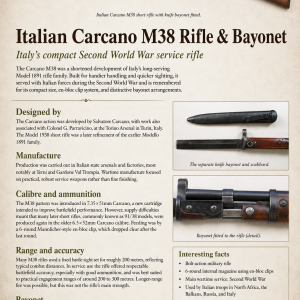
Their personal weapons reflected those of the Italian Army generally. The Carcano series of 6.5mm rifles and carbines was widely used, alongside Breda Model 30 light machine guns, Beretta sub-machine guns and pistols. The Breda 37 heavy machine gun provided more sustained fire, while 81mm mortars gave the infantry an extremely useful form of indirect support. Some paratroopers also employed hand grenades, demolition charges and improvised anti-tank methods when enemy armour penetrated their positions.
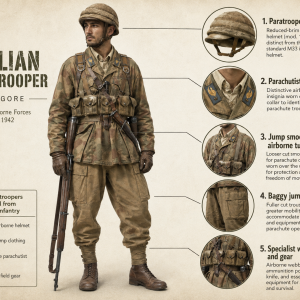
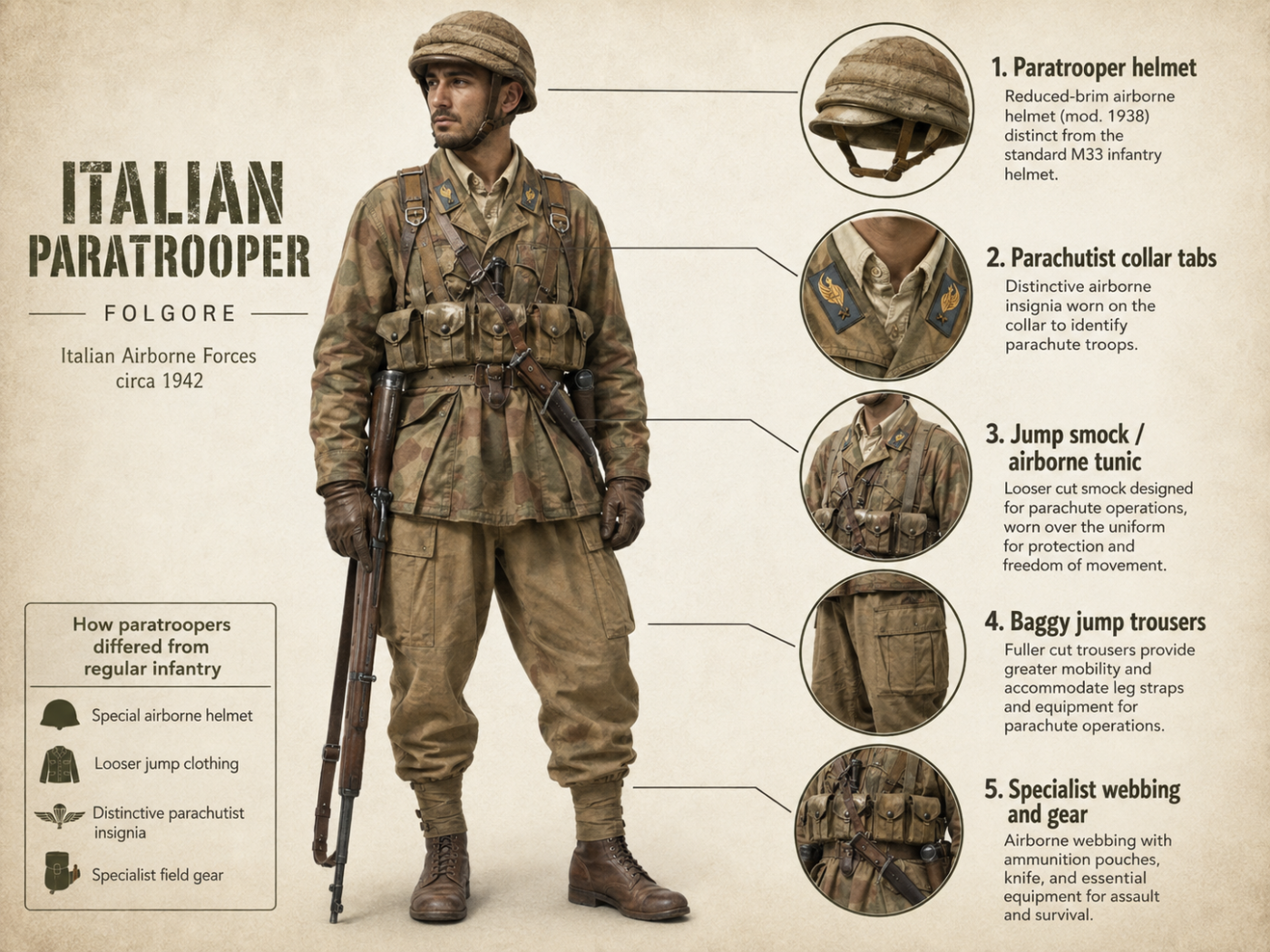
The paratroopers were distinctive in appearance. Their specialist clothing included the Italian paratrooper smock and a purpose-designed airborne helmet rather than simply the normal infantry steel helmet. Their insignia and badges helped create a strong separate identity within the Royal Italian Army. Like the British airborne forces and German Fallschirmjäger, this sense of belonging to an elite organisation became an important part of their morale.
Folgore first experienced major fighting in the El Alamein area before the famous October battle. During the Battle of Alam el Halfa between 30 August and 5 September 1942 the division participated in Rommel's unsuccessful attempt to break through the British position. On 29 September British forces launched Operation Braganza against positions occupied by Folgore. The attack was repulsed, giving the Italian paratroopers increasing confidence in their ability to hold prepared desert positions.
The decisive test began on 23 October 1942 when General Bernard Montgomery opened the Second Battle of El Alamein. The British Eighth Army possessed enormous superiority in artillery, tanks, ammunition and supplies. Folgore's southern positions were attacked by Commonwealth infantry and armour as Montgomery attempted to fix and break different sections of the Axis front.
The Italians repeatedly resisted attacks that would ordinarily have been expected to overwhelm such lightly equipped troops. Trenches, minefields and carefully positioned anti-tank guns turned portions of the battlefield into killing grounds. When British and Commonwealth tanks penetrated the defensive positions, small groups of paratroopers continued fighting around isolated strongpoints. The terrain, together with Folgore's aggressive defence, made a rapid breakthrough extraordinarily difficult.
It is important not to turn the battle into legend at the expense of historical accuracy. Folgore did not single-handedly stop the British Eighth Army, and the southern sector also contained other Axis artillery and formations. Nevertheless, contemporary and later accounts from both sides consistently recognised that the Italian paratroopers offered unusually stubborn resistance. Their reputation therefore did not arise solely from post-war Italian commemoration.
Eventually the wider Axis position became impossible to maintain. Montgomery's forces broke through farther north, Axis armour suffered catastrophic losses and the entire German-Italian army faced the danger of encirclement. Folgore received orders to withdraw rather than being simply destroyed in its original positions. For largely foot-mobile troops with little transport, however, retreat across the desert while pursued by mechanised forces was extremely difficult.
By early November organised resistance by the division had effectively ended. The 186th Regiment was described by the modern Italian Army as having been decimated by the battle by 6 November. Survivors were subsequently gathered into smaller formations, some of whom continued fighting through Tunisia until the final Axis surrender in North Africa in May 1943.
The price paid by Folgore was enormous. Exact figures vary according to the dates and units counted, so claims sometimes made that only a few hundred men survived should be treated carefully. What is certain is that a formation that had entered the El Alamein sector with approximately 5,000 men ceased to exist as an effective division. The modern Italian Army describes Folgore as “exhausted but not defeated” at El Alamein and records its formal dissolution on 23 November 1942.
While Folgore was fighting in Egypt, Italy was already creating a second airborne division. The 185th Regiment left Folgore during September 1942 and became the nucleus of the 184th Parachute Division “Nembo”. Nembo was formally established on 1 November 1942 and eventually contained the 183rd, 184th and 185th parachute infantry regiments together with the 184th Parachute Artillery Regiment and supporting troops. Its personnel were trained through Tarquinia and, increasingly, the new parachute school at Viterbo.
Nembo never received the opportunity to conduct the large airborne operation for which such a formation had been created. During 1943 its components were deployed around Italy at a time when an Allied invasion was clearly approaching. Parts of the division served in north-eastern Italy, while other elements were moved south. A large part of Nembo went to Sardinia, where its battalions acted as mobile reserves protecting the island and its airfields against a possible Allied landing.
Elements of the 185th Nembo Regiment saw combat around Sicily and Calabria in the summer of 1943. Following the Allied landings on mainland Italy during Operation Baytown on 3 September, Nembo paratroopers fought British and Canadian troops in Calabria. Their experience illustrates an odd feature of Italian airborne history: although tens of thousands of training jumps were undertaken and whole divisions organised around parachuting, much of their actual combat took place on the ground as conventional elite infantry.
The Italian armistice of 8 September 1943 then produced one of the most complicated episodes in the paratroopers’ history. Italy's armed forces fragmented. Some troops obeyed the Royal Government and eventually fought alongside the Allies, others attempted to resist German disarmament, while a proportion joined forces loyal to Mussolini's newly created Italian Social Republic and continued fighting alongside Germany.
Nembo itself divided. Most of the division remained under Royal Italian authority, but the XII Parachute Battalion and other individuals chose to join the Germans. The division's chief of staff, Lieutenant-Colonel Alberto Bechi Luserna, attempted to stop the defecting paratroopers in Sardinia. He was shot and killed on 9 September 1943 while trying to persuade them to return to their posts. He was later awarded the Gold Medal of Military Valour.
Those Nembo units that remained loyal to the King eventually became part of the Italian Co-belligerent Army fighting alongside the Allies against Germany. In May 1944 Nembo moved from Sardinia to mainland Italy and entered combat as part of the Italian Liberation Corps. The division fought in central Italy, including the hard-fought action at Filottrano during the Allied advance towards Ancona.
The airborne tradition even returned during the final weeks of the European war. In April 1945 Italian paratroopers who were now fighting alongside the Allies took part in Operation Herring. A force of 226 Italian paratroopers was selected for an airborne operation behind German lines in northern Italy. Among them were men from the Nembo tradition and Squadron F. They were given refresher training using British parachutes before being dropped during the night of 20 April 1945 in the area south of the River Po. Their mission was to disrupt German communications and withdrawal routes as the Allied armies broke through the final defensive positions in northern Italy.
Italy also attempted to create a third parachute division, the 183rd “Ciclone”. It began forming at Viterbo during the summer of 1943, by which time Italy's strategic position was deteriorating rapidly. Four parachute battalions were reportedly being assembled, but the armistice arrived before Ciclone could become a fully operational division. Elements subsequently took different paths during the confused fighting that followed the German occupation of Italy.
So how many Italian paratroopers were there during the Second World War? There is no single figure that perfectly describes the entire wartime force because personnel passed through different Army, Air Force, Navy and Carabinieri formations and because units were continuously created, reorganised, destroyed and rebuilt. The most useful surviving figure is that Tarquinia alone reportedly qualified 10,728 paratroopers during its wartime existence. Folgore's theoretical strength in 1942 was approximately 5,900 and it took roughly 5,000 men into the El Alamein sector. Nembo subsequently created another division-sized airborne organisation, while Ciclone was only partly formed. The total number of men serving at some stage in Italian parachute organisations was therefore considerably larger than the famous 5,000 Folgore defenders of El Alamein, although it would be misleading to present all of them as belonging to a single operational airborne division.
One of the most fascinating aspects of their story is the contrast between training and employment. Italy invested heavily in selecting and preparing troops capable of airborne assault, built specialist schools and formed complete parachute divisions, yet circumstances repeatedly prevented them from performing their intended role. Malta was never invaded. Folgore went to Egypt without its parachutes and fought as infantry. Nembo spent much of 1943 preparing to counter Allied landings. Only relatively small Italian formations carried out genuine wartime combat parachute operations.
Yet the absence of spectacular mass airborne drops did not diminish their reputation. Folgore in particular became synonymous in Italy with El Alamein. Its soldiers had gone into the desert lightly armed and with limited transport and anti-tank capability, confronted one of the best-equipped Allied armies in the world and continued resisting until the strategic situation around them made further defence impossible.
The Italian paratrooper tradition survived the war. Today's Italian Army Folgore Paratroopers Brigade directly preserves the names and traditions of the wartime formations, including the 183rd Nembo, 186th Folgore, 187th Folgore and 185th artillery lineage. Tarquinia and El Alamein consequently occupy a place in Italian airborne history comparable in emotional importance to places such as Arnhem in British airborne tradition.
The story of the Italian paratroopers is therefore considerably broader than the frequently repeated image of Folgore fighting British tanks in the desert. It began with experimental parachuting in Libya, developed into one of Italy's first genuinely specialist modern forces at Tarquinia, produced more than ten thousand qualified parachutists, created three divisional organisations and eventually saw Italian paratroopers fighting on opposing sides after the collapse of Mussolini's regime. Some fought the Allies in North Africa and southern Italy; others later fought alongside Allied troops against Germany, while still others continued the war on the German side.
Of all these episodes, El Alamein remains the defining one. The Folgore Division never carried out the great airborne assault for which it had trained, but on the ground its men demonstrated the discipline, cohesion and aggression that airborne training was intended to produce. Their stand in the Egyptian desert earned them a military reputation that survived the destruction of their division and continues to influence the identity of Italian paratroopers more than eighty years later.