Japanese attack Oregon
In September 1942, the war in the Pacific reached the forests of the American mainland when a small Japanese floatplane launched from a submarine attempted to start a series of devastating fires in Oregon. It was the first time an enemy aircraft had bombed the continental United States, yet the unusual operation caused little damage and is now one of the lesser-known episodes of the Second World War.
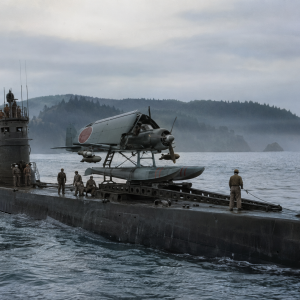
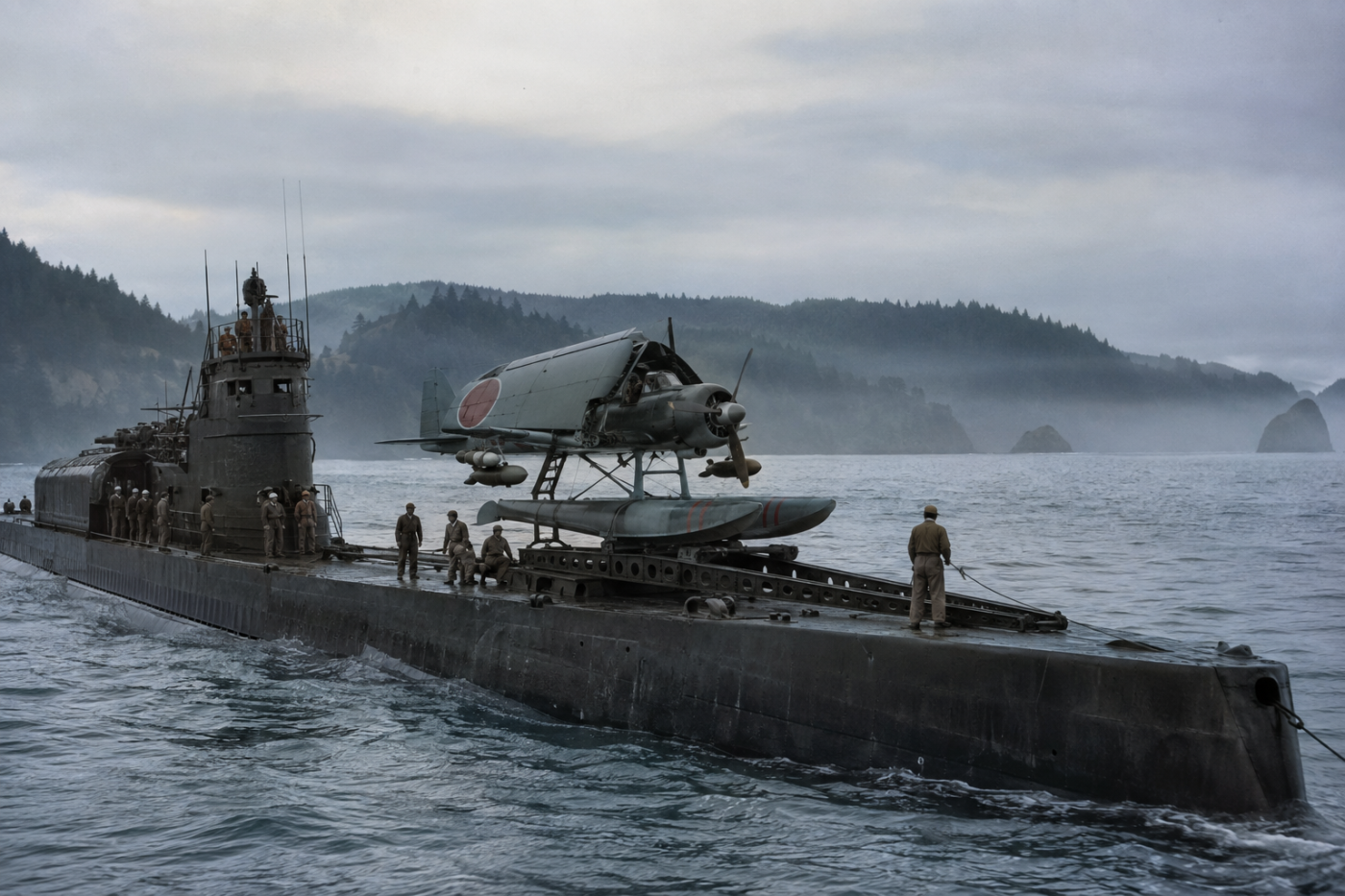
The attack was carried out by the Japanese submarine I-25, a large Type B1 vessel designed for long-range reconnaissance missions. Unlike most submarines, I-25 carried a small Yokosuka E14Y reconnaissance floatplane, known to the Allies by the reporting name “Glen”. The aircraft was stored with its wings and floats removed inside a watertight hangar positioned in front of the submarine’s conning tower. Once the submarine surfaced, its crew could assemble the aircraft, place it on a compressed-air catapult and launch it from the deck. After completing its mission, the floatplane landed on the sea beside the submarine and was lifted back aboard by crane.
The pilot selected for the operation was Warrant Flying Officer Nobuo Fujita, accompanied by his observer and radio operator, Chief Petty Officer Shoji Okuda. Fujita had previously flown reconnaissance missions over Sydney, Melbourne and other Allied locations. His new orders were very different. He was to fly inland over Oregon and drop specially constructed incendiary bombs into the heavily wooded coastal mountains. Japanese planners hoped that the dry forests would ignite, creating enormous wildfires that would destroy valuable timber, divert American resources and spread fear among the civilian population.
I-25 approached the Oregon coast during the night of 8 September 1942 and surfaced before dawn on 9 September. The crew assembled the aircraft in darkness and attached two 76-kilogram incendiary bombs beneath its wings. Each bomb contained hundreds of small incendiary elements designed to scatter burning material across a wide area when the casing burst. Fujita and Okuda climbed aboard, and the little floatplane was launched into the misty morning sky.
After crossing the coastline near Brookings, Fujita flew towards the forested slopes around Mount Emily. He released the two bombs over the Siskiyou National Forest, intending to create several separate fires among the trees. One bomb exploded as planned, scattering burning fragments through the woodland, while the fate of the second remains uncertain. Fujita circled the area and believed that he could see flames developing below before turning back towards the Pacific.
The fires were discovered by forest lookout Howard Gardner, who saw smoke rising through the trees and reported it to the local authorities. Gardner and a small team reached the area and found a shallow crater, fragments of the bomb and several small fires. Recent rainfall had left the forest damp, while mist and light winds prevented the flames from spreading. The men were able to extinguish the fires before they caused serious damage. Investigators recovered Japanese markings and bomb fragments, confirming that the forest had been attacked from the air.
Fujita returned safely to I-25, landing on the sea alongside the submarine. The aircraft was recovered, dismantled and placed back inside its hangar before the vessel submerged. American aircraft searched the surrounding waters, and I-25 was attacked from the air, but the submarine escaped.
The Japanese made a second attempt on the night of 29 September 1942. Fujita again took off from I-25 carrying incendiary bombs and flew inland using coastal lights as navigation points. He dropped the bombs into the forests east of Brookings and reported seeing flames, but no major fire developed. Weather conditions were again unfavourable, and American searches failed to find clear evidence of extensive damage. Plans for further attacks were abandoned as autumn rain made the possibility of starting large forest fires increasingly remote.
Although the bombing raids caused no deaths and very little physical damage, they held considerable historical importance. Fujita became the only enemy pilot known to have dropped bombs on the continental United States from an aircraft during the Second World War. The operation also demonstrated the remarkable reach of Japan’s submarine force and the versatility of submarines capable of carrying and launching their own reconnaissance aircraft.
I-25 continued operating off the American coast and later torpedoed the tanker SS Camden and the freighter SS Larry Doheny. On 11 October 1942, the submarine also sank the Soviet submarine L-16 after apparently mistaking it for an American vessel. I-25 was eventually destroyed in the Pacific in 1943, with the loss of its crew. Fujita survived the war, but his observer, Shoji Okuda, was killed in action in 1944.
More than twenty years after the Oregon raid, Fujita was invited to visit Brookings. Some residents were initially uneasy about welcoming the man who had attempted to burn their surrounding forests, but the visit developed into an extraordinary act of reconciliation. Fujita presented the town with his family’s 400-year-old samurai sword, explaining that he had intended to use it to take his own life if the people of Brookings could not forgive him. Instead, he was warmly received and later became an honorary citizen of the town.
Fujita returned to Oregon several times, helped finance a visit to Japan for local students and planted a tree near the site of the bombing as a symbol of peace. He died in 1997, and some of his ashes were scattered close to the place where his incendiary bomb had fallen 55 years earlier. The forest attack that had begun as an attempt to spread destruction ultimately became remembered for something very different: the reconciliation between a former Japanese pilot and the American community he had once been ordered to attack.