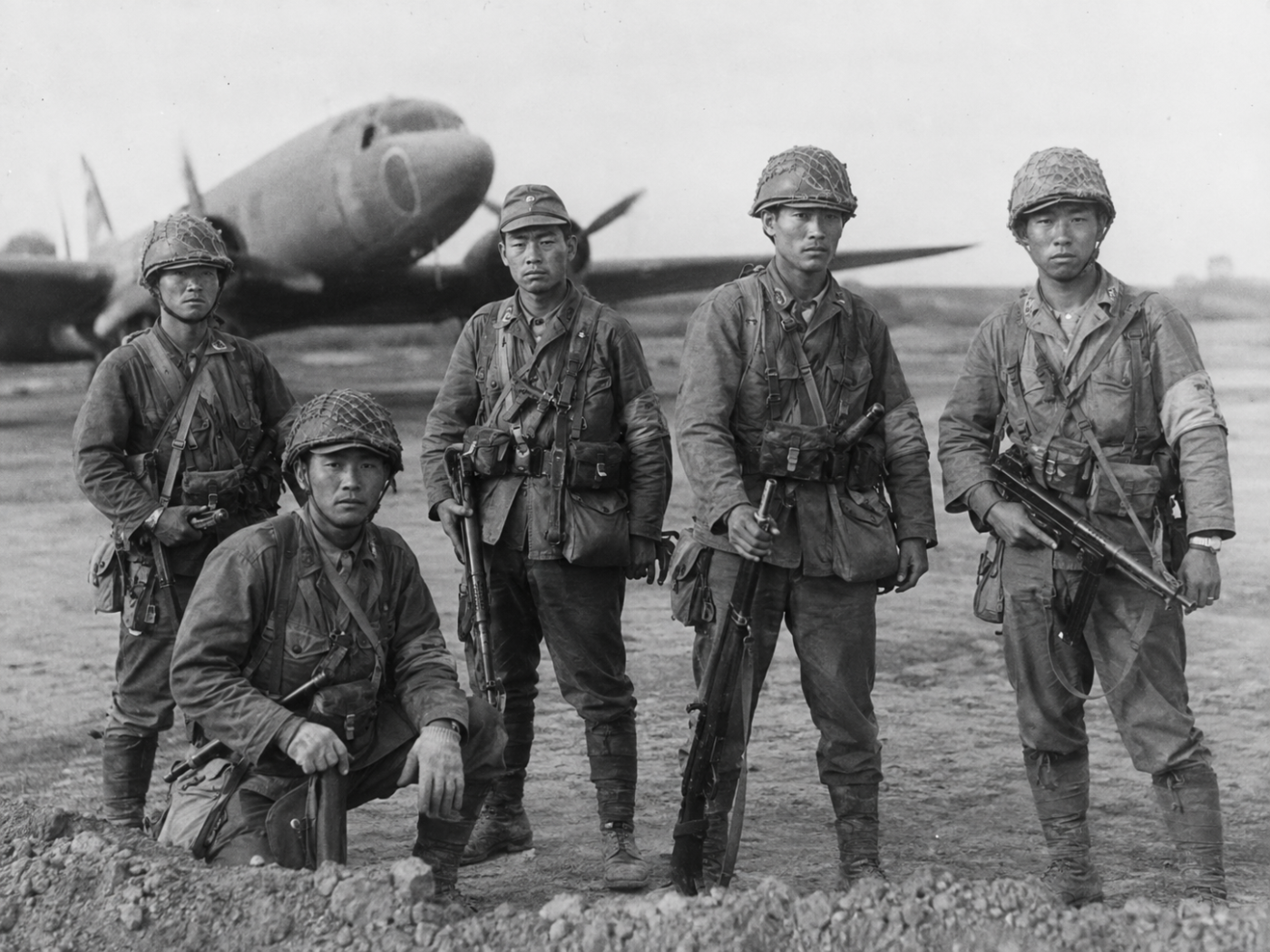
Japanese Special Forces
During the Second World War Japan developed a number of specialist fighting formations whose existence remains far less well known than Germany’s Fallschirmjäger, Britain’s Commandos or America’s Rangers. Among the most remarkable were the airborne soldiers of the Imperial Japanese Army known as the Teishin Shudan and, emerging from them during the desperate final months of the Pacific War, the Giretsu Kuteitai. These were troops trained to descend by parachute, land by aircraft or glider behind enemy lines, seize strategically important objectives, destroy aircraft and installations, conduct sabotage and fight surrounded without expecting immediate reinforcement. By 1945 the concept had evolved still further, producing small assault groups whose missions were effectively one-way operations from which survival was considered unlikely.
The term Teishin is usually translated as “raiding”, “dashing forward” or “advancing aggressively”, while Shudan referred to a larger group or formation. The Teishin Shudan was therefore essentially the Imperial Japanese Army’s airborne raiding force. It should not be confused with the parachute troops of the Imperial Japanese Navy. Japan maintained separate Army and Navy establishments during the war and both services developed their own airborne forces. Some operations often attributed generally to “Japanese paratroopers”, such as the Japanese parachute landing at Menado in the Netherlands East Indies in January 1942, were actually undertaken by naval parachutists rather than the Army’s Teishin troops.
Japan had experimented with airborne warfare before the outbreak of the Pacific War, but development accelerated dramatically after Japanese military observers studied the spectacular German successes of 1940. German airborne troops had demonstrated that lightly equipped elite soldiers delivered from the air could capture bridges, airfields and other important positions before conventional ground forces arrived. The German assault on the Belgian fortress of Eben-Emael and airborne operations during the invasion of the Netherlands attracted particular international attention.
Japanese planners recognised that airborne troops could be extremely useful during the expansion planned across South-East Asia and the Pacific, where airfields, oil installations, ports and communications centres were frequently separated from one another by great distances, jungle and sea. If paratroopers could seize an airfield ahead of advancing conventional forces, Japanese aircraft could quickly begin operating from it and support the next stage of an offensive.
The Army therefore established a specialised parachute training organisation. Men selected for the new force were expected to possess considerable physical fitness, courage and initiative. Airborne troops would often be isolated from their parent formation and might have to continue fighting even when communications had broken down. This required a different mentality from ordinary infantry service.
Their training was demanding. Recruits underwent intensive physical conditioning before progressing to parachute instruction. Training included jumping from towers and platforms, landing techniques, aircraft drills and eventually live descents from transport aircraft. Particular attention had to be paid to landing correctly because early parachutes were less controllable than modern equipment and injuries during training were a constant danger.
Once on the ground, the paratrooper had to become an infantryman immediately. Consequently the Teishin troops received extensive instruction in small-unit tactics, rapid movement, close-quarter fighting and independent action. Weapons handling, fieldcraft, demolition work, communications and attacks on defended positions were all important elements of their preparation.
Demolition was especially significant. An airborne force might be ordered to capture an objective, but it could equally be required to destroy aircraft, fuel dumps, bridges, radio installations or other important equipment. Engineers therefore formed an important part of Japanese airborne organisation.
The equipment carried by a parachutist had to be relatively light. Heavy weapons and large quantities of ammunition could not simply be carried during the jump. Weapons and supplies could be dropped separately in containers, creating an obvious danger if the containers landed some distance from the soldiers who needed them.
Japanese airborne troops consequently relied heavily upon rifles, pistols, grenades, light machine guns and other portable weapons. Special versions of some standard Japanese weapons were developed that could be broken down or folded to make them easier to carry during parachute operations. The Japanese also experimented with gliders capable of carrying heavier equipment.
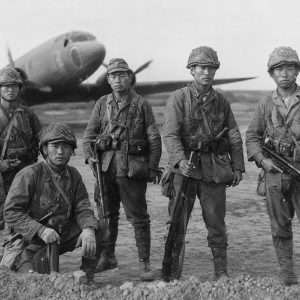
Their clothing and protective equipment were distinctive. Early Japanese Army parachutists wore padded protective helmets, while later equipment included steel airborne helmets and specialised clothing designed to reduce the possibility of equipment becoming caught during a jump. Like paratroopers in other armies, they were expected to land carrying enough ammunition and supplies to fight independently until contact could be made with supporting forces.
The first great test of the Army parachutists came during the Japanese offensive into the Netherlands East Indies. One of Japan’s most important objectives was Palembang on Sumatra. The area contained a strategically important airfield and enormous oil-refining facilities. Japan desperately needed the oil resources of the East Indies and wanted to capture the installations before Allied forces could completely destroy them.
On 14 February 1942 Japanese Army paratroopers descended around Palembang. Approximately 425 men from the 2nd Raiding Regiment took part in the opening airborne assault, with objectives including the P1 airfield and the nearby oil refineries. The operation was particularly dangerous because the Japanese troops were numerically weak once on the ground. They nevertheless succeeded in causing considerable confusion and contributed to the seizure of the strategically vital region as Japanese ground forces advanced towards Palembang. The action became one of the best-known achievements of Japanese Army airborne forces.
Another regiment had originally been intended to participate, but disaster had intervened before the operation. The transport carrying elements of the 1st Raiding Regiment caught fire and sank while travelling through the South China Sea in January 1942. Although the soldiers themselves were rescued, much of their specialised equipment was lost and they could not be prepared in time for the Palembang assault.
The Palembang operation demonstrated both the enormous potential and the considerable limitations of airborne warfare. A relatively small number of men could suddenly appear around an important objective hundreds of miles beyond the conventional front line, but once they landed they possessed limited heavy weaponry, ammunition and medical facilities. If supporting forces failed to arrive quickly, an airborne force could easily be surrounded and destroyed.
As the war continued, Japan expanded its airborne establishment. New raiding regiments, engineers, signal units and specialist formations were created. Experiments were even carried out with glider-borne armour. A specialised glider tank element was established during 1943. Japanese planners investigated whether light tanks such as the Type 95 Ha-Go and later the Type 2 Ke-To could be delivered with airborne troops. The idea showed how ambitious the Japanese airborne programme had become, although Japan never developed anything approaching the huge airborne transport capability later fielded by the United States and Britain.
By late 1944 these formations were consolidated into what became the 1st Teishin Shudan, effectively Japan’s principal Army airborne formation. Determining its exact strength is difficult because Japanese wartime organisations changed frequently and modern sources give different totals. One commonly quoted establishment is approximately 5,575 personnel, while other assessments put the enlarged airborne organisation considerably higher, in some cases approaching 8,000 to 12,000 men when associated aviation, glider and support elements are included.
It is therefore misleading to imagine the Teishin Shudan as a conventional infantry division containing perhaps 15,000 or more heavily equipped soldiers. It was a specialised formation made up of comparatively small raiding regiments supported by engineers, signals, aviation and other specialist units. An organisation frequently associated with the Teishin force included headquarters personnel, raiding brigades and regiments, an aviation or transport element, glider infantry, engineers, signals and artillery support. A headquarters company alone contained around 220 men, while specialist engineer and signals formations added several hundred more.
Despite its impressive title, however, the Teishin Shudan was never dropped into battle as one huge airborne division. Japan simply did not possess the transport aircraft, air superiority or logistical resources necessary for an airborne operation on the scale of the Allied landings in Normandy or Operation Market Garden. Instead, individual regiments, companies and detachments were committed to particular operations.
By 1944 the military situation had changed dramatically. Japan was no longer advancing through South-East Asia. American forces were moving steadily towards the Philippines and the Japanese home islands. Allied air superiority made conventional parachute operations increasingly hazardous because slow transport aircraft were highly vulnerable to fighters and anti-aircraft guns.
It was in the Philippines that the Teishin troops undertook another extraordinary operation. Following the American return to the Philippines in October 1944, Japanese commanders attempted to disrupt American air operations on Leyte. On the night of 6 December 1944 Japanese airborne troops launched attacks against American-held airfields in the Burauen area.
Hundreds of Teishin soldiers were committed. Figures vary between accounts because several aircraft and ground formations were involved, but roughly 450 airborne troops are recorded as having been dropped during the operation, while broader Japanese plans involved substantially more men. The transports flew through intense American defensive fire. Some were destroyed before reaching their objectives, while others crash-landed or released their troops in scattered locations.
Those Japanese soldiers who successfully reached the ground attacked American positions and airfield installations with remarkable aggression. Aircraft and equipment were damaged and American troops initially faced considerable confusion as Japanese soldiers appeared inside and around supposedly secure airfield areas. Yet the attackers had virtually no realistic means of sustaining themselves. Once the Americans reorganised their defences, the isolated Japanese groups were hunted down. Most of the attacking force was eventually destroyed.
The Leyte raid demonstrated the direction in which Japanese airborne doctrine was moving. Earlier operations had been intended to capture objectives that advancing Japanese forces would soon relieve. By late 1944 airborne soldiers were increasingly being employed as heavily armed raiders expected to land directly among enemy installations, destroy as much as possible and continue fighting until killed.
From this environment emerged an even more specialised force: the Giretsu Kuteitai. Giretsu Kuteitai, written 義烈空挺隊, can be translated approximately as the “Heroic Airborne Unit”, “Righteous Heroism Airborne Unit” or “Giretsu Airborne Unit”. Translation varies, but the significance was unmistakable. These were not conventional paratroopers intended simply to seize ground. They were commandos created specifically to penetrate heavily defended American air bases and destroy valuable aircraft on the ground.
The catalyst for their creation was the arrival of American B-29 Superfortress bombers in the Mariana Islands. After the United States captured Saipan, Tinian and Guam, enormous air bases were constructed from which B-29 bombers could strike the Japanese home islands. Tokyo and other Japanese cities were suddenly exposed to sustained strategic bombing.
Japan possessed only limited means of stopping the B-29 offensive. One proposed answer was extraordinarily daring: instead of attempting merely to shoot the bombers down, Japanese commandos would land directly on American airfields and destroy the aircraft where they stood.
Late in 1944 the 1st Raiding Brigade was instructed to create a specialist assault force for the mission. Captain Michiro Okuyama, an experienced airborne officer associated with the brigade’s engineer company, was selected to lead it. His engineering background was particularly appropriate because the mission depended upon demolition and sabotage rather than conventional infantry combat.
Okuyama selected approximately 126 men, many from his own formation. Additional intelligence specialists and radio personnel joined them, bringing the original Giretsu force to around 136 men. The formation was divided into a headquarters element and several small assault platoons. The men underwent extremely intensive training for attacks on airfields.
Their proposed method of insertion was extraordinary. Instead of parachuting some distance from the objective and assembling before attacking, transport aircraft would fly directly into the enemy airfield at night and deliberately crash-land or belly-land on or alongside its runways. Within seconds the doors would open and assault troops would emerge carrying automatic weapons, grenades and demolition charges.
Individual groups would immediately spread across the airfield. Some men would attack American personnel and defensive positions. Others would run directly towards parked aircraft and attach explosive charges to wings, engines, fuel tanks and fuselages. Fuel installations, ammunition dumps, communications equipment and maintenance facilities were also priority targets.
Speed was everything. The attackers knew that once the defenders understood what was happening, overwhelming American forces would quickly surround them. Training therefore concentrated heavily upon physical fitness, night fighting, close-quarter combat, demolition, infiltration and the rapid destruction of aircraft. Mock aircraft and airfield installations could be used to practise the placing of charges, while teams repeatedly rehearsed their assigned tasks so that they could continue even amid darkness, fire and confusion.
Men also learned exactly where explosives would cause the most serious damage to an aircraft. Destroying an engine, fuel system or critical structural component could be considerably more effective than randomly placing a charge against the fuselage. This was sabotage conducted at extremely close range.
The Giretsu carried a mixture of weapons suitable for close combat. These included rifles, pistols, grenades and automatic weapons, together with demolition charges and incendiary devices intended to destroy aircraft and fuel supplies. Some photographs of the unit also show extraordinary camouflage clothing. Members prepared specially patterned uniforms intended to break up their outline during night operations around vegetation and airfields. Their appearance has made photographs of the Giretsu some of the most unusual images of Japanese soldiers from the entire Pacific War.
There was one fundamental difference between these raids and most modern special-forces operations: extraction was essentially absent from the plan. No aircraft was expected to return to collect the men. Once their transport had intentionally landed or crashed inside an American airfield there was little possibility of taking off again. Surrounded by thousands of enemy troops, the commandos were expected to continue destroying targets and fighting for as long as possible.
The operation was therefore effectively suicidal, although the Giretsu should not simply be described as kamikaze troops. A kamikaze pilot generally destroyed himself and his aircraft at the moment of attack. The Giretsu were expected to survive their landing, conduct an organised ground operation and continue fighting afterwards. Their deaths were considered extremely likely, but dying itself was not the weapon; their purpose was to inflict maximum destruction before they were overwhelmed.
The original target was the American B-29 bases in the Marianas, particularly Saipan. A plan was developed in which the commandos would be flown towards the islands using Japanese airfields on Iwo Jima as an intermediate staging or refuelling point. Had the operation succeeded, even a few Giretsu reaching a densely packed B-29 base could potentially have destroyed aircraft worth enormous amounts of money.
The raid never took place. American attacks damaged the Japanese facilities required to support the operation, making the mission impractical. Another proposal considered attacking American airfields after the United States invaded Iwo Jima, but the rapid collapse of Japanese resistance there prevented that operation as well.
Then came Okinawa. American forces landed on Okinawa on 1 April 1945. After capturing Japanese airfields at Yontan and Kadena, the Americans rapidly repaired and expanded them. Fighters operating from these bases became a serious threat to Japanese aircraft, including the huge waves of kamikazes being sent against the American fleet offshore.
Japanese planners therefore resurrected the Giretsu concept. If commandos could disable the American airfields, even temporarily, Japanese kamikaze aircraft might have a clearer path towards the fleet. The operation was designated Gi-gō.
On the evening of 24 May 1945 a force of Japanese Ki-21 twin-engined aircraft took off carrying Giretsu assault troops towards Okinawa. Twelve transports are commonly recorded as participating in the mission, although several encountered mechanical problems or were intercepted before reaching their targets. The transports flew into one of the most heavily defended areas in the Pacific.
Japanese conventional aircraft simultaneously attacked Okinawa, helping create confusion around the American bases. Most of the Giretsu transports never successfully delivered their troops. Some turned back because of mechanical problems and several were shot down.
But at Yontan Airfield Japanese aircraft suddenly appeared extremely low over the runway. At least one transport made a successful belly landing directly on the airfield while others crashed nearby. The doors opened and Japanese commandos poured out.
For the American defenders the situation was initially bewildering. Enemy troops had effectively appeared in the middle of their airfield. The Giretsu immediately began moving among parked aircraft and installations, firing weapons and throwing grenades while demolition men placed explosive and incendiary charges.
Fuel was ignited. Aircraft began burning. For several hours small groups of Japanese soldiers moved around the airfield while American troops attempted to locate and eliminate them.
The physical destruction achieved by such a tiny force was considerable. Contemporary and later accounts generally credit the attackers with destroying around nine American aircraft and damaging approximately two dozen or more, with some estimates placing the damaged total at 29. Roughly 70,000 gallons of aviation fuel were also destroyed.
American personnel were killed and wounded, although the Japanese force itself was virtually annihilated. The raid therefore failed in its wider strategic objective. Yontan was not permanently disabled and American air operations resumed. Yet tactically it demonstrated what a very small force could achieve when inserted directly into the centre of a valuable enemy installation.
The commandos had penetrated one of the most heavily defended Allied positions in the Pacific and destroyed aircraft and fuel before being eliminated. Remarkably, at least one member of the assault force is reported to have escaped from the airfield area and eventually reached Japanese lines several weeks later.
The Giretsu were not finished. Japan began preparing an operation on an even larger scale against the American bases in the Mariana Islands. Usually associated with the name Operation Ken-gō, the plan envisaged attacking B-29 airfields with a far larger force.
Around 60 transport aircraft and as many as 900 assault troops were contemplated for attacks planned during August 1945. The target once again was the American strategic bomber force. By then the B-29 campaign had devastated large areas of Japan and the atomic bombs had been dropped on Hiroshima and Nagasaki. The Soviet Union had also entered the war against Japan.
Before the mass Giretsu assault could be launched, Emperor Hirohito announced Japan’s acceptance of surrender terms on 15 August 1945. The operation was cancelled. Had it taken place, it would have been one of the largest and most extraordinary commando raids of the entire Pacific War.
The story of the Teishin Shudan and Giretsu Kuteitai illustrates the changing nature of Japan’s war. In 1942 Japanese airborne troops were instruments of victory. They landed ahead of advancing armies, seized airfields and valuable installations and helped Japan capture enormous territories across South-East Asia.
By 1944 and 1945 those same specialist skills were being used in an entirely different strategic situation. Japan had lost control of the sea and increasingly lost control of the air. Transport aircraft attempting conventional parachute operations faced devastating interception. Reinforcement of airborne troops became increasingly difficult and recovering them was almost impossible.
Consequently the airborne soldier gradually became a raider. The final development of that process was the Giretsu commando: a soldier deliberately flown into an enemy airfield aboard an aircraft that was never expected to leave.
Their missions combined several ideas now associated with special operations: intelligence preparation, specialised equipment, small autonomous assault teams, infiltration, demolition of high-value targets and attacks far behind enemy lines. Yet they were also a product of Japan’s increasingly desperate strategic circumstances and military culture during the final year of the war.
The Japanese Army had invested considerable time and resources training its airborne troops. Producing a competent parachutist was far more expensive than training an ordinary infantryman. Aircraft, parachutes, instructors and specialist facilities were required, and every combat loss represented skills that could not quickly be replaced.
This partly explains why Japan never possessed airborne forces comparable in scale with those fielded by the major Allied powers. Germany, Britain and the United States could deploy airborne divisions involving thousands or even tens of thousands of soldiers supported by enormous fleets of transport aircraft and gliders. Japan possessed excellent individual airborne soldiers but lacked the industrial and logistical capability necessary to employ them repeatedly on such a scale.
Instead Japan often used relatively small groups where surprise could compensate for their numerical weakness. Their greatest conventional success came early in the war at Palembang. Their later operations on Leyte and Okinawa were very different. These became increasingly desperate attempts to damage American air power at a time when Japan had few other effective methods available.
The Giretsu attack on Yontan is particularly fascinating because it anticipated a style of airfield raid seen repeatedly after the Second World War: small teams penetrating an enemy base and destroying expensive aircraft on the ground. The difference was that later special-forces doctrine generally placed enormous importance upon extraction and survival.
For the Giretsu, there was effectively no extraction plan at all. Their aircraft were intended to crash-land inside the objective. Once there, the men fought until killed, captured or somehow able to escape through enemy lines. Their objective was not to hold the airfield indefinitely. Their purpose was destruction.
For a soldier selected for such a mission, training therefore had a grim simplicity: reach the target, leave the aircraft as rapidly as possible, find predetermined objectives, destroy as many aircraft and installations as possible and continue fighting until no further resistance was possible.
The exact total number of men who served in Japan’s various wartime airborne formations remains difficult to establish. Organisations expanded, contracted and were reorganised during the war, while sources calculate strength differently depending upon whether aviation and support units are included.
A figure of approximately 5,575 men is frequently given for the formal Teishin Shudan organisation, although other estimates for the wider late-war formation are significantly larger and can reach roughly 8,000 to 12,000 personnel. The original Giretsu organisation was dramatically smaller, numbering only around 136 specially selected men after attached intelligence and communications specialists were added. Later plans contemplated expanding the concept substantially, including the approximately 900-man force intended for the cancelled attack on the Mariana Islands in August 1945.
Numbers alone, however, do not explain their importance. The Teishin troops represented one of Japan’s earliest attempts to create soldiers specifically trained for vertical envelopment: attacking an enemy not from the front but by suddenly appearing behind him.
The Giretsu took that principle to its extreme conclusion. Instead of dropping miles away and manoeuvring towards an objective, their transports were intended to carry them straight into the heart of it. There was no long approach march. The crash of their aircraft announced their arrival.
Within moments the commandos were expected to be among enemy bombers, fighters, fuel stores and ammunition dumps. The entire operation depended upon the first few minutes of confusion.
Their history has often been overshadowed by the much larger kamikaze campaign, the battles of Iwo Jima and Okinawa and the atomic bombing of Japan. Yet the Teishin Shudan and Giretsu Kuteitai occupied a distinctive place within the Japanese armed forces.
They were paratroopers, assault troops, engineers, saboteurs and commandos. The Teishin Shudan had been created during an era when Japan expected airborne troops to help win an expanding empire. The Giretsu Kuteitai emerged when that empire was collapsing.
Between them they tell the story of Japanese airborne warfare from the victorious parachute drops over the Netherlands East Indies in 1942 to the desperate crash-landing raid on Yontan Airfield in May 1945 and finally the enormous one-way mission against America’s B-29 bases that was being prepared when Japan surrendered.
They remain some of the least known yet most unusual elite troops of the Second World War.