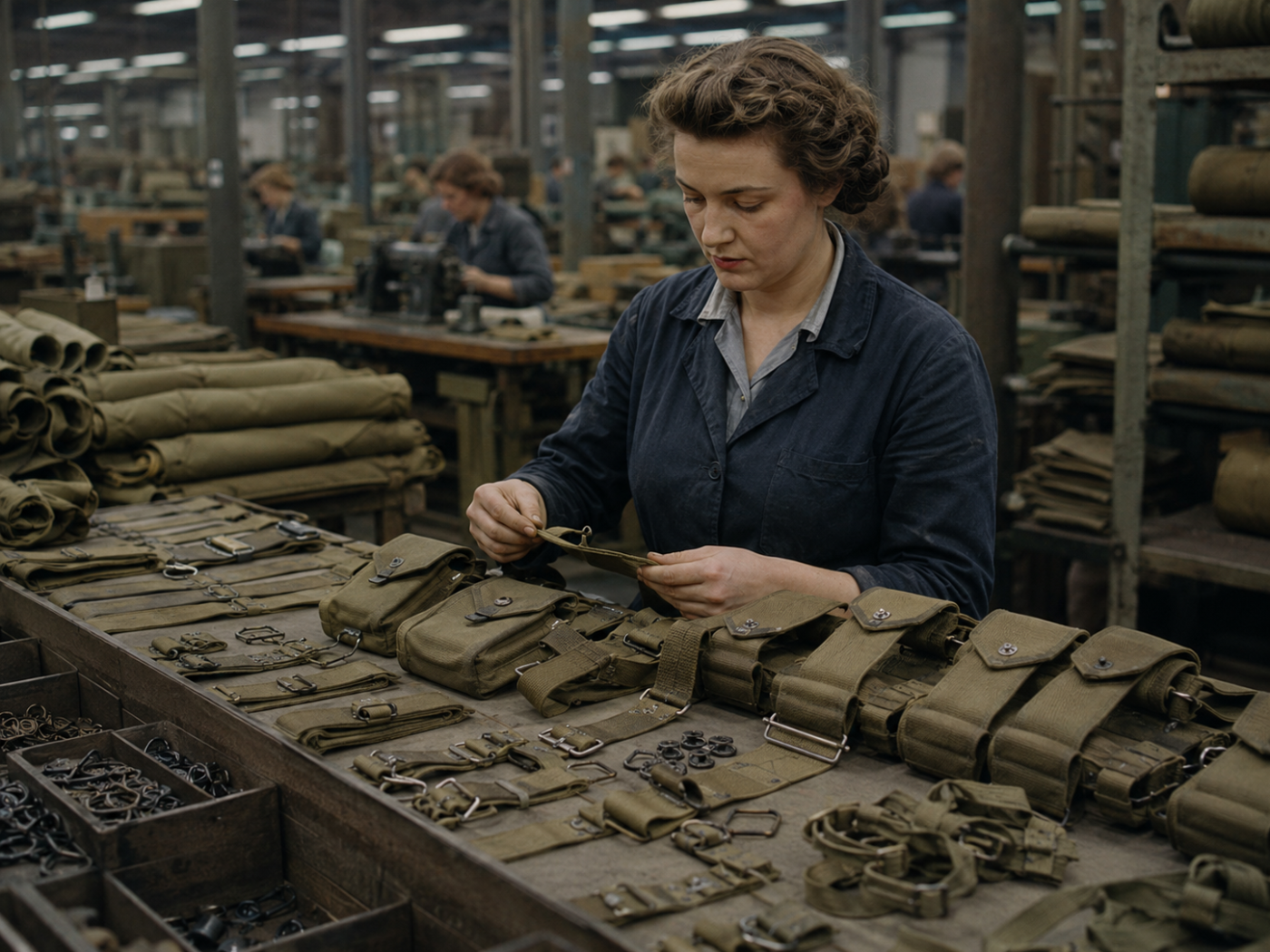
Manufacturing 37 Pattern Webbing
Few pieces of British military equipment are as instantly recognisable as the khaki webbing worn by British and Commonwealth soldiers during the Second World War. Officially known as Web Equipment, Pattern 1937, or simply “37 Pattern”, it became the standard load-carrying equipment of the British Army and accompanied soldiers from France and North Africa to Italy, Normandy, Burma and eventually into Germany. Tough, adaptable and relatively simple to manufacture, it was one of the most successful pieces of British military equipment of the twentieth century.
The 1937 Pattern system did not suddenly appear from nowhere. Britain had already been a pioneer in replacing traditional leather equipment with woven cotton webbing. The earlier 1908 Pattern had proved extremely durable during the First World War, and the Mills Equipment Company had been central to its development. During the 1930s the Army began looking for a more flexible system suitable for increasingly mechanised warfare and for new weapons such as the Bren light machine gun. The resulting 1937 Pattern was designed around interchangeable components rather than permanently arranging ammunition pockets and other equipment in one fixed configuration. The final design was confirmed in June 1938 and large-scale issue followed as Britain prepared for war.
The most important name connected with the manufacture of 1937 Pattern webbing was the Mills Equipment Company, usually encountered by collectors through the ink marking “M.E.Co.” Mills had decades of experience manufacturing woven military equipment and possessed specialised machinery capable of producing the dense and extremely strong webbing required by the War Office. It was the principal contractor during the introduction of the equipment and appears particularly frequently on pre-war and early-war pieces. Complete early sets dated 1938, 1939 and 1940 are often found with M.E.Co. markings throughout.
Another extremely important manufacturer was M. Wright & Sons, normally stamped “M.W.&S.” The company had a long history in specialist textile weaving and was already involved in producing military webbing long before the Second World War. M. Wright & Sons of Quorn, Leicestershire, produced substantial quantities of British military webbing during the war and even manufactured equipment for American forces. Remarkably, the company survives today as a specialist manufacturer of technical woven textiles.
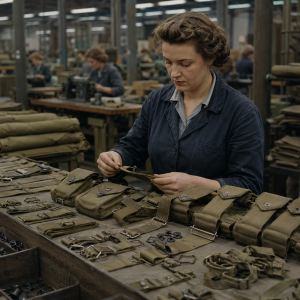
As Britain's armed forces expanded from a relatively small peacetime establishment into an army of millions, Mills and the established specialist manufacturers simply could not supply sufficient equipment. Government contracts therefore spread throughout British industry. Firms that had previously produced everything from bags and clothing to upholstery, rubber products and even toys found themselves manufacturing components of Army web equipment.
Known wartime British manufacturers included Barrow Hepburn & Gale, Bagcraft Ltd, Albert Gill Ltd, Associated Cutters, Bass Smeaton, Blackman Leather Goods, H.H. Carroll & Co., Caoutchouc Products Ltd, Civic Co., County Screen Co., Crown Bedding Co., Hampton & Sons, Hewit Sons & Co., J. & A. Hillman, Peckwash Mills, R. Burns Ltd, S. Norton Ltd, Vesta Ltd and Waring & Gillow. Even companies such as the Rover Car Company and Teddy Toy Company appear among recorded wartime webbing manufacturers. This extraordinary variety illustrates just how widely Britain's industrial resources were mobilised after 1939.
Each contractor normally marked its products with an abbreviated maker's code and the year of manufacture. Mills pieces commonly carry “M.E.Co.”, M. Wright & Sons used “M.W.&S.” and Barrow Hepburn & Gale used “B.H.G. Ltd.” Other surviving markings include “BAGCRAFT”, “C.P. Ltd.” for Caoutchouc Products, “H&S Ltd” for Hampton & Sons and “W&G” for Waring & Gillow. These apparently insignificant ink stamps are extremely useful today because they allow collectors to identify who manufactured an individual belt, pouch or strap and when it was produced. The markings were also important during the war because defective batches could potentially be traced back to the contractor responsible.
The heart of the equipment was woven cotton. This was not ordinary canvas cut into strips. High-quality web equipment required extremely tightly woven cotton yarn, with specialised weaving techniques producing straps of considerable strength without the weight and maintenance requirements of leather. The cotton yarn was pre-shrunk and dyed before weaving, producing the characteristic light khaki or sand-coloured appearance of new equipment. The dense weave also provided a degree of water resistance and considerable resistance to abrasion.
Britain was dependent upon imported raw cotton, which entered the huge British textile industry through established wartime supply networks. Cotton was obtained from several overseas sources within and beyond the Empire rather than from a single dedicated “webbing cotton” supplier. Once in Britain it passed through the spinning and textile industries before being supplied as suitable yarn to specialist webbing manufacturers. It is therefore generally possible to identify the company that assembled a particular wartime pouch or belt, but much more difficult to identify the plantation, merchant or spinning mill that supplied the cotton used in that particular item.
Mills and other established webbing manufacturers had a major advantage because specialised looms were necessary to produce some of the more complicated woven components. Certain straps were “reduction woven”, meaning the width of the web could change during manufacture rather than simply being made from pieces cut and sewn together. Wartime subcontractors without this specialised machinery sometimes had to use different construction methods, explaining why apparently identical 1937 Pattern components can show noticeable variations in stitching and manufacture.
Metalwork was equally important. Early 1937 Pattern equipment made extensive use of brass for buckles, hooks, keepers, tips and press studs. The waistbelt itself was normally made from approximately 2¼-inch-wide webbing and fitted with the distinctive interlocking buckle arrangement familiar from wartime photographs. Smaller brass buckles and hooks connected the braces, packs and carriers.
The metal fittings were manufactured separately or as part of specialist supply arrangements before being incorporated into the finished webbing. There was not one single company responsible for every buckle fitted to every piece of British 1937 Pattern equipment. Large contractors such as Mills had established sources and designs for their fittings, while Britain's metalworking industry supplied huge quantities of stamped brass hardware to government contractors. Individual metal components can occasionally bear their own manufacturer's marks, making them a fascinating collecting subject in their own right.
Brass eventually became increasingly valuable because enormous quantities were required for cartridge cases and other war production. As the conflict continued, economy measures appeared. Some buckles, hooks and keepers were manufactured from steel rather than brass, usually with a protective treatment intended to prevent corrosion. This means that steel fittings on genuine wartime equipment should not automatically be regarded as post-war replacements. Blackened steel became particularly widespread on later and post-war equipment.
A typical infantryman's Battle Order could be assembled from around eight principal individual webbing pieces if paired items are counted separately: one waistbelt, two braces, two basic ammunition pouches, one bayonet frog, one water-bottle carrier and one small pack or haversack. The entrenching-tool equipment could add further components, while Full Marching Order introduced the large pack together with its associated shoulder and supporting straps. Consequently there was no single fixed number of items that every soldier always wore. The great advantage of the system was that components could be added, removed or rearranged according to the man's weapon, rank and role.
The waistbelt formed the foundation. It carried much of the load while the two braces crossed over the soldier's shoulders and helped distribute the weight. At the front sat two large Basic Pouches. These are sometimes casually described simply as Bren magazine pouches, but they were deliberately designed as general-purpose ammunition containers. Depending upon the soldier's weapon and role they could carry Bren magazines, rifle ammunition, grenades and eventually magazines for weapons such as the Sten. Several versions of the Basic Pouch appeared during the war as battlefield requirements changed.
The bayonet frog was normally positioned on the left side of the belt and could accommodate the appropriate bayonet and scabbard. The water bottle carrier was usually worn towards the right rear. British troops initially continued using the familiar water bottle inherited from the previous equipment system, but the 1937 Pattern introduced carriers designed to integrate it properly with the new braces and belt arrangement.
The small pack was one of the most useful components. Depending upon the order of dress it could be carried on the back or at the side. It held much of the soldier's essential personal equipment, which might include washing and shaving items, spare socks, rations, eating utensils and other necessities. The rectangular British mess tins fitted naturally into the system, while the soldier's groundsheet or gas cape could also form part of the load.
For Full Marching Order the large pack was added. This carried bulkier equipment such as spare clothing and the greatcoat. The complete load of an infantryman could become substantial; official calculations for a fully equipped infantryman approached 56 lb when his rifle and carried equipment were included. The webbing therefore performed a far more important job than its simple appearance suggests: it had to distribute a heavy load over the shoulders and hips while allowing a man to run, crawl, fire his weapon and climb in and out of vehicles.
Officers and specialist troops used additional components. Pistol holsters, ammunition pouches, compass pouches and binocular cases could all be attached to the basic system. The compass pouch was externally similar to a small ammunition pouch but was padded internally to protect its contents. Armoured troops could use specialised pistol equipment, while Bren-gun crews carried additional bags and equipment associated with the weapon. Airborne troops similarly adapted the system to meet the special requirements of parachute operations.
One reason photographs of British soldiers show such variation is that soldiers did not necessarily receive a perfectly matched set from one manufacturer. A belt could have been produced by Mills in 1940, one pouch by M. Wright & Sons in 1941 and another by a completely different wartime contractor in 1942. Damaged equipment was replaced from stores rather than an entirely new matching set being issued. Mixed manufacturers and dates can therefore be completely authentic.
Colour is another area that frequently causes confusion among collectors. New British Army webbing was basically khaki, but units used web-equipment cleaner and colouring compounds generally known as Blanco. Different shades were used at different periods and by different formations, including several greens. Consequently an original piece that began life as light khaki might today appear deep green after repeated wartime applications. RAF versions of web equipment could be produced or finished in blue-grey, while white webbing was associated with duties such as military policing and ceremonial use.
Blanco served several purposes. It helped produce a uniform appearance, provided camouflage colouring and offered some additional protection to the cotton. Soldiers became so accustomed to applying it that “blancoing the webbing” became part of British military vocabulary. Together with polishing brass fittings, it was also responsible for countless hours of preparation before inspections and parades.
During active operations things were very different. Highly polished brass could reflect sunlight and reveal a soldier's position, so field equipment was not necessarily maintained to parade-ground standards. Photographs from North Africa frequently show troops wearing naturally khaki webbing without heavy green Blanco treatment, while equipment seen in North-West Europe often appears considerably darker.
Production was by no means confined to Britain. Versions of the 1937 Pattern were produced across the Commonwealth, including Canada, Australia, India and South Africa. The basic principle remained the same, but materials, shades, weaving techniques and fittings differed. Canadian webbing in particular developed a reputation for excellent manufacturing quality, while collectors can often recognise Commonwealth manufacture from characteristic colours, fittings and markings.
Demand became so enormous at the beginning of the war that even the vast expansion of webbing production could not immediately keep pace. This contributed to the introduction of the 1939 Pattern leather equipment as an emergency alternative. The intention was to use Britain's extensive leather-working industry to supplement production while specialist webbing factories expanded their output. Once adequate quantities of 1937 Pattern equipment became available, the cotton system became dominant.
The success of the design is perhaps demonstrated most clearly by its extraordinary service life. Developed before the Second World War, it remained in service through Korea and many post-war campaigns. Although the 1958 Pattern eventually replaced it as Britain's standard equipment, 1937 Pattern items continued to appear with reservists, cadets and second-line organisations for decades afterwards.
Today the humble manufacturer's stamp hidden beneath a pouch flap or on the inside of a belt tells part of the wider story of Britain's wartime mobilisation. M.E.Co. represents one of the world's great pioneers of woven military equipment; M.W.&S. represents Britain's specialist textile industry; while names such as Bagcraft, Hampton & Sons, Waring & Gillow, Rover and dozens of smaller contractors demonstrate how civilian factories were drawn into war production.
What appeared on the soldier as a simple collection of khaki straps and pouches was therefore the end product of an enormous industrial chain. Imported cotton had to be processed into suitable yarn, woven on specialised machinery, cut and stitched into dozens of different components, combined with millions of brass or steel buckles and fittings, inspected, marked, packed and distributed through Army stores across the world.
From Dunkirk to El Alamein, Monte Cassino, Arnhem, Normandy and Burma, 1937 Pattern webbing was quite literally attached to the British soldier wherever he fought. It carried his ammunition, water, bayonet, food and personal possessions, and its simple modular design allowed the same basic equipment to serve riflemen, machine-gunners, officers, airborne troops and countless specialists. More than eighty years later, surviving examples still demonstrate just how robustly it was made – and the faded manufacturer's marks on their reverse reveal the remarkable network of British companies that helped equip an army for a world war.