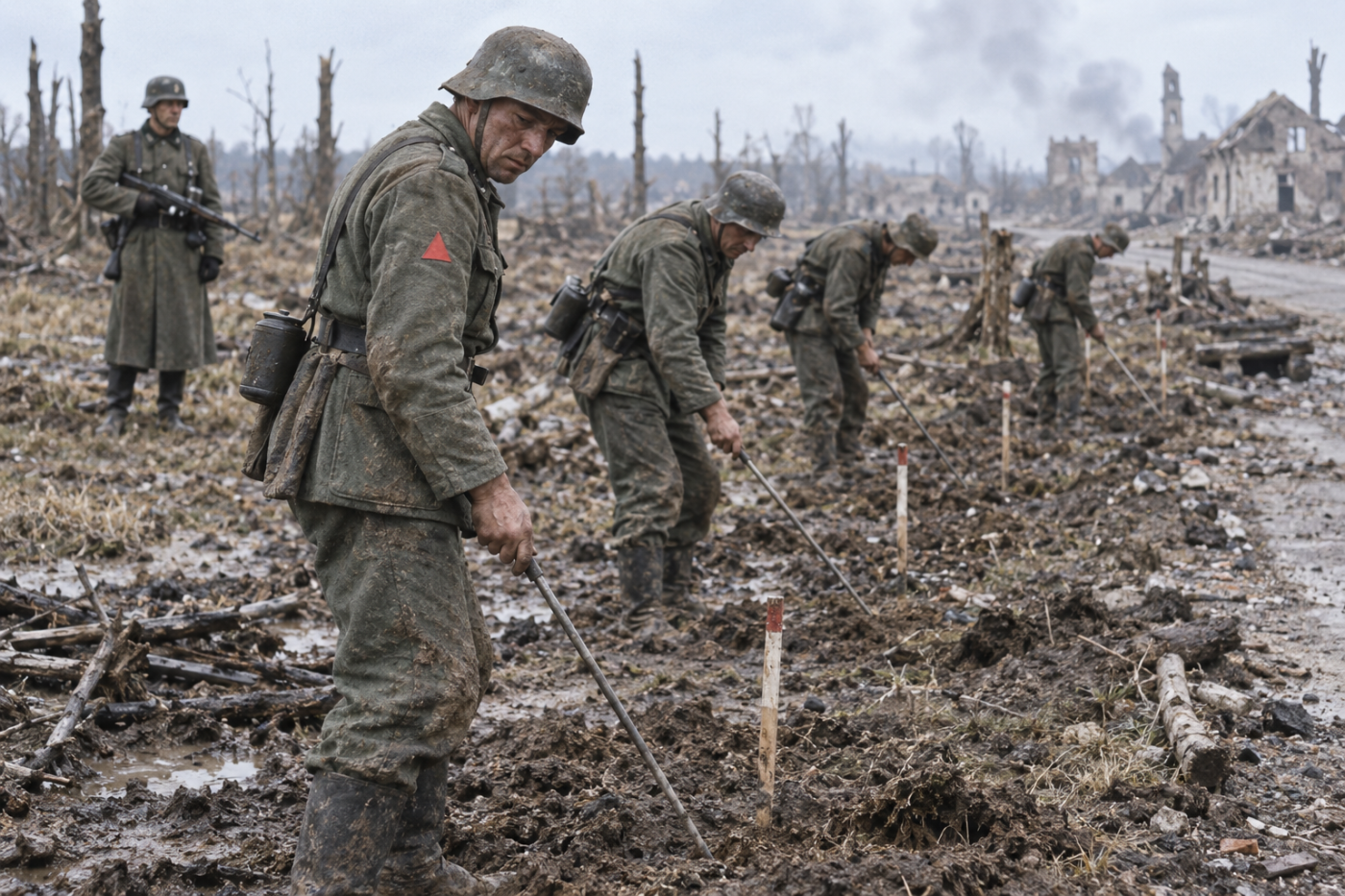
Red Triangle Soldiers
Among the most feared assignments in the German armed forces during the Second World War was service in a Strafbataillon, a punishment battalion whose men were sent into situations where survival was often considered less important than completing the task. These units contained convicted soldiers, deserters, persistent disciplinary offenders, men accused of avoiding conscription and civilians offered military service in place of imprisonment. They also included political opponents of the Nazi regime and men previously declared unworthy of serving in the armed forces.
The system expanded as the war continued and Germany’s need for manpower became increasingly desperate. A soldier could be transferred to a penal formation for desertion, cowardice, insubordination, theft, sleeping while on duty, striking a superior or repeatedly breaking military regulations. Some offences were serious, while others might appear comparatively minor but were treated harshly by a regime determined to maintain obedience through fear.
Not every man in these formations was an ordinary criminal. Many had been imprisoned because of their political beliefs, while others had refused to support the Nazi Party or had attempted to evade military service. The large Strafdivision 999, formed in October 1942, drew heavily upon men who had previously been classified as Wehrunwürdig, meaning unworthy of military service. This included convicted criminals but also communists, socialists, anti-Nazis and others considered politically unreliable.
Another part of the system consisted of probationary formations in which convicted soldiers were supposedly given an opportunity to redeem themselves through courage in battle. In theory, a man who proved himself could have his military honour restored and return to an ordinary unit. In practice, the route to redemption frequently involved repeated exposure to the most dangerous work on the battlefield, with no guarantee that good conduct would result in release.
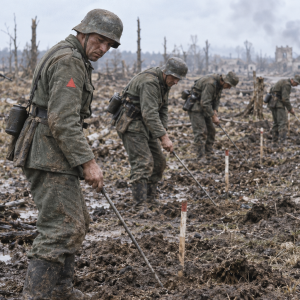
Penal soldiers generally wore standard German field-grey uniforms but could be deprived of rank badges, unit insignia and decorations. A plain red triangular patch was associated with their punished status and was worn on the upper sleeve. Contrary to a commonly repeated description, the military penal badge pointed upwards. The inverted, downward-pointing red triangle belonged primarily to the concentration-camp classification system, where it was used to mark political prisoners. The distinction is important because the two markings represented different systems of Nazi punishment and imprisonment.
Life inside a penal unit was governed by strict discipline and close supervision. The men were often watched by guards or military police, and refusal to obey an order could bring further imprisonment or a death sentence. Equipment, training and leadership varied greatly between formations, but penal troops frequently received fewer comforts and less consideration than ordinary soldiers. Leave could be restricted, correspondence monitored and any future promotion or recognition withheld until the authorities decided that a man had redeemed himself.
Mine clearance became one of the duties most closely associated with these formations. Retreating armies left roads, fields, bridges and approaches covered with anti-personnel and anti-tank mines. Before vehicles, artillery or infantry could advance, somebody had to open a safe route. Trained engineers normally carried out this work, but penal soldiers could be used when the task had to be completed quickly, under enemy observation or in areas still exposed to artillery, mortar or small-arms fire.
Working slowly along the ground, the men used probes to search for buried mines and carefully removed soil by hand. Tripwires had to be spotted before they were touched, while booby traps could be connected to apparently abandoned equipment, bodies, doorways or damaged vehicles. Once discovered, mines might be marked for engineers, disarmed where possible or destroyed with explosives. A single mistake could kill the man handling the device and anyone working beside him.
The work became even more dangerous when a cleared lane had to be opened during an attack. Penal troops might be ordered forward before the main assault to locate mines, cut wire and mark a path wide enough for infantry or vehicles. They could be forced to continue while shells fell around them and enemy machine-gunners covered the obstacle. The officers directing the operation understood that casualties were likely, but the lives of punished soldiers were often considered expendable.
Mine clearance was only one of many high-risk duties. Penal formations were employed on dangerous reconnaissance patrols, raids against defended positions, attacks across exposed ground and attempts to recover wounded men or damaged equipment from between the opposing lines. They carried ammunition forward under fire, dug positions in areas targeted by artillery, repaired roads and bridges, laid communication cables and constructed obstacles close to enemy positions.
Some were used as forward observers or placed in exposed strongpoints from which withdrawal was forbidden. Others were committed to desperate infantry attacks intended to identify enemy firing positions or draw fire before regular troops advanced. These operations have often been described as suicide missions. Although conditions differed between units and fronts, the possibility of suffering exceptionally heavy casualties was built into the way penal manpower was employed.
The experience of Strafdivision 999 also revealed a serious weakness in the Nazi system. By placing political opponents together, arming them and sending them beyond Germany’s borders, the regime created units containing men who had little desire to fight for Hitler. Some deserted when the opportunity arose, while others established contact with resistance organisations or surrendered to Allied forces. Members of the division serving in Greece and the Balkans were involved in anti-Nazi activity, although discovery could result in execution.
Penal soldiers were not automatically innocent victims simply because they had been punished by their own regime. Some had committed genuine crimes, and members of German military formations could still participate in brutality against civilians and prisoners. The system contained ordinary offenders, political prisoners, reluctant conscripts and experienced soldiers convicted of military offences. Their individual stories were far more complicated than the single red triangle suggested.
What united them was the fact that the German command regarded their lives as having a lower value. Their punishment was not simply imprisonment but enforced exposure to danger. Redemption was measured through obedience, suffering and survival, and many men were killed before they had any opportunity to regain their former status.