U-9 sinks British Ships
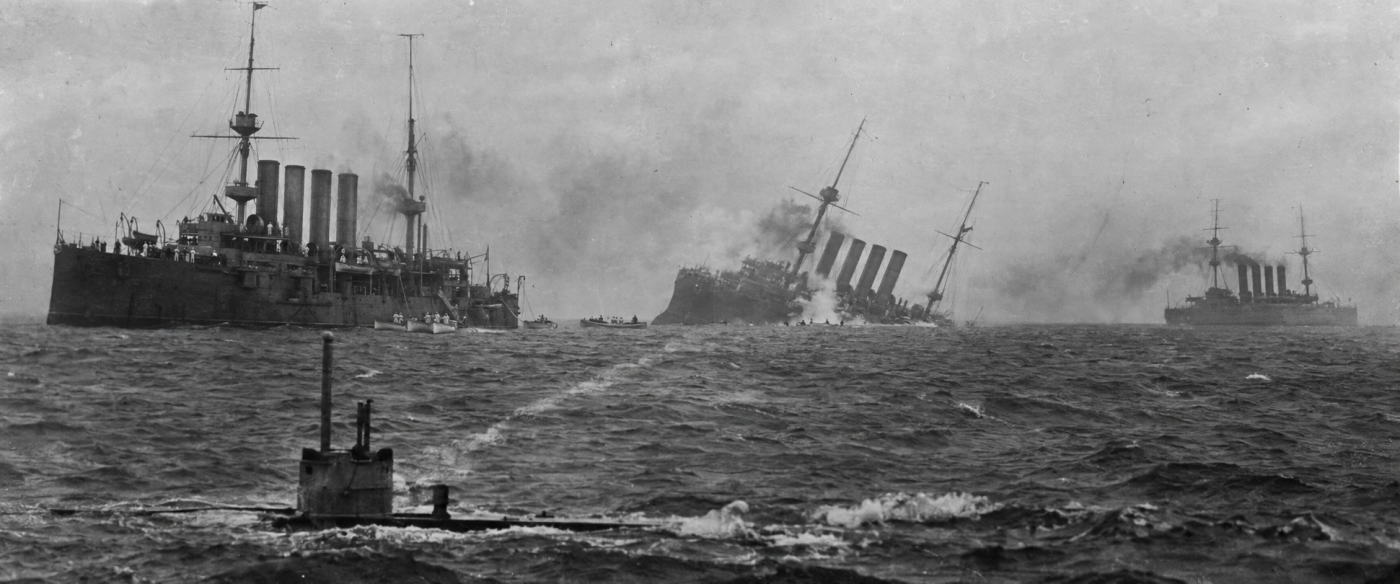
During the early hours of 22 September 1914, the German submarine U-9 carried out one of the most devastating naval attacks of the First World War, sinking the British armoured cruisers HMS Aboukir, HMS Hogue and HMS Cressy in little more than an hour. The disaster cost the lives of 1,459 British sailors and demonstrated with terrible clarity that the submarine had become a major weapon of modern naval warfare.
The three Cressy-class cruisers formed part of the Royal Navy’s 7th Cruiser Squadron and were patrolling the Broad Fourteens area of the southern North Sea. Already considered old and too slow for modern fleet operations, they were manned largely by reservists and had acquired the grim nickname the “Live Bait Squadron”. Normally accompanied by destroyers, the cruisers were alone that morning because heavy weather had forced their escorts to return to harbour.
Commanded by Kapitänleutnant Otto Weddigen, U-9 sighted the three British ships sailing steadily through calmer seas. At approximately 6.20 am, Weddigen fired a single torpedo at HMS Aboukir. It struck the cruiser’s starboard side, flooding her engine room and bringing the ship to an immediate halt. Captain John Drummond initially believed that Aboukir had struck a mine and signalled the other cruisers to approach and assist.
HMS Hogue and HMS Cressy stopped to rescue hundreds of men struggling in the water, unknowingly presenting U-9 with almost stationary targets. Aboukir capsized and sank approximately half an hour after being hit, with many of her boats trapped because the explosion had disabled the steam-powered equipment needed to lower them.
U-9 then moved closer and fired two torpedoes at HMS Hogue. As they were launched, the submarine’s bow briefly broke the surface and British gunners opened fire, but it was already too late. Both torpedoes struck Hogue, causing her to list heavily. The order to abandon ship was given within minutes, and the cruiser capsized and sank at approximately 7.15 am.
HMS Cressy attempted to locate and ram the submarine before turning back to rescue survivors. Weddigen manoeuvred U-9 into another firing position and launched two torpedoes from the submarine’s stern tubes. One missed, but the other struck Cressy on her starboard side. U-9 then turned and fired its final bow torpedo, which delivered another devastating hit. Cressy rolled over and remained floating upside down for a short time before disappearing beneath the sea at approximately 7.55 am.
The entire British squadron had been destroyed by one small submarine in around 75 minutes. Hundreds of sailors were left clinging to wreckage in cold, oil-covered water. The Dutch steamships Flora and Titan, British trawlers and later Royal Navy destroyers rescued approximately 837 men, but 62 officers and 1,397 ratings lost their lives.
U-9 escaped without suffering any casualties and returned to Germany, where Weddigen and his crew were celebrated as national heroes. The attack shocked Britain and damaged public confidence in the Royal Navy. It also forced the Admiralty to reconsider the practice of stopping large warships to rescue survivors while an enemy submarine might still be nearby.
The sinking of Aboukir, Hogue and Cressy marked the end of an era in which powerful surface warships were believed to be almost invulnerable to smaller vessels. In one terrible morning, U-9 proved that a submarine armed with torpedoes could destroy an entire squadron and kill more men than many major surface battles. The loss remains one of the greatest single disasters suffered by the Royal Navy during the First World War.