War Car
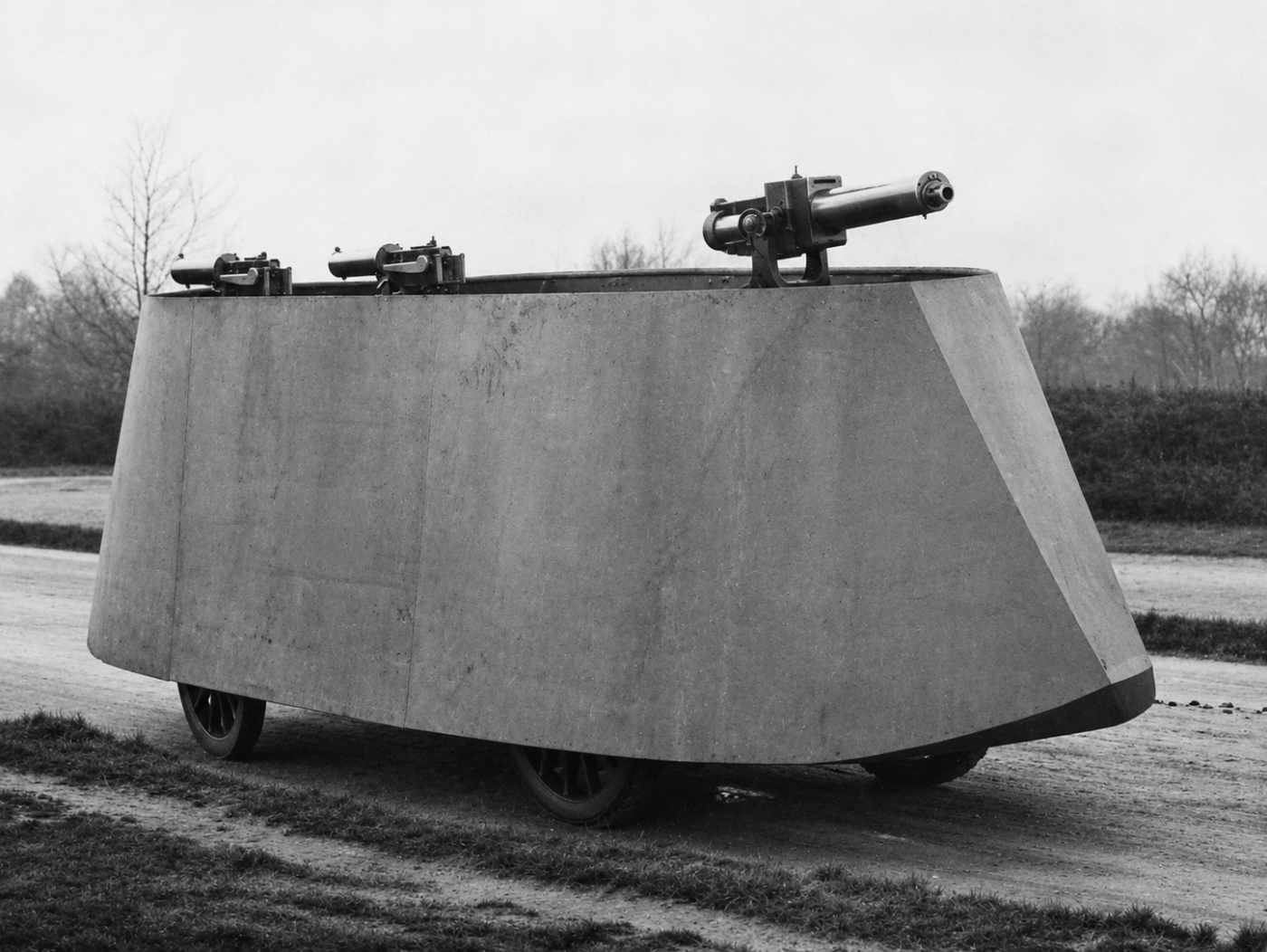
When Frederick Richard Simms unveiled his Motor War Car at London’s Crystal Palace in April 1902, it looked like a gunboat on wheels. Its steel sides curved into pointed ends, it carried machine guns and a small automatic cannon, and it weighed about five and a half tons. All of that sat on four wooden wheels with iron tyres. At a time when the motor car itself was still a novelty, Simms had built what is generally regarded as the world’s first armoured car.
Simms was a British engineer who helped found what became the Royal Automobile Club. In 1899 he demonstrated his Motor Scout, a small De Dion-Bouton quadricycle fitted with a Maxim machine gun and a shield at the front. The Scout showed how a motor could move a machine gun without horses. His next design went further by surrounding the crew with 6 mm of Vickers steel armour, though they still worked under an open sky.
Backed by Vickers, Sons & Maxim, the War Car was 28 feet long and had a ram at either end. At Crystal Palace it carried two Maxim machine guns and a one-pounder automatic cannon, known as a ‘pom-pom’ for the sound it made when firing. Four men were considered enough to operate the vehicle, with room on the platform for additional riflemen.
Under all that steel was a four-cylinder Daimler engine developing just 16 horsepower. The gearbox gave it four speeds, with a quoted top gear speed of 9 mph. All four gears worked in reverse as well, so the driver could back away at the same speed without turning the 28-foot vehicle around. Even on ordinary roads, vibration shook the armour rivets loose during development. The builders solved the problem by mounting the armour on springs, allowing it to move a little independently of the chassis.
One of the uses put forward at the time was defending Britain’s coastal roads. On firm roads the car could move its guns and crew together behind steel protection, but its iron-tyred wheels and modest engine made it poorly suited to rough ground. Only one was built, and it never entered military service.
The machine’s most lasting idea was simple. A gun crew could move under its own power with armour around it and weapons ready to fire from the vehicle. A little over a decade later, armoured cars were scouting ahead and carrying firepower along the roads of the First World War. In 1902, the idea had already rolled into Crystal Palace on wooden wheels.