Avro 504 plane
Few aircraft played such a varied and influential role in the early history of aviation as the Avro 504. It went to war as a reconnaissance aircraft and bomber, took part in one of the earliest strategic air raids, served as a night fighter and became one of the most important training aircraft of the First World War. More than 10,000 examples and derivatives were eventually produced, with some estimates placing total worldwide production at around 11,000.
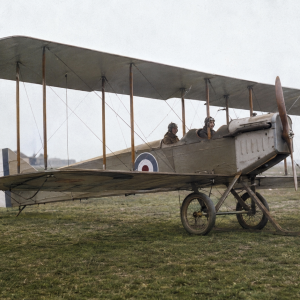
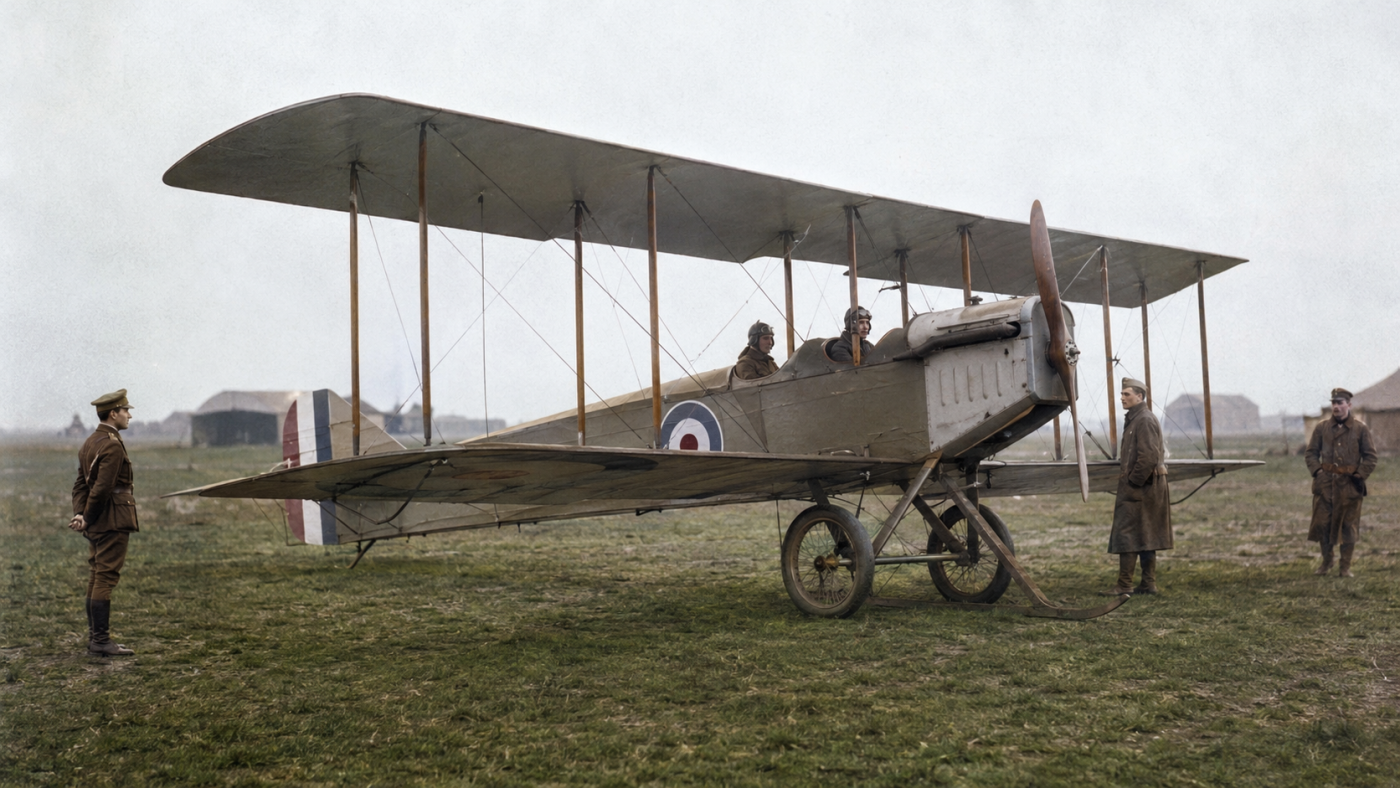
The aircraft was developed by A.V. Roe & Company, better known as Avro, founded by British aviation pioneer Alliott Verdon Roe and his brother Humphrey. The design evolved from the earlier Avro 500 and first flew at Brooklands on 18 September 1913, piloted by Freddie Raynham. It was a two-seat, two-bay biplane built mainly from wood and covered with fabric, with the pilot and passenger, observer or instructor sitting in separate open cockpits.
Early machines were powered by rotary engines such as the 80-horsepower Gnome, although many other engines were fitted during its long production life. A distinctive long skid projected forward between the main wheels, helping protect the propeller and preventing the aircraft from nosing over on rough grass airfields. Its relatively straightforward construction and predictable handling would later make it ideal for training.
When Britain entered the First World War in August 1914, military aviation was still in its infancy. Examples accompanied the British Expeditionary Force to France and were initially used for reconnaissance. On 22 August 1914 an aircraft of No. 5 Squadron Royal Flying Corps was shot down, killing Second Lieutenant Vincent Waterfall and Lieutenant Charles George Gordon Bayly. It is generally regarded as the first British aircraft lost to enemy action during the war.
One of the most dramatic episodes in its history came on 21 November 1914 when Royal Naval Air Service aircraft attacked the German Zeppelin works at Friedrichshafen on Lake Constance. Four machines had been allocated to the operation, with three reaching the target. They flew deep into hostile territory carrying small bombs and operating with primitive navigation equipment, unreliable engines and no radios. Bombs struck the Zeppelin complex and damaged important installations, including the hydrogen-producing plant. The raid became an early demonstration of aircraft being used to attack strategic targets far behind enemy lines.
Rapid advances in aviation soon made the type unsuitable for frontline combat, but instead of disappearing it found the role that would make it famous: pilot training. Thousands of British and Commonwealth airmen learned to fly in these machines. Pupils were taught take-offs, landings, climbing, turning, navigation and eventually more advanced manoeuvres from its open cockpits.
The 504J became an important trainer, while the 504K was produced in particularly large numbers. One of the K model's greatest advantages was its interchangeable engine mounting, allowing several different rotary engines, including Gnome, Le Rhône and Clerget types, to be fitted. During wartime shortages this was extremely useful because production did not depend upon the availability of one particular engine.
Demand became far greater than Avro could satisfy alone, so numerous British companies manufactured aircraft under contract. Production was spread across several factories and subcontractors, helping turn the design into one of the most numerous aircraft of the First World War. Foreign manufacture and later derivatives also appeared in countries including Canada, Japan and Russia.
Its wartime duties extended well beyond training. During 1918 a number of machines were converted into single-seat Home Defence fighters. These carried a Lewis machine gun above the upper wing and were used to defend Britain against German air attacks. Around 274 converted aircraft were issued to eight Home Defence squadrons, an unusual role for a machine better known for teaching pilots to fly.
The type therefore served as a reconnaissance aircraft, bomber, trainer, communications machine and fighter. Yet its greatest contribution was the enormous number of airmen who gained their first experience of powered flight in its cockpit. Many later went on to fly frontline fighters, bombers and reconnaissance aircraft.
After the Armistice in November 1918, large numbers of military aircraft became surplus and were sold cheaply into civilian ownership. Hundreds appeared on the British civil register and found new lives in flying schools, aerial displays, advertising and pleasure flying. For many members of the public during the 1920s, their first experience of flight came in the open cockpit of a former military biplane.
Operators travelled around Britain offering short pleasure flights from fields and temporary aerodromes. The aircraft also became popular with barnstormers and display pilots performing aerobatics and public demonstrations. In this way, a machine designed before the First World War helped make aviation familiar to ordinary people during the interwar years.
Development continued with the later 504N, introduced during the 1920s. This version used the Armstrong Siddeley Lynx radial engine and incorporated several structural improvements. Nearly 600 were built between 1925 and 1932, serving with RAF training schools and communication units. They were also exported to numerous countries including Belgium, Brazil, Chile, Denmark, Greece, Siam and South Africa.
The aircraft's international influence was considerable. Japan produced licence-built versions, while Soviet Russia developed its own derivative known as the U-1, sometimes nicknamed the "Little Avro". It became an important Soviet trainer during the 1920s and helped establish flying training programmes far beyond Britain.
Its service life was remarkably long. Although conceived before the First World War, improved examples continued operating well into the interwar period. RAF machines were largely replaced by the Avro Tutor in the early 1930s, but a handful of surviving civilian aircraft were impressed into military service again during the Second World War for duties including glider-towing experiments.
One particularly historic survivor, now with the Shuttleworth Collection, was built in 1918, later converted to 504N standard and eventually returned to military service in 1940. It was later used in the film Reach for the Sky before becoming part of the collection.
Performance varied depending on version and engine, but the 504K had a wingspan of about 36 feet and usually carried an engine producing between 80 and 110 horsepower. Maximum speed was around 90 to 95 mph. Speed, however, was never its greatest strength. Its real advantages were simplicity, versatility, forgiving handling and the ability to operate from basic grass airfields.
The aircraft appeared at exactly the right moment in aviation history. Britain entered the First World War with a relatively small air arm and emerged with the Royal Air Force, created as an independent service on 1 April 1918. Thousands of pilots had to be trained during those four years, and this dependable biplane became one of the machines that made that enormous expansion possible.
Numerous variants were developed, including the 504A, B, C, D, E, F, G, H, J, K and N. Some were built for specialised naval duties, others as trainers or combat aircraft, and float-equipped versions were also produced. This ability to adapt the same basic airframe to so many different roles was one of the principal reasons for its success.
Avro itself would later become one of the most famous names in British aviation, producing aircraft such as the Lancaster heavy bomber and the Vulcan. The modest wood-and-fabric trainer belonged to an earlier era, but it helped establish the company as a major aircraft manufacturer.
Today surviving examples are treasured museum exhibits and flying examples are extremely rare. Their fragile-looking wooden structures and fabric-covered wings may appear primitive beside later aircraft, but their historical importance is enormous.
The Avro 504 fought, bombed, observed, defended British skies and, above all, trained thousands of pilots. After the war it introduced civilians to flight and helped spread aviation around the world. From its first flight in 1913 through decades of military and civilian use, it became one of the true workhorses of early aviation and one of the most important British aircraft of its generation.