On this day in military history…
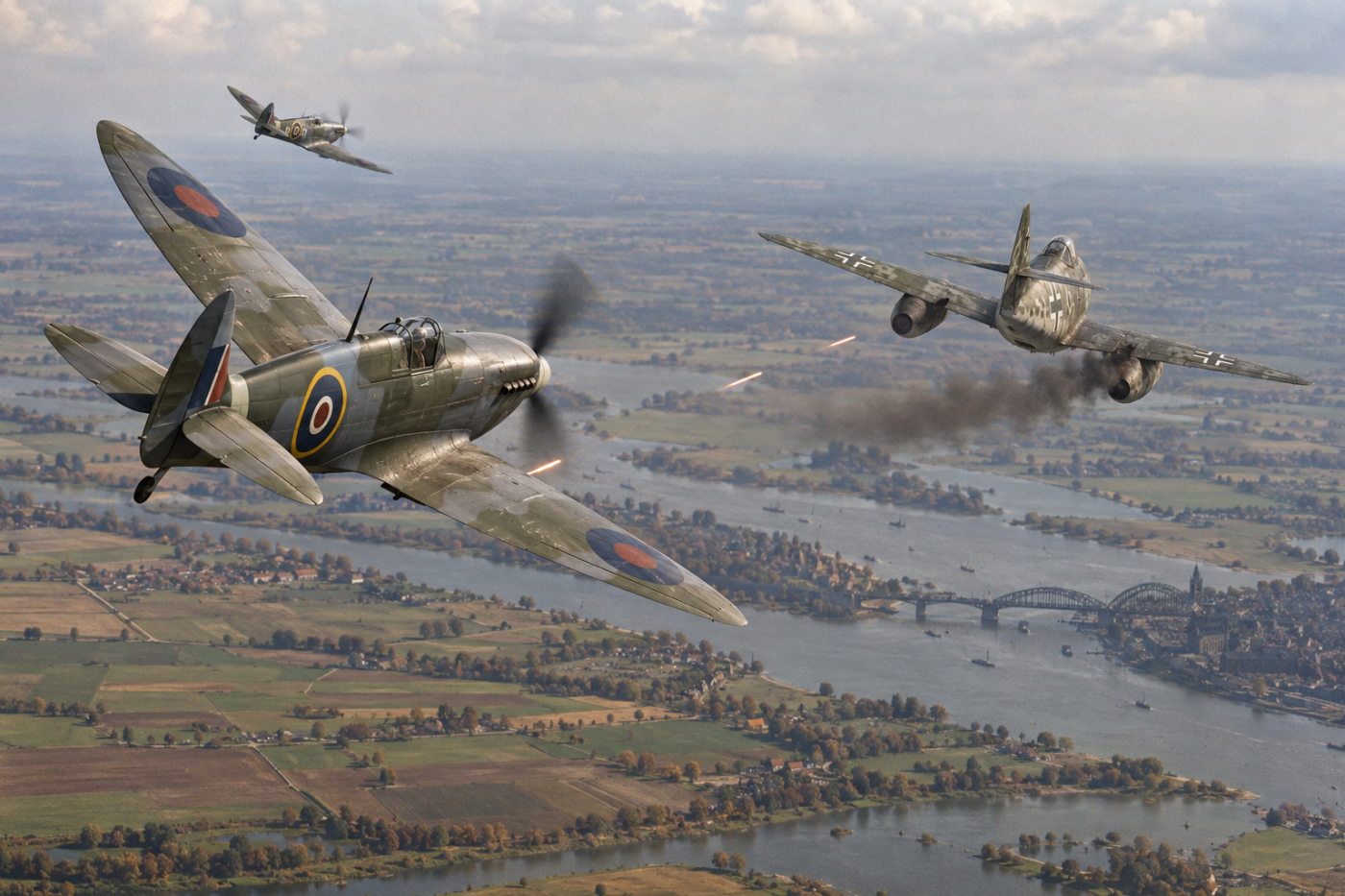
On 5 October 1944, Canadian Spitfire pilots patrolling over the Netherlands brought down one of Germany’s most advanced aircraft, a Messerschmitt Me 262. The encounter near Nijmegen became the first generally recognised destruction of an Me 262 by gunfire from Allied fighters. It was a remarkable achievement for men flying propeller-driven aircraft against a machine that represented the future of aerial warfare. The fighting took place in the aftermath of Operation Market Garden. Although the Allies had failed to secure the crossing at Arnhem, British troops and American paratroopers had captured the bridges at Nijmegen. These remained vital to the Allied position and faced repeated German attacks, with fighter patrols helping protect the troops, roads and river crossings below.
The Me 262 was a formidable new opponent. Known as the Schwalbe, or Swallow, it was the world’s first operational jet fighter, powered by two Junkers Jumo 004 turbojets mounted beneath its wings. Capable of approximately 540 mph, it had a substantial speed advantage over conventional Allied fighters. Germany also employed it as a fighter-bomber, bringing jet-powered attacks to the battlefield. On the afternoon of 5 October, twelve Spitfire Mk IXs from No. 401 Squadron, Royal Canadian Air Force, were patrolling the Arnhem–Nijmegen area under Squadron Leader Roderick “Rod” Smith. At approximately 14.45, they encountered an Me 262 approaching Nijmegen. The aircraft, serial number 170093, belonged to 3. Staffel of Kampfgeschwader 51 and was flown by Hauptmann Hans-Christoff Buttmann.
Smith later recalled that his formation had been circling at around 13,000 feet when their controller warned of an aircraft approaching from the north-east. He turned towards it and recognised the unfamiliar machine as an Me 262. With the sun behind the Canadians, he believed the German pilot had failed to see the Spitfires until he was almost among them. Knowing that the jet could pass through the formation within seconds, Smith swung to his right to turn in behind it. The interception developed into a fierce engagement. In his recollection, an early burst struck the port engine, producing a pale trail that he thought might have been escaping fuel. Buttmann descended sharply before climbing steeply again, losing speed as he rose. Smith followed and fired during the climb, while the jet’s changes in direction gave other Spitfires opportunities to bring their weapons to bear.
The German pilot continued to resist, with the contemporary operational summary recording that he returned fire several times without hitting the Canadians. Five pilots shared the victory: Squadron Leader Smith, Flight Lieutenants Davenport and Everard, and Flying Officers Mackay and Sinclair. Their combined attacks left the aircraft burning, and it crashed in Allied-held territory near Nijmegen. Buttmann attempted to escape, but his parachute failed to open and he was killed. The impact left a substantial crater in the wet ground. Royal Engineers prepared to pump water from the crash site so RAF specialists could examine the remains of the propulsion equipment, providing an opportunity to investigate German jet technology.
The distinction attached to the victory is important. American P-47 pilots had already forced Me 262s to crash during earlier encounters, so the Canadians were not the first Allied airmen to cause the loss of one in combat. Their achievement on 5 October was the first generally credited shoot-down by air-to-air gunfire. For No. 401 Squadron, it became a memorable chapter in the Spitfire’s wartime service. Above Nijmegen, an aircraft whose origins lay in the 1930s had successfully fought a new generation of warplane, demonstrating that judgement, positioning and accurate shooting still mattered against a faster opponent.