On this day in military history…
In the early hours of 14 October 1939, the battleship HMS Royal Oak was sunk at anchor in Scapa Flow, Orkney, after a German submarine penetrated the defences of Britain’s principal wartime naval anchorage. Just six weeks after Britain entered the Second World War, 835 sailors and Royal Marines lost their lives in an attack that stunned the country. Among the dead were 134 boy seamen under the age of eighteen, young lads whose naval careers had barely begun.
Launched at Devonport in 1914, Royal Oak was a Revenge-class battleship and a veteran of the Battle of Jutland. She had served through the First World War and the uncertain peace that followed, but by 1939 she was an ageing vessel in a rapidly changing navy. Although still part of the Home Fleet, she belonged to a generation of battleships built for engagements between heavily armed fleets. At Scapa Flow, surrounded by the islands of Orkney, her crew had every reason to believe they were sheltered from a submarine attack.
That confidence concealed serious weaknesses. Scapa Flow’s entrances were guarded by a combination of patrol vessels, nets, booms and blockships, old vessels deliberately sunk to obstruct the channels. However, the defences were incomplete, and gaps remained between the wrecks. Surveys before the war had identified navigable passages through the eastern approaches, including Kirk Sound. British officers had warned that a submarine might get through under favourable conditions, but improvements had not been completed when war began.
The German submarine commander Günther Prien was selected to exploit this vulnerability. During the night of 13–14 October, he brought U-47 through Kirk Sound on the surface, navigating between the blockships and entering the anchorage. Much of the Home Fleet was away, but Royal Oak remained, having returned early from a sortie. Prien located the battleship and manoeuvred into position to attack. A submarine had reached the heart of a base whose reputation for security had been established during the previous war.
Around one o’clock in the morning, a torpedo struck near the battleship’s bow. The explosion woke sleeping men, but its cause was not immediately understood. Some believed there had been an accident inside the ship, possibly involving inflammable stores. The possibility that an enemy submarine was operating within Scapa Flow seemed almost inconceivable. While officers investigated, Prien had time to prepare another attack. Churchill later told Parliament that even after the first torpedo struck, experienced officers had not recognised it for what it was.
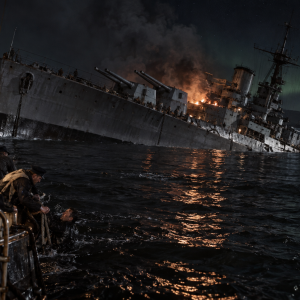
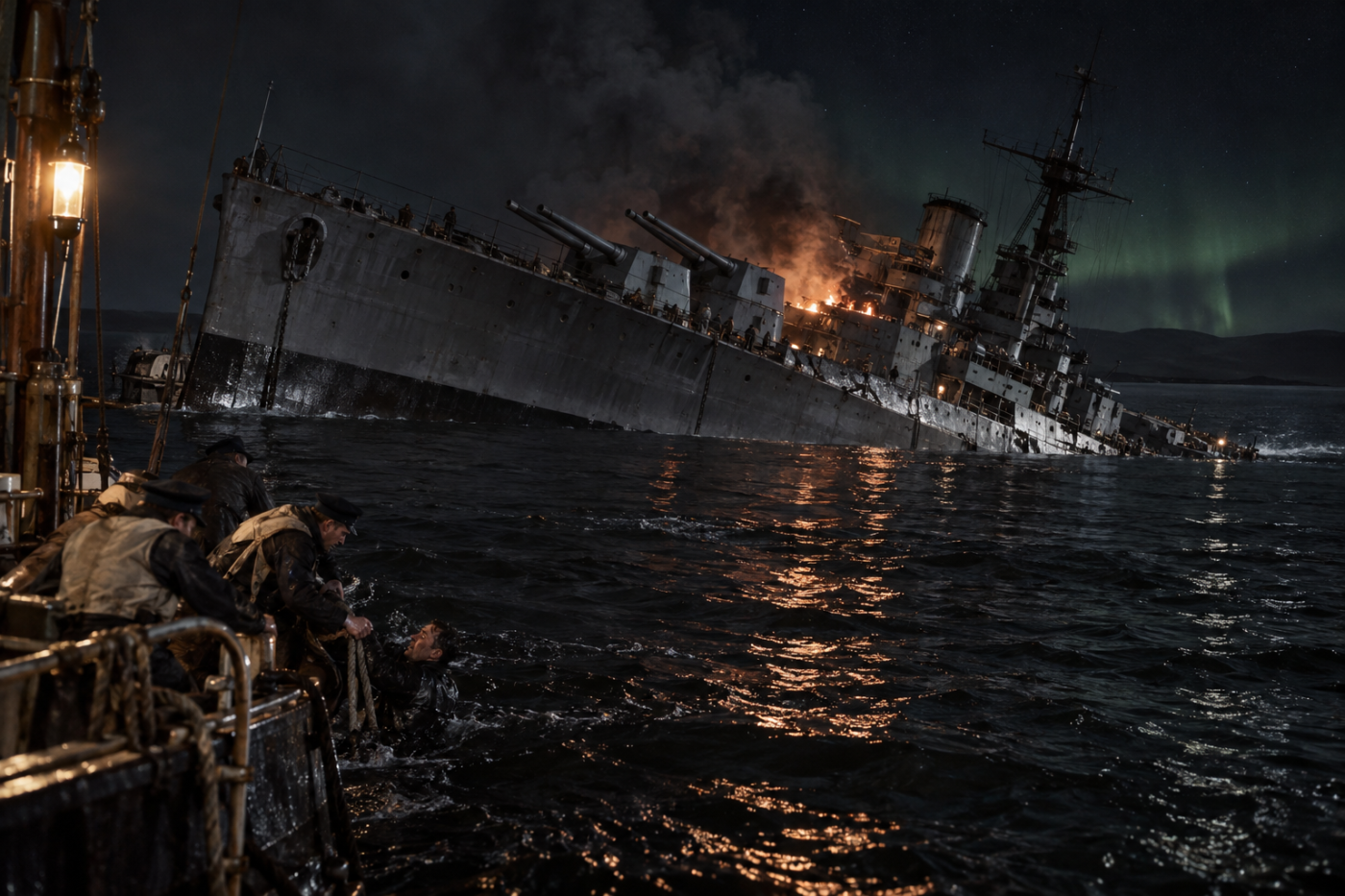
The subsequent torpedo hits were devastating. Explosions tore into Royal Oak’s starboard side, and she began to heel over as water poured into the damaged hull. For those below decks, familiar passageways became desperate escape routes. The increasing list made movement difficult, while the speed of the flooding left little time to reach safety. At approximately 1.29 am, the battleship rolled over and sank. Within minutes, a vessel that had survived the great naval battle of the First World War had disappeared beneath the waters of her own anchorage.
For those who escaped, the struggle continued in the cold, oil-covered sea. Men who had reached the upper deck entered the water with little opportunity to prepare themselves. Some were injured, others exhausted, and the darkness made it difficult to find boats or floating wreckage. Survivors faced the further danger of swallowing fuel oil as they tried to stay afloat. Many of their shipmates remained trapped inside the overturned hull.
Amid the disaster, the crew of the small tender Daisy II carried out an extraordinary rescue. Her skipper, John Gatt, brought aboard 386 survivors, including Royal Oak’s captain, William Benn. Pulling so many cold and oil-covered men onto a vessel only about 100 feet long was a remarkable achievement. Boats from HMS Pegasus also helped, while a few survivors managed to reach the shore. Gatt received the Distinguished Service Cross for his actions that night.
U-47 escaped, and the attack became a major German propaganda victory. For Britain, it exposed the consequences of placing too much trust in Scapa Flow’s existing protection. In his statement to the House of Commons, Churchill, then First Lord of the Admiralty, acknowledged that the physical defences and patrol arrangements had been inadequate. He also admitted that an undue degree of risk had been accepted both at the Admiralty and within the Fleet.
The disaster prompted lasting changes. Further blockships were sunk, and the eastern approaches were eventually sealed by the Churchill Barriers, substantial causeways linking the islands and preventing another submarine from following Prien’s route. These structures remain a visible reminder of the attack and the measures taken to protect the anchorage afterwards.
Royal Oak remains beneath Scapa Flow as a protected war grave. Royal Navy divers have traditionally replaced a White Ensign on the wreck, ensuring that the ship continues to fly the flag under which her crew served. Each anniversary remembers the men and boys who died, the survivors who carried the experience throughout their lives, and those whose courage brought hundreds safely out of the water. On 14 October 1939, the war reached into a supposedly secure harbour and left families across Britain mourning sons, husbands, fathers and brothers.