On this day in military history…
As daylight began to fade over the Palestinian desert on 31st October 1917, hundreds of Australian horsemen waited for the order to advance. Ahead lay the Ottoman trenches defending Beersheba, a town whose wells held the water desperately needed by the British Empire’s advancing army. With darkness approaching and the town still in enemy hands, commanders faced a difficult choice: withdraw their thirsty mounted troops or attempt a charge across open ground under enemy fire. Beersheba stood at the eastern end of the Ottoman defensive line stretching from Gaza on the Mediterranean coast. Two earlier attempts to break through at Gaza had failed at heavy cost, so General Sir Edmund Allenby, commanding the Egyptian Expeditionary Force, planned to strike inland, capture Beersheba and turn the enemy’s flank, opening the way towards Jerusalem.
The operation involved British infantry, Australian light horsemen and New Zealand mounted troops. British infantry attacked from the south-west while mounted formations moved around the town’s eastern approaches. Fighting continued throughout the day, with particularly stubborn resistance at Tel el Saba, a fortified hill overlooking the approaches. New Zealand troops, supported by Australian units and British artillery, finally secured this position during the afternoon, but precious daylight had been lost. Lieutenant General Sir Harry Chauvel, commanding the Desert Mounted Corps, needed to take Beersheba before his horses’ need for water forced a withdrawal. He ordered Brigadier William Grant’s 4th Light Horse Brigade to make a mounted attack, led by the 4th and 12th Australian Light Horse Regiments.
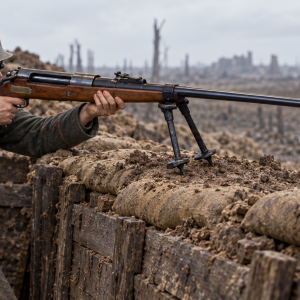
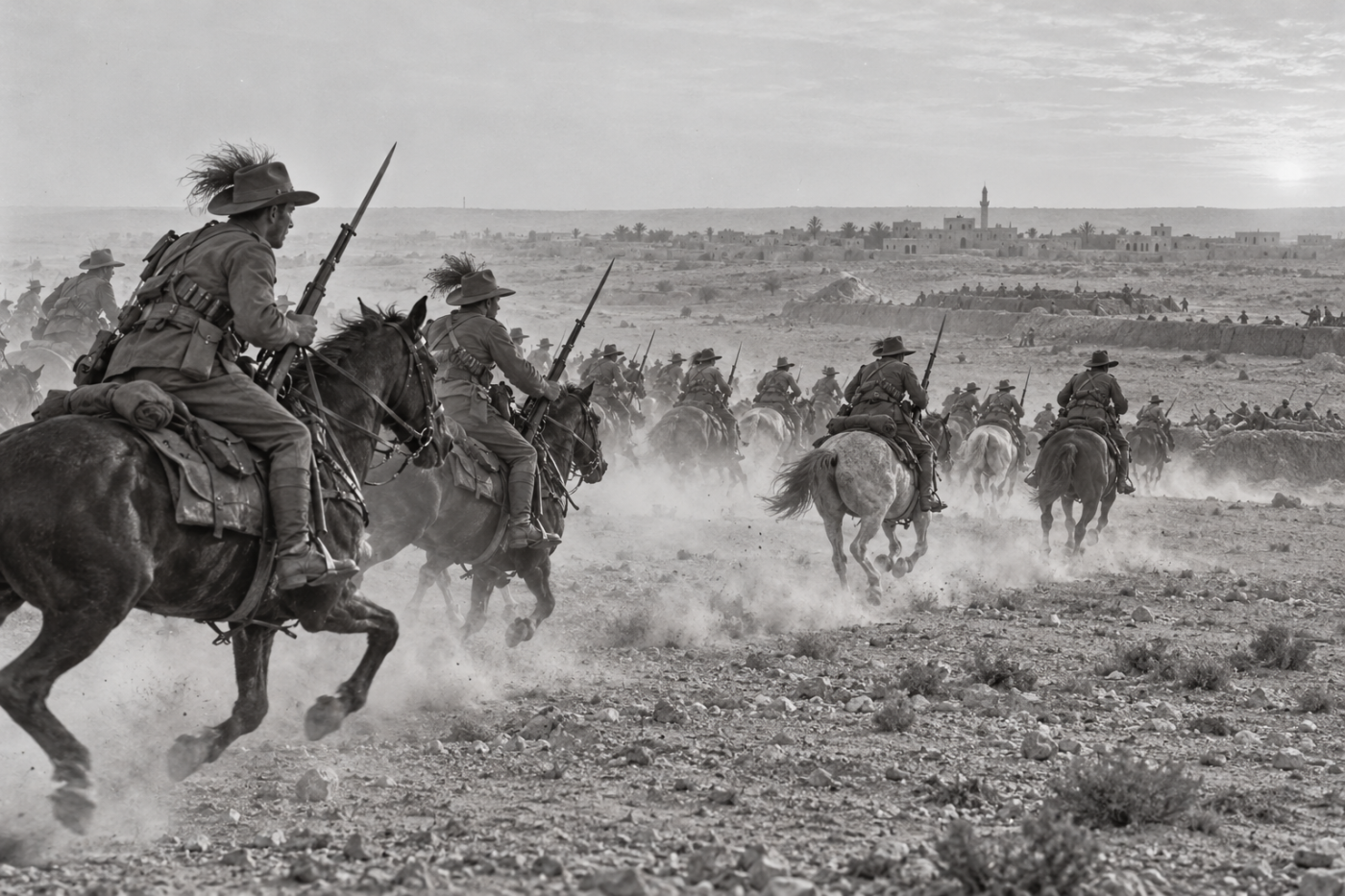
These men were mounted infantry, trained to ride into position and normally dismount to fight with their rifles. They did not carry the swords or lances of conventional cavalry, so many drew their long bayonets and held them in their hands. The Ottoman trenches on their line of advance lacked continuous barbed-wire protection, giving the horsemen a chance to reach them at speed. At about 4.30 pm, roughly 800 Australians began moving towards the town. Starting at a trot and gathering speed, successive lines of horsemen advanced across several miles of exposed ground. Ottoman artillery and machine guns opened fire, sending shells and bullets through the approaching ranks. Men and horses fell, but the charge continued, the distance closing too quickly for the defenders to stop it.
As the Australians reached the trenches, horses leapt across the earthworks. Some riders dismounted and fought the defenders with rifle and bayonet, while others pressed on towards Beersheba itself. The attack broke through the defensive positions, carrying the fighting into the town before the Ottoman garrison could organise an effective response. Securing the wells was crucial: without water, the victory would have been of limited use to an army dependent on thousands of horses. Although some demolition took place, enough of the water supply survived to sustain the mounted troops and allow operations to continue. More than 1,000 Ottoman prisoners were taken during the capture of Beersheba. The famous charge cost the two Australian regiments 31 men killed and 36 wounded, with many horses also lost.
The fall of Beersheba helped unravel the Ottoman defensive line. Gaza was abandoned during the following week, and Allenby’s forces advanced deeper into Palestine. Jerusalem surrendered in December, giving the Allies a significant victory after years of difficult campaigning in the Middle East. Beersheba is sometimes described as the last successful cavalry charge in history, but mounted charges occurred in later wars. Its real distinction needs no exaggeration. It was a daring attack by mounted infantry, delivered at a decisive moment after British, Australian and New Zealand troops had fought throughout the day to make it possible. For the men who rode towards the trenches that evening, the task was immediate and unforgiving: cross the open ground, break the enemy line and reach the water before darkness.