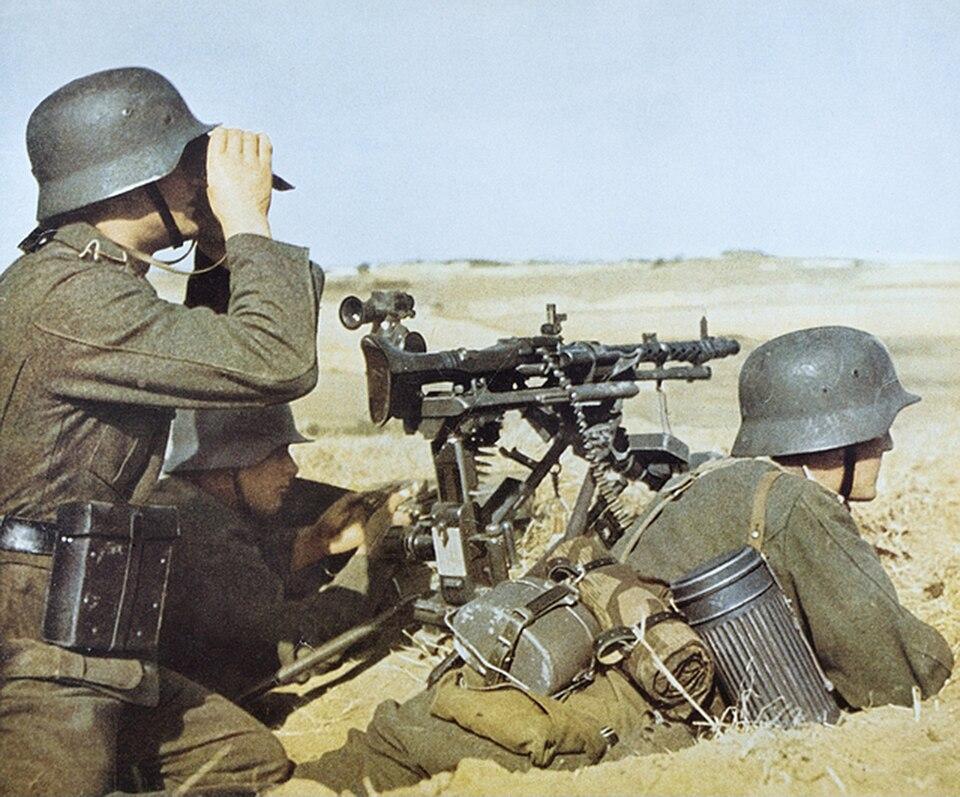
German Machine Guns 1914-1945
At the start of the First World War, machine guns were powerful but hard to move. A gun often needed several men, many boxes of bullets and a strong stand. By the end of the Second World War, German soldiers had machine guns that were easier to carry and could be used in many different places. The letters MG come from the German word Maschinengewehr, meaning machine gun. The story of these weapons is also a story about how soldiers fought from 1914 to 1945.
The MG 08 had been used by the German army since 1908. It was based on the Maxim machine gun and fired 7.92 mm bullets from long cloth belts, often with 250 rounds. It could fire around 450 rounds per minute. One of its greatest strengths was its ability to keep firing for long periods. Water around the barrel kept it cool, so a crew could fire for a long time. Its heavy stand also helped keep the gun steady and made it easier to aim accurately. But the gun, its heavy stand, the water and the ammunition were a large load. The gun itself weighed about 26.5 kg, while its stand weighed another 38.5 kg. With cooling water, the total was about 69 kg, without ammunition. This made it difficult to move. It worked best when soldiers could prepare a position before the fighting began.
In the trenches of the Western Front, German crews placed MG 08s where they could fire across open ground. They often worked together with barbed wire, which slowed down attacking soldiers. During the Battle of the Somme, which began on 1 July 1916, many German defenders survived the British artillery fire in deep shelters. When British soldiers advanced, they came under fire from German machine guns, rifles and artillery. The British suffered more than 57,000 casualties on the first day. Machine guns were not the only cause, but the battle showed how dangerous an attack over open ground could be. The MG 08 was much less useful when its crew had to carry it forward through mud and shell holes. Its great weight was its biggest weakness. If a crew had to retreat or change position quickly, moving the gun could be very difficult.
The MG 08/15 was an attempt to make the older gun easier to move. It was issued in large numbers from 1917. Like the MG 08, it used 7.92 mm ammunition and water cooling, with a similar firing rate of about 450 rounds per minute. It had a wooden shoulder stock and a bipod, a small two-legged support. It weighed about 18 kg without water and about 21 kg with water, making it much lighter than the MG 08. A drum on the side held a 100-round belt. Soldiers could take it closer to the front of an attack, set it on the ground and fire while other men moved ahead. Its main strength was that infantry could bring machine-gun fire forward without needing the large stand of the MG 08. Water cooling also helped during longer periods of firing. It was still too heavy to use easily while running, and the crew had to carry water and extra ammunition. The 100-round belt also needed replacing more often than the larger belts normally used with the MG 08.
After the First World War, the Treaty of Versailles limited Germany's armed forces, but the German army still worked on new weapons. The MG 13 entered service in the early 1930s. It could fire roughly 550 rounds per minute. Its main advantages were that it was easier to carry than the older water-cooled guns and did not need cooling water. However, it was still quite heavy for a light machine gun. The MG 13 usually held only 25 rounds in a magazine, although a larger 75-round drum was available. The smaller magazine meant frequent stops to reload. At its full firing speed, a 25-round magazine would be empty in less than three seconds. This was a serious weakness during longer fights, because the gunner could not keep firing without stopping to change magazines. The MG 13 did not remain Germany's main light machine gun for long. When the better MG 34 arrived in the mid-1930s, the older weapon was gradually replaced. Many MG 13s were sold to other countries, including Portugal, which bought about
2,800 in 1938. The Portuguese army called it the Dreyse m/938 and continued using it for many years. Some MG 13s remained in German storage and were brought back into service during the Second World War, especially with units away from the front line.
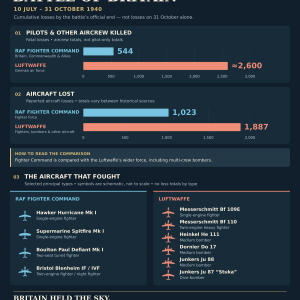
The MG 15 was made for a different job: defending aircraft. It was an air-cooled 7.92 mm gun with a double-drum magazine holding 75 rounds. It had a very high firing rate of about 1,000 rounds per minute. This was useful in air combat, because a gunner often had only a few seconds to hit an enemy aircraft. A gunner in a German bomber could move the gun by hand and aim at an enemy fighter approaching from the side, above or behind, depending on where the gun was fitted. During the Battle of Britain in 1940, aircraft such as the Heinkel He 111 used MG 15s for defence against British fighters. The gunner had only a short time to aim as a fast aircraft passed. He also had to change the drum after using his ammunition. At its highest firing speed, the 75 rounds could be used in less than five seconds. This was one of the gun's biggest weaknesses, because reloading during an air attack could leave the bomber unprotected. These guns could help protect a bomber, but they could not cover every direction at once. Later, when heavier aircraft guns became common, some MG 15s were fitted with stocks and bipods and given to soldiers on the ground. Although it was light and powerful, it was less suitable for long periods of ground fighting because changing an overheated barrel was difficult.
The MG 17 was also an air-cooled 7.92 mm aircraft gun, but it was fixed in place instead of being moved by a gunner. It used an ammunition belt rather than a drum. It could fire around 1,100 to 1,200 rounds per minute, although the rate was lower when the gun was timed to fire through a propeller. Early Messerschmitt Bf 109 fighters had MG 17s above the engine. The pilot had to point the whole aircraft at the target before firing. A special timing system allowed the guns to shoot between the turning propeller blades. During the Battle of Britain, Bf 109 pilots used these guns, often alongside larger cannon, in short attacks on British aircraft. One of the MG 17's strengths was its belt feeding, which allowed longer bursts without changing magazines. Its high firing rate also increased the chance of hitting a fast-moving target. As aircraft became better protected, the MG 17's small bullets were less useful, and heavier weapons took its place.
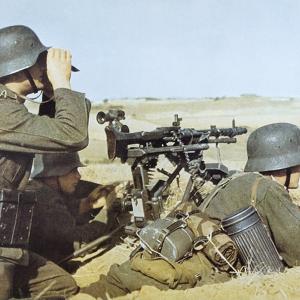
The MG 34 brought a major change to German infantry. Introduced in the 1930s, it was an air-cooled 7.92 mm gun fed by metal ammunition belts. It fired around 800 to 900 rounds per minute, almost twice as fast as the older MG 08. With its bipod, a small team could carry it forward with the rest of a squad. On a larger tripod, it could fire from a fixed position for longer periods. It was also fitted to many tanks and other vehicles. Its barrel could be changed when it became too hot. This made it a general-purpose machine gun: one basic design could do several jobs. Its greatest strength was this flexibility. Instead of needing different machine guns for different tasks, the army could use the MG 34 in several roles. Its belt feeding also made it better suited to longer fights than guns with small magazines.
In battle, the MG 34 was often the centre of a German infantry squad's firepower. The gunner fired while other soldiers carried ammunition, watched for danger and moved to new positions. In an attack, its fire helped riflemen cross open ground. In defence, the crew could cover a road, a gap or an approach to a position. It also had problems: Its many carefully made parts made it expensive to produce and more difficult to maintain in dirty conditions. The gun also used ammunition quickly, so the crew needed a steady supply of belts.
The MG 42 entered service in 1942. It was made to be faster and cheaper to produce than the MG 34. Many parts were pressed from sheets of steel instead of being carefully cut from solid metal. It fired the same 7.92 mm ammunition from metal belts. Like the MG 34, it could be used
on a bipod with infantry or on a tripod for longer support fire. Its most famous feature was its very fast rate of fire, usually around 1,200 rounds per minute, although some examples could fire even faster. This gave the MG 42 an important advantage: it could put a large number of bullets towards a target in a very short time.
The MG 42 was used on many fronts, including in Normandy after the Allied landings in June 1944. German crews could place it in a hidden position near a field, road or hedge, then fire short bursts when Allied soldiers moved into view. The purpose was not always to hit every soldier. Heavy fire could force attackers to take cover while German troops moved or prepared a defence. The gun was also useful in attacks, when one group fired and another moved. Its very high firing rate was also one of its weaknesses. It used ammunition extremely quickly, and its high firing rate could also make accurate firing more difficult during longer bursts.
By 1945, German machine guns were easier to move and could do more jobs than the heavy MG 08 of 1914. Even so, no machine gun worked on its own. Every model depended on a trained crew, a good position and a steady supply of ammunition. The MG 34 continued to serve alongside the MG 42, especially in vehicles, and the MG 42 later influenced the post-war MG 3. The biggest lesson from both world wars is simple: a powerful machine gun was useful only when soldiers could keep it working in the middle of a battle.
Author: Tom Dankers, Historian - Arnhems Oorlogsmuseum 40-45
Photo: Collection Database of the Australian War Memorial under the ID Number: 044591