on this day in military history…
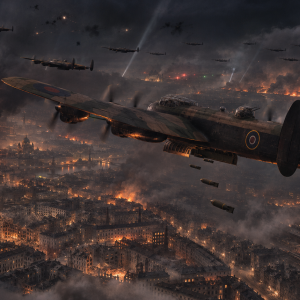
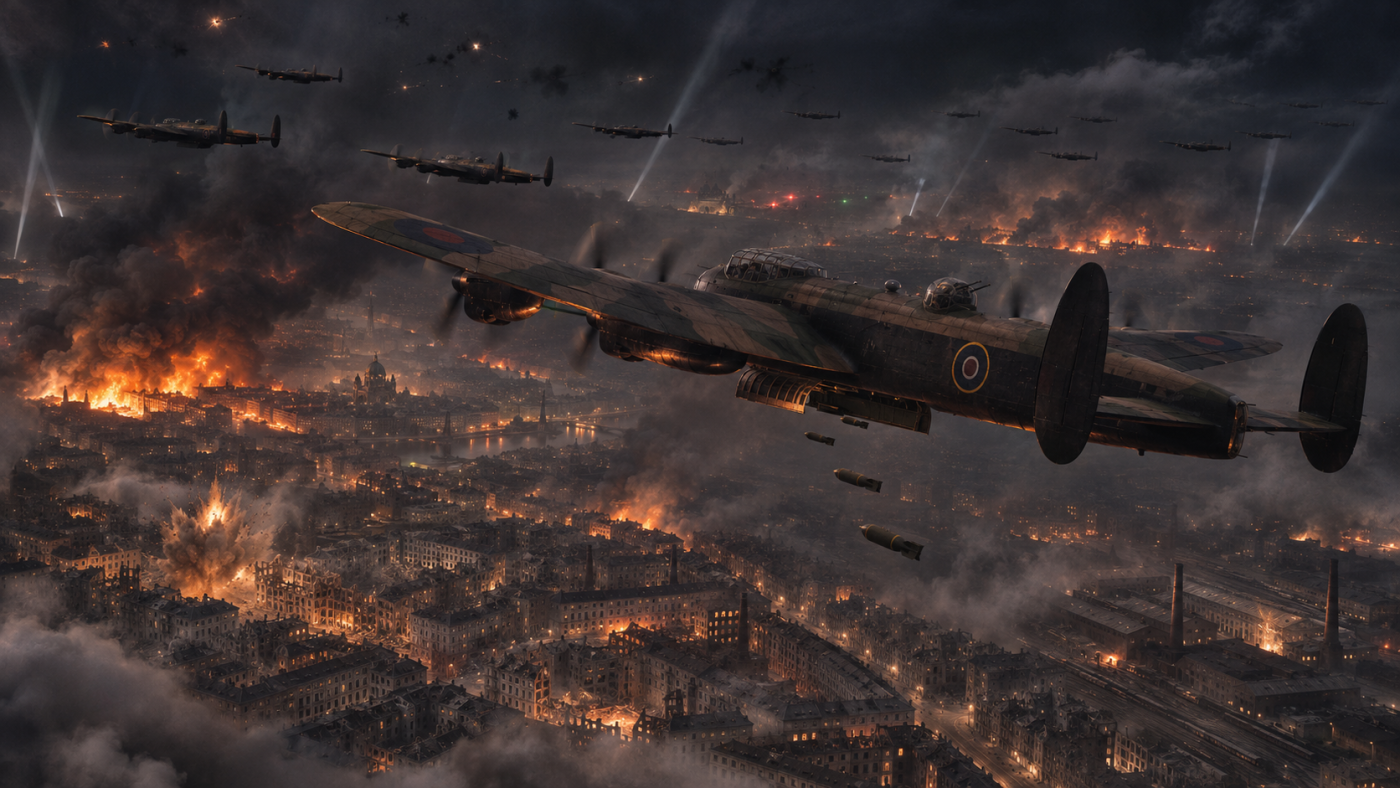
On the night of 18 November 1943, hundreds of RAF bombers headed east towards the German capital. Their departure marked the beginning of the sustained winter offensive remembered as the Battle of Berlin. Over the following four months, Bomber Command would attempt to strike at the heart of Nazi Germany, confronting formidable defences, difficult navigation and some of the most dangerous weather of the war.
Berlin had been bombed before, but this campaign carried greater ambitions. Air Chief Marshal Sir Arthur Harris believed that repeated attacks on the capital and other major cities could inflict damage sufficient to undermine Germany’s ability and determination to continue fighting. What followed became a severe test of that belief—and of the men ordered to carry it out.
Berlin mattered for more than its association with Hitler. It was a centre of government, communications, transport and war industry. Disrupting its factories, railway connections and administration could affect the wider German war effort. Attacking the capital also had an unmistakable psychological purpose: the Nazi leadership could no longer claim that the heart of its empire was beyond Britain’s reach.
The opening attack on 18–19 November involved 440 Lancasters and four Mosquitoes. Berlin lay beneath cloud, forcing the attackers to rely on instruments and target-marking methods rather than a clear view of the streets below. Nine Lancasters failed to return. The relatively low loss rate on this first operation offered little warning of how costly the campaign would become.
That same night, another 395 bombers were sent against Mannheim and Ludwigshafen. This substantial diversion was intended to complicate the German defensive response, but it became a deadly operation in its own right. Twenty-three aircraft were lost from that force. Across all Bomber Command operations that night, 32 aircraft were lost—a reminder that the opening of the Battle of Berlin involved far more than the aircraft sent to the capital.
For the men inside the bombers, the campaign was experienced through individual operations. A Lancaster normally carried seven: pilot, flight engineer, navigator, bomb aimer, wireless operator, mid-upper gunner and rear gunner. Each depended on the others. Navigation errors could take an aircraft away from the protection offered by the concentration of the bomber stream, while a gunner’s warning might give the pilot the few seconds needed to evade a fighter.
Many crews were young, yet their responsibilities were immense. The navigator worked to keep the aircraft on its planned route; the engineer monitored engines and fuel; the wireless operator handled communications; and the gunners searched the darkness. Over the target, the pilot and bomb aimer had to complete the bombing run while the aircraft remained exposed to the defences.
Winter offered the long hours of darkness needed to reach Berlin and return, but it also brought cloud, icing and fog. Darkness concealed aircraft from some observers while depriving their crews of visual landmarks. A flight could become a struggle against the weather long before the bombers reached the enemy’s guns.
Berlin also exposed the limits of Britain’s navigation equipment. It lay beyond the useful reach of the Oboe target-marking system operating from Britain. Gee could be disrupted by German jamming, while the broad outline of the city was difficult to identify precisely on H2S radar. The Pathfinders faced the demanding task of placing markers accurately enough for the following aircraft to concentrate their bombing.
The Germans, meanwhile, had developed a powerful night-defence system. Radar, controllers, searchlights, anti-aircraft batteries and night fighters combined to threaten the incoming bombers. Some fighters carried upward-firing cannon known as Schräge Musik. By positioning beneath a bomber, a fighter could attack from a blind spot, firing into the wings and fuel tanks before the bomber’s crew realised that an enemy aircraft was there.
These encounters could be terrifyingly one-sided. A bomber’s defensive guns offered little protection against an attacker its gunners could not see. The darkness that helped Bomber Command penetrate Germany also concealed the aircraft hunting it.
The offensive intensified almost immediately. On 22–23 November, 764 aircraft were dispatched against Berlin, with 26 reported missing. Further attacks followed on 23–24 and 26–27 November. The campaign settled into a punishing rhythm: prepare, fly, return if possible, and prepare again. For squadrons, the loss of experienced crews meant losing knowledge and judgement that could not be replaced simply by delivering another aircraft.
The Pathfinders suffered particularly heavily. Their duties placed them at the front of the attack, and the campaign claimed skilled crews and senior officers whose experience was exceptionally valuable. Replacing them required more than training men to operate a bomber; it required developing the confidence and precision needed to find and mark a defended city at night.
Even reaching England did not guarantee survival. On 16–17 December 1943, returning bombers encountered thick fog over their airfields. After surviving the journey to Germany and back, crews faced dwindling fuel and the difficulty of finding somewhere to land. Aircraft were lost in crashes on home soil. The night became remembered as Black Thursday, one of the clearest examples of how British winter weather could prove as deadly as enemy action.
Below the bombers, Berlin’s inhabitants endured repeated air-raid warnings, explosions, fires and the destruction of homes. Although the campaign sought to disrupt the German war machine, area bombing spread devastation through residential districts. Civilians, including people with no control over Nazi policy, paid a terrible price. The courage of the aircrews and the suffering of those beneath them belong in the same account.
Sixteen major RAF attacks on Berlin are generally counted in the campaign beginning in November 1943. The last took place on 24–25 March 1944. The broader winter offensive also included attacks on other German cities, so figures for its total aircraft losses must not be confused with losses on Berlin raids alone.
The campaign caused extensive damage, but it did not achieve Harris’s hope of forcing Germany out of the war. The Nazi regime remained in power, resistance continued, and the demands of the approaching Normandy invasion increasingly shaped Allied air operations. Bomber Command’s effort would be redirected towards preparations for the land campaign.
The Battle of Berlin remains a difficult chapter in the history of air power. It demonstrated the reach of Bomber Command and the endurance of its crews, while revealing the limits of what sustained attacks on a capital could accomplish. For those who flew it, the battle meant repeated journeys into darkness, cold and danger. For those waiting on the ground, in Britain and Germany alike, it meant another night of uncertainty—and the possibility that morning would bring news of someone who would never return.