Jewish SIG Unit
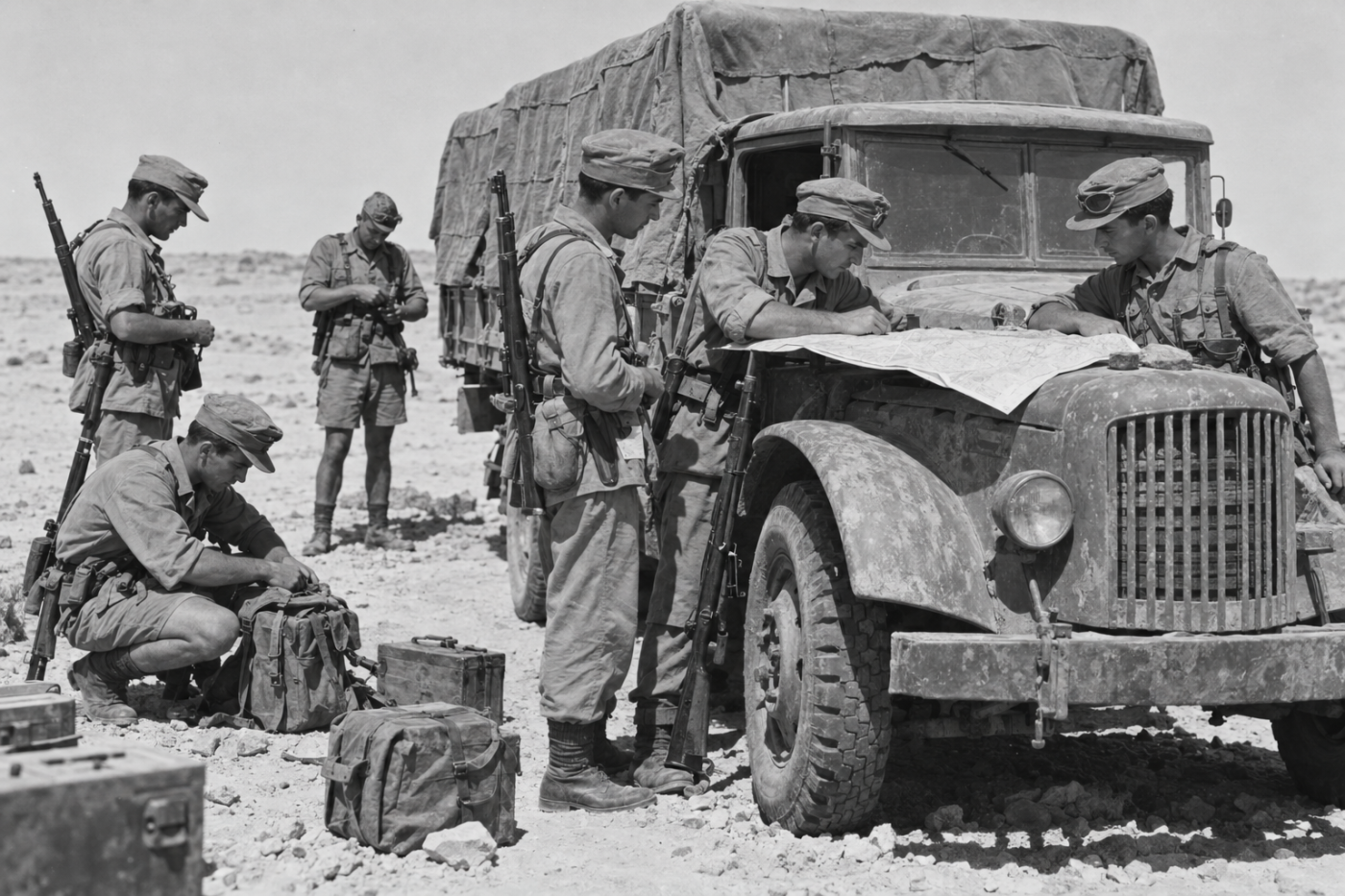
In the deserts of North Africa during the Second World War, a small group of Jewish volunteers undertook one of the most dangerous assignments in the British Army. Wearing German uniforms, speaking the language of the enemy and travelling in captured vehicles, they slipped behind Axis lines to gather intelligence and help strike targets that conventional forces could not easily reach. Known as the Special Interrogation Group, or SIG, these men relied on their ability to convince German soldiers that they belonged among them. For volunteers whose communities and families faced Nazi persecution, the decision to serve carried an intensely personal meaning.
The idea came from Captain Herbert Cecil Buck, a British officer who spoke fluent German. After being captured in North Africa, he escaped and used German uniform during his journey back to Allied lines. The experience suggested that a carefully trained force could use the same deception offensively. By March 1942, recruitment was under way, drawing particularly on German-speaking Jewish veterans of the recently disbanded No. 51 Middle East Commando. Others came from different Allied formations. Most were living in British Mandatory Palestine, although their backgrounds stretched across Europe. Estimates of the group’s strength vary between about twenty and thirty-eight men, making it a force whose success depended heavily on each individual.
Buck directed the group’s preparation in Egypt. Surviving member Maurice “Tiffen” Tiefenbrunner recalled that its first training base was at Geneifa, near Suez, while other accounts place a training camp near Mersa Matruh on Egypt’s Mediterranean coast. The locations appear in different descriptions of the unit’s preparation and should not be treated as one camp. Instruction in German military practice was provided by Walter Essner and Herbert Brueckner, two German prisoners captured while serving with the Afrika Korps. Both had previously served in the French Foreign Legion and claimed to oppose Nazism. They taught the volunteers about German army routines, equipment and the language used by serving soldiers. Some Jewish recruits deeply distrusted them, but Buck considered their knowledge valuable and retained them.
Training demanded far more than fluency in German. The volunteers had to adopt the habits, military language and daily routines of Afrika Korps soldiers. Orders and instruction were given in German, and they learned army songs, slang and drill alongside desert navigation, unarmed combat, explosives and the handling of German weapons. Their isolation from other British troops helped them maintain the deception. Buck warned that discovery could bring torture and execution. These were Jewish soldiers preparing to place themselves within an army serving the regime that threatened their people, with little reason to expect mercy if their identities were exposed.
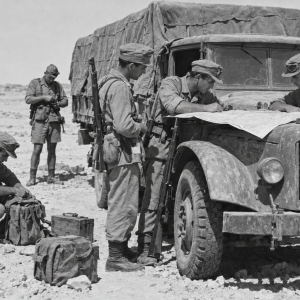
Their equipment supported carefully constructed false identities. Forged German paybooks, personal letters and photographs helped make their stories convincing, while captured uniforms, weapons and vehicles gave them the appearance of ordinary German troops. During early operations they posed as military police, stopped enemy transport and questioned its occupants. They also entered German camps and gathered information through conversation. Such work depended on nerve and judgement as much as military skill: an incorrect response, unfamiliar expression or suspicious document could undo months of preparation.
The decision to trust the German instructors had disastrous consequences during a joint mission with French SAS troops against the Libyan airfields at Derna and Martuba in June 1942. The deception involved German-uniformed guards escorting apparent prisoners of war through enemy territory. At Martuba, the raiders reportedly destroyed around twenty aircraft and escaped. At Derna, Brueckner stopped his vehicle, claimed mechanical trouble and went for assistance, returning with German soldiers. The very man who had helped prepare the volunteers to impersonate the enemy had betrayed the raiding party.
The exposed raiders fought back, but the Derna party was overwhelmed. Lieutenant Augustin Jordan escaped wounded; most of his comrades were killed or captured. Accounts differ over the precise final moments of the Jewish operatives Peter Haas and Eliyahu Gottlieb, including reports of resistance to the last and execution after capture. Their fate revealed the terrible vulnerability of the operation. Essner, who accompanied the successful Martuba party, was subsequently placed in British custody; accounts describe his later death as a shooting during an attempted escape.
Despite the betrayal, SIG personnel took part in Operation Agreement, the ambitious attack on Tobruk on the night of 13–14 September 1942. Once again, men in German uniform helped a land force penetrate enemy defences by posing as guards escorting British prisoners. The wider plan combined an overland assault with landings from the sea, aiming to damage the Axis supply base. Although the infiltrating force reached its targets, the operation collapsed as the amphibious attacks failed. The British suffered several hundred men killed or captured and lost the cruiser HMS Coventry and the destroyers HMS Sikh and HMS Zulu. Survivors ashore faced capture or an exhausting escape across the desert.
The failure at Tobruk brought the SIG’s brief existence to an end, and its surviving personnel dispersed into other formations. Some continued their military careers after the war, including Karl Kahane, who helped establish Israel’s parachute forces, and Israel Carmi, who became a senior Israeli officer. Their desert unit remains a remarkable example of Jewish military resistance during the Second World War. Its volunteers turned their knowledge of German language and culture into weapons against Nazi Germany, accepting exceptional risks to take an active part in the fight. Their service deserves a place alongside the better-known stories of the commandos, the SAS and the Long Range Desert Group.