On this day in military history…
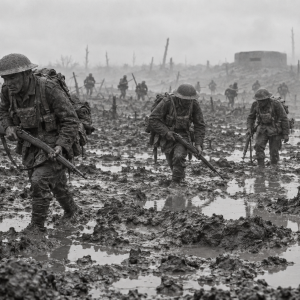
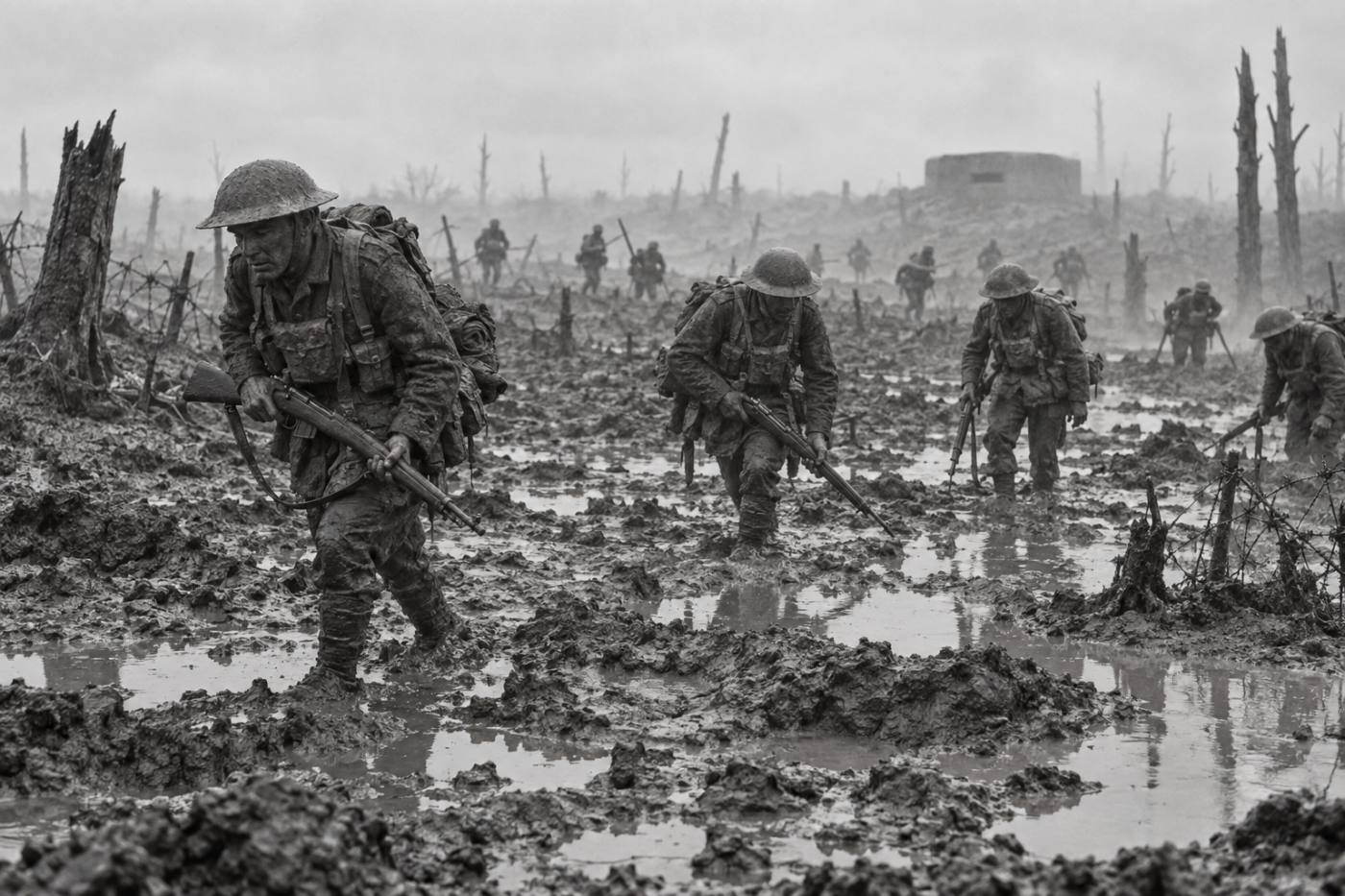
On 12 October 1917, British, Australian and New Zealand troops attacked towards Passchendaele in Belgium, fighting across a battlefield devastated by shellfire and relentless rain. Known as the First Battle of Passchendaele, the assault became one of the most tragic episodes of the First World War. Although the wider campaign, the Third Battle of Ypres, had begun on 31 July, this October attack brought the struggle for the village and its surrounding heights into particularly grim focus. Men advanced through deep mud against German positions that remained dangerously intact, suffering terrible losses for little lasting gain.
Earlier successes had encouraged hopes that the German defences were weakening. During September and early October, attacks at Menin Road, Polygon Wood and Broodseinde had pushed the front forward through carefully prepared advances supported by powerful artillery barrages. These victories came at considerable cost, but they demonstrated what could be achieved when infantry and guns worked closely together. Then the weather deteriorated. Rain filled shell craters, tracks became treacherous and the shattered countryside turned into a morass. In places, narrow duckboard paths offered the only practical route across ground that could scarcely support a man, let alone guns and ammunition wagons.
An attack on 9 October failed to secure the ground needed for the next advance, yet the assault planned for the 12th went ahead. Preparations were rushed, and the mud prevented artillery from being brought forward and properly positioned. Guns already in place struggled to remain stable, ammunition supplies were restricted, and German wire and concrete pillboxes had not been adequately destroyed. At 5.25 am, the New Zealand infantry began their advance towards Bellevue Spur. The supporting barrage proved insufficient to suppress the defenders, leaving the attackers exposed to machine-gun fire from ahead and from their flanks.
The 2nd New Zealand Infantry Brigade and 3rd New Zealand Rifle Brigade encountered obstacles that courage alone could not overcome. Uncut barbed wire blocked their path, while German machine guns swept the approaches. A few men forced their way through, only to be killed; others sought what protection they could find in shell holes. On their right, Australian troops also struggled forward under heavy fire. Some ground was captured, but the advance could not be sustained and much of it had to be relinquished. The defenders retained the positions from which they could break up further attacks.
For the wounded, the ordeal continued long after the assault had stalled. Men lay exposed in the mud, beyond the immediate reach of help, and some died before stretcher-bearers could get to them. Recovering casualties required exhausting journeys across the battlefield, with rescuers themselves struggling through the same appalling conditions. Extensive efforts continued over the following two days, assisted in places by an informal truce as German troops refrained from firing on stretcher parties. The New Zealand Division suffered approximately 2,700 casualties. Official records list 843 men as dying on 12 October, although the precise time of death of some men left between the lines could never be established. Others subsequently died of their wounds, making it New Zealand’s darkest day of the war.
Passchendaele remained beyond reach. Canadian troops later took over the principal assault and captured the ruined village on 6 November, following further costly attacks. The breakthrough once hoped for had never materialised. For those who fought on 12 October, the battle became a memory of mud, wire, machine-gun fire and comrades who could not be brought home. Its enduring significance lies in the courage of men who continued forward under almost impossible conditions, and in the terrible consequences of sending infantry against strong defences without the preparation and support they needed.
![[current-page:title]](/sites/default/files/styles/small_thumbnail/public/default_images/articles_0.jpg?itok=EFbOdIwg "[current-page:title]")