Cuban Missile Crisis
In the late summer of 1962, quiet stretches of Cuban countryside began changing into some of the most dangerous military installations on Earth. Roads were widened, launch positions prepared and long trailers manoeuvred into clearings among trees and farmland. Beneath the appearance of a growing military camp lay a secret that would shake the world: the Soviet Union was establishing nuclear missile bases within striking distance of major American cities.
Although these installations stood on Cuban soil and had Fidel Castro’s approval, they were principally Soviet projects. Soviet missile troops, engineers and specialists brought the weapons across the Atlantic, prepared the launch sites and would operate them. Cuba provided the territory and supported the deployment, but the nuclear missiles remained under Soviet control.
Castro had powerful reasons for accepting them. In April 1961, Cuban exiles backed by the United States had landed at the Bay of Pigs in a failed attempt to overthrow his government. Washington subsequently pursued Operation Mongoose, a secret campaign intended to undermine his regime. From Havana’s perspective, another invasion was a real possibility. Soviet nuclear weapons offered a deterrent that Cuba’s conventional armed forces could never provide.
For Soviet leader Nikita Khrushchev, protecting Cuba also offered an opportunity to alter the balance of the Cold War. The United States possessed a substantial strategic nuclear advantage and had stationed Jupiter missiles in Turkey, close to Soviet territory. Placing missiles in Cuba would bring American cities within reach of weapons that could be deployed far more quickly than an entirely new intercontinental missile force.
The deployment received the codename Operation Anadyr, a name associated with the Soviet far north rather than the Caribbean. The undertaking involved much more than a few missiles. Soviet planners proposed an entire military force, including missile regiments, fighter aircraft, anti-aircraft batteries, infantry, tanks, communications units and hospitals. Personnel were issued civilian clothing as part of the concealment effort. By the height of the confrontation, approximately 42,000 Soviet military personnel were in Cuba.
The scale of the engineering task appears in a secret Soviet planning memorandum dated 24 May 1962. For the proposed deployment, it listed 20 bulldozers, ten excavators, ten mobile graders and 120 dump trucks, alongside cranes and cement mixers. The material requirements included 2,000 tons of cement and 2,000 tons of metal. These were planning figures for the wider programme, rather than a record of everything actually used at San Cristóbal, but they reveal how substantial the operation was intended to become.
The installations did not all require enormous underground bunkers. The R-12 medium-range missile, known to NATO as the SS-4 Sandal, could be deployed at prepared surface positions using transporters, erector equipment and supporting vehicles. Soviet planners intended its crews to establish launch positions within about ten days of reaching their designated locations. Sites for the longer-range R-14, or SS-5 Skean, required more extensive construction, with the original plan allowing around four months.
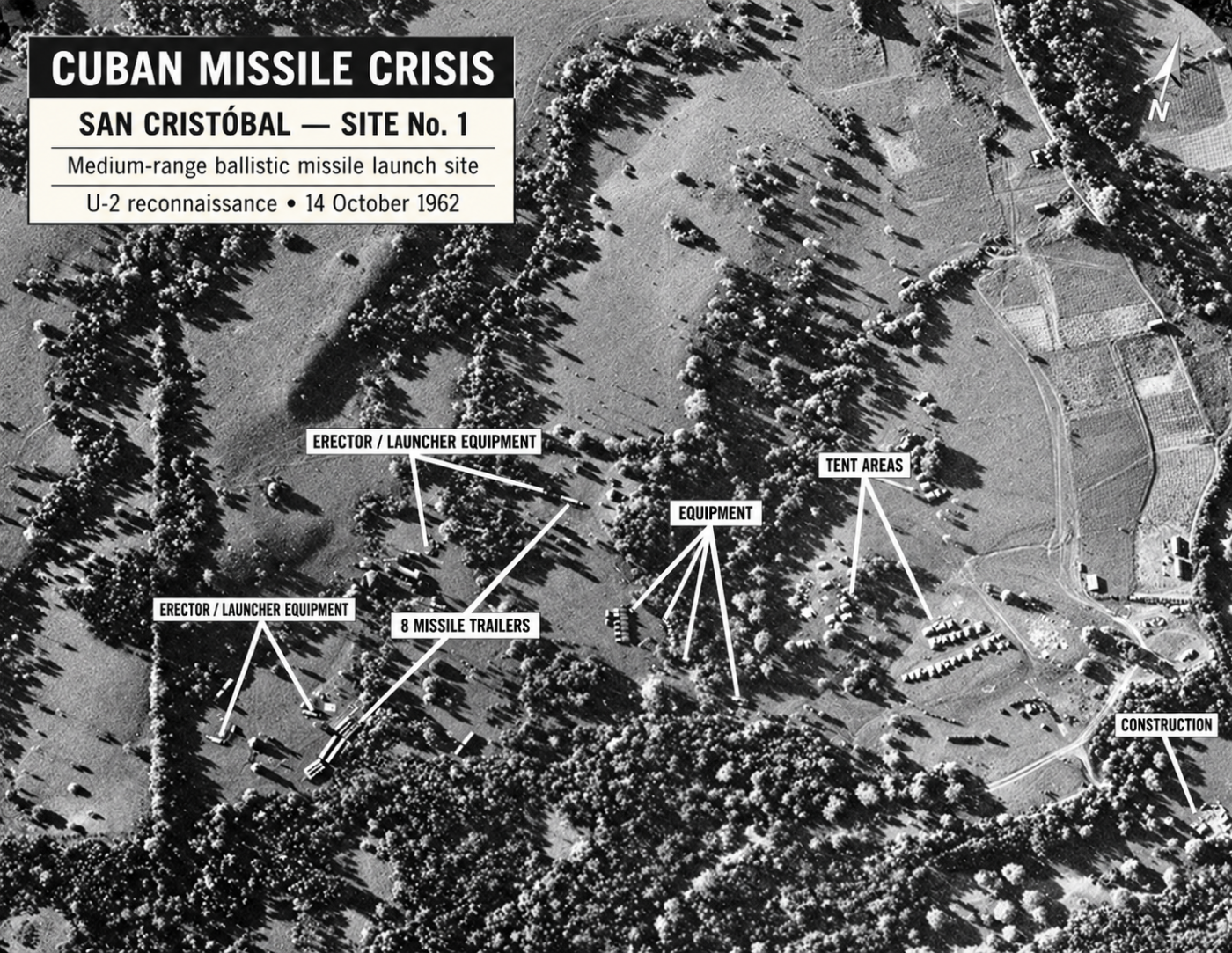
This difference mattered. A field launch site could become threatening while still looking unfinished from the air. Tent accommodation, rough tracks and equipment parked among trees did not mean that the installation was harmless. The crucial question was whether its launch crews and supporting systems could prepare the missiles for firing.
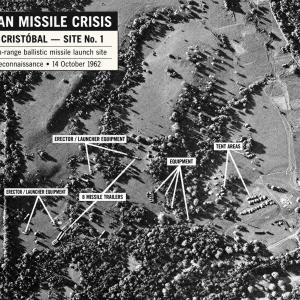
The reconnaissance photograph of San Cristóbal Site No. 1, taken on 14 October 1962, shows the practical shape of this deployment. Its annotations identify missile trailers, erector-launcher equipment, support equipment, tent areas and construction activity. To an ordinary observer, the scene might resemble a scattered military encampment. To trained photographic interpreters, the combination of vehicles, equipment and layout revealed a Soviet ballistic missile installation.
The trailers carried the missiles, while the erector equipment was used to raise them into their firing position. Other vehicles and facilities supported the demanding work of preparing and servicing the weapons. This was a complete military system being assembled in the countryside, with accommodation and construction activity forming part of the same installation.
The intended strategic force comprised 24 R-12 launchers and 16 R-14 launchers, with additional missiles available for reloading. The distinction between the plan and what actually arrived is important: the R-12 force reached Cuba, but the R-14 missiles did not. Equipment and construction materials for the longer-range weapons were already on the island, while the missiles themselves were turned back at sea. Even without them, the deployment represented a major nuclear threat.
Secrecy ultimately failed because the work left recognisable traces. On 14 October, Major Richard Heyser flew a U-2 reconnaissance aircraft over western Cuba. The photographs reached the National Photographic Interpretation Center the following morning, where analysts identified evidence of Soviet medium-range ballistic missiles. President John F. Kennedy was informed on 16 October, beginning the thirteen days most closely associated with the Cuban Missile Crisis.
Kennedy’s advisers considered air strikes and an invasion, but neither offered a reliable guarantee that every missile would be destroyed before it could be used. On 22 October, he publicly announced the discovery and ordered a naval “quarantine” intended to prevent further offensive weapons reaching Cuba. Meanwhile, reconnaissance photographs showed that construction continued. Reports described rapid work, camouflage being added and launch sites moving towards full operational readiness.
The danger extended beyond the strategic missile bases. Soviet forces had also brought tactical nuclear weapons to Cuba, intended for use against military targets and an invading force. American intelligence had not understood the full extent of this deployment. An invasion could therefore have encountered nuclear weapons on the battlefield, creating a route towards escalation that Washington had not fully anticipated.
On 27 October, the confrontation became still more dangerous when a Soviet surface-to-air missile shot down a U-2 over Cuba, killing Major Rudolf Anderson Jr. Kennedy resisted an immediate retaliatory strike while diplomatic exchanges continued. The following day, Khrushchev agreed to dismantle and remove the offensive missiles. The settlement included an American assurance against invading Cuba and a private understanding that US Jupiter missiles in Turkey would also be withdrawn.
The launch complexes were dismantled, their missiles shipped away and the naval quarantine eventually lifted on 20 November. What had begun as a secret attempt to defend Cuba and strengthen the Soviet position had instead produced a confrontation neither side could safely control. The photograph of San Cristóbal captures that danger at an extraordinary moment: a seemingly ordinary patch of countryside being transformed into a nuclear launch site, just before its discovery forced the world to confront what had been built there.