On this day in military history…
On 27 October 1961, American and Soviet tanks faced one another across a Berlin street, their guns trained towards opposing positions barely 100 yards away. For the soldiers inside them, the Cold War had become something immediate and dangerous. A dispute over access to East Berlin had brought the armies of two nuclear powers into direct confrontation, with neither side willing to appear to retreat.
Berlin’s unusual position lay at the heart of the crisis. Following Germany’s defeat in 1945, the city had been divided into American, British, French and Soviet occupation sectors, despite lying deep inside the Soviet occupation zone. The three Western sectors became West Berlin, while the Soviet sector became East Berlin. The Western powers maintained that their wartime victory and subsequent agreements gave them rights in the city which East Germany could not simply overturn.
The construction of the Berlin Wall, beginning on 13 August 1961, made this division brutally visible. Barbed wire and barriers cut through streets and neighbourhoods, separating families and closing an escape route used by East Germans heading west. At Friedrichstrasse, the crossing known to the Americans as Checkpoint Charlie became a particularly sensitive meeting point between the two systems.
The immediate dispute began on the evening of 22 October, when American diplomat E. Allan Lightner and his wife attempted to enter East Berlin to attend a performance. East German guards demanded identification. Lightner refused, following the American position that only Soviet representatives had authority to check the papers of Allied officials. What might have seemed a routine border inspection carried a much greater implication: accepting the demand could suggest recognition of East German authority over Allied access. Armed American military police eventually escorted him through the crossing.
Over the following days, similar encounters became a contest of resolve. American officials approached the crossing, East German guards challenged them, and armed escorts intervened. General Lucius D. Clay, President John F. Kennedy’s personal representative in Berlin and a prominent figure during the earlier Berlin Airlift, supported a firm response. American tanks moved forward to reinforce the escorts and demonstrate that access rights would be defended.
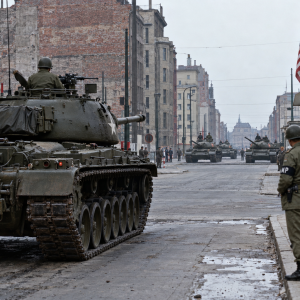
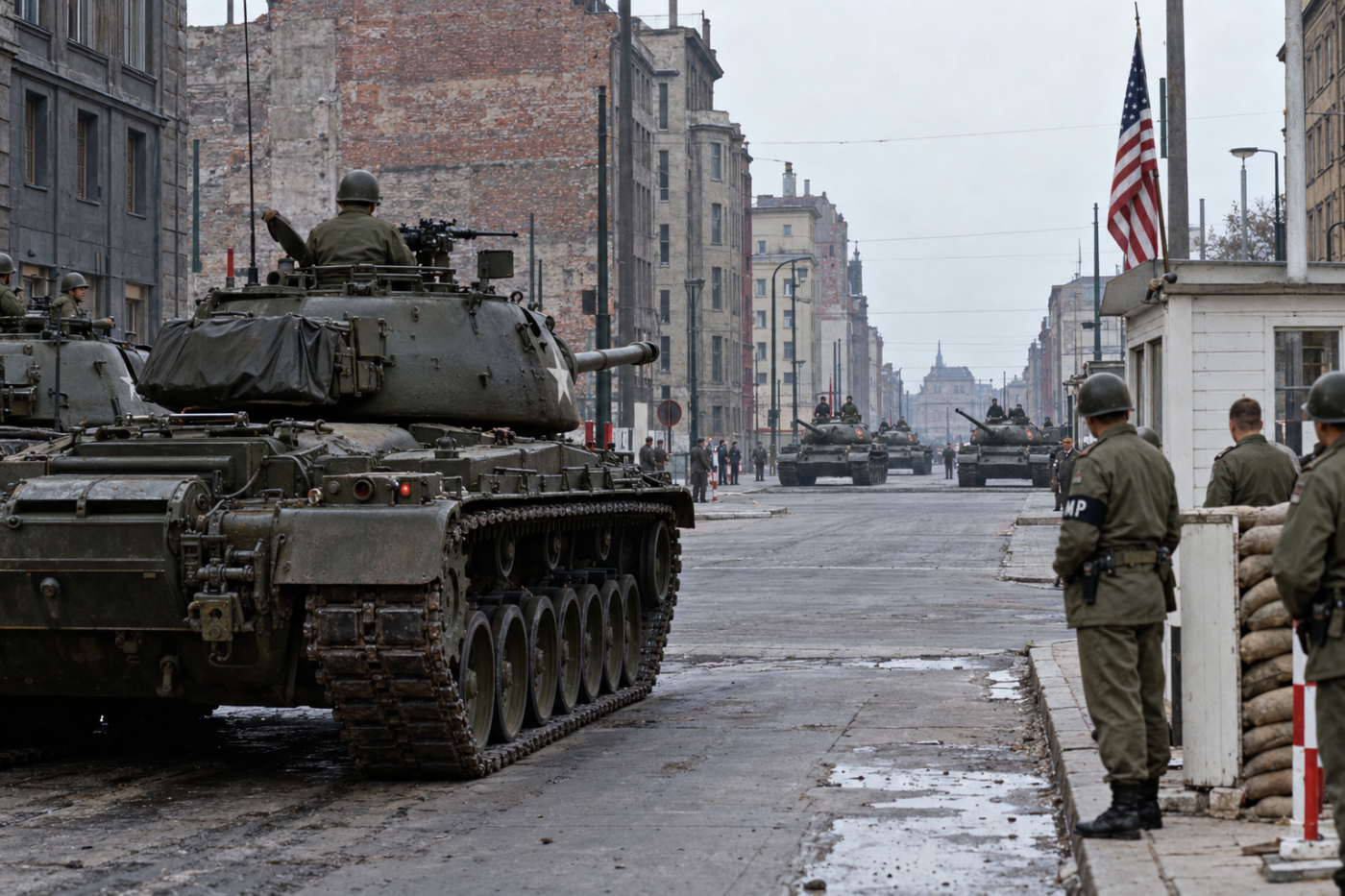
On 27 October, the confrontation escalated. Ten Soviet tanks advanced towards the eastern side of the crossing, and American armour returned to its positions opposite them. By early evening, the two forces faced each other along Friedrichstrasse. Journalists and spectators gathered nearby as photographs of the extraordinary scene began spreading around the world. A street crossing had become the setting for a confrontation between the superpowers.
The American force included M48A1 Patton tanks, substantial fighting vehicles whose presence transformed the small military police checkpoint into a potential battlefield. Across the narrow gap stood Soviet armour. Their deployment also exposed the larger issue behind the dispute: whatever authority East Germany claimed at the border, the Soviet Union remained the military power capable of confronting the Western Allies.
Through the night, neither side opened fire. The danger was nevertheless considerable. A misunderstood movement or an unauthorised shot could have started fighting in a city where American and Soviet prestige was already at stake. Political leaders had to find a way to end the confrontation while avoiding a public humiliation that might make compromise harder. Private contacts helped create room for withdrawal, although accounts differ over the precise exchanges and who initiated them.
On the morning of 28 October, after a stand-off lasting roughly sixteen hours, the Soviet tanks began pulling back. The Americans withdrew shortly afterwards. No battle followed, and no shots had been exchanged between the opposing tank forces. The immediate crisis was over, although the Wall and the division of Berlin remained.
Checkpoint Charlie became one of the defining images of the Cold War: opposing tanks, watchful soldiers and a narrow stretch of road between them. The confrontation demonstrated how a dispute over identity papers could develop into a military crisis when it touched questions of sovereignty, occupation rights and national credibility. On that October night, restraint mattered as much as firepower.