On this day in military history…
On 24 July 1944, United States Marines began the invasion of Tinian, a small island in the Mariana Islands that would become one of the most strategically important pieces of territory captured during the Pacific War. The battle itself lasted little more than a week, but the airfields subsequently constructed on the island would play a major role in the final defeat of Imperial Japan and would forever connect Tinian with the closing chapter of the Second World War.
Tinian lies only a few miles south-west of Saipan and had been under Japanese control since the end of the First World War. By 1944, the Mariana Islands had become a major objective in the American advance across the Central Pacific. Their capture would provide bases within range of the Japanese home islands for the new Boeing B-29 Superfortress heavy bomber, allowing the United States to conduct a sustained strategic bombing campaign directly against Japan.
The invasion formed part of Operation Forager, the wider American campaign to seize the Mariana Islands. Saipan had been invaded on 15 June 1944 and, after weeks of exceptionally bitter fighting, organised Japanese resistance there had largely been destroyed. Attention then turned towards neighbouring Tinian.
The Japanese defenders understood the island's importance and had prepared defensive positions across its roughly rectangular landscape. The garrison consisted of several thousand Japanese troops, including soldiers of the Imperial Japanese Army and naval personnel. Colonel Kiyochi Ogata commanded the principal Japanese army forces and prepared his men to resist the expected American assault.
American planners faced the problem of choosing where to land. The most obvious beaches were near Tinian Town in the south-west, where the coastline offered easier access for an amphibious assault. The Japanese had consequently concentrated much of their defensive strength in this area.
Instead, the Americans developed an ingenious deception plan. On the morning of 24 July, elements of the 2nd Marine Division staged a demonstration off the beaches near Tinian Town, supported by naval gunfire and other activity designed to convince the defenders that the main invasion was about to take place there.
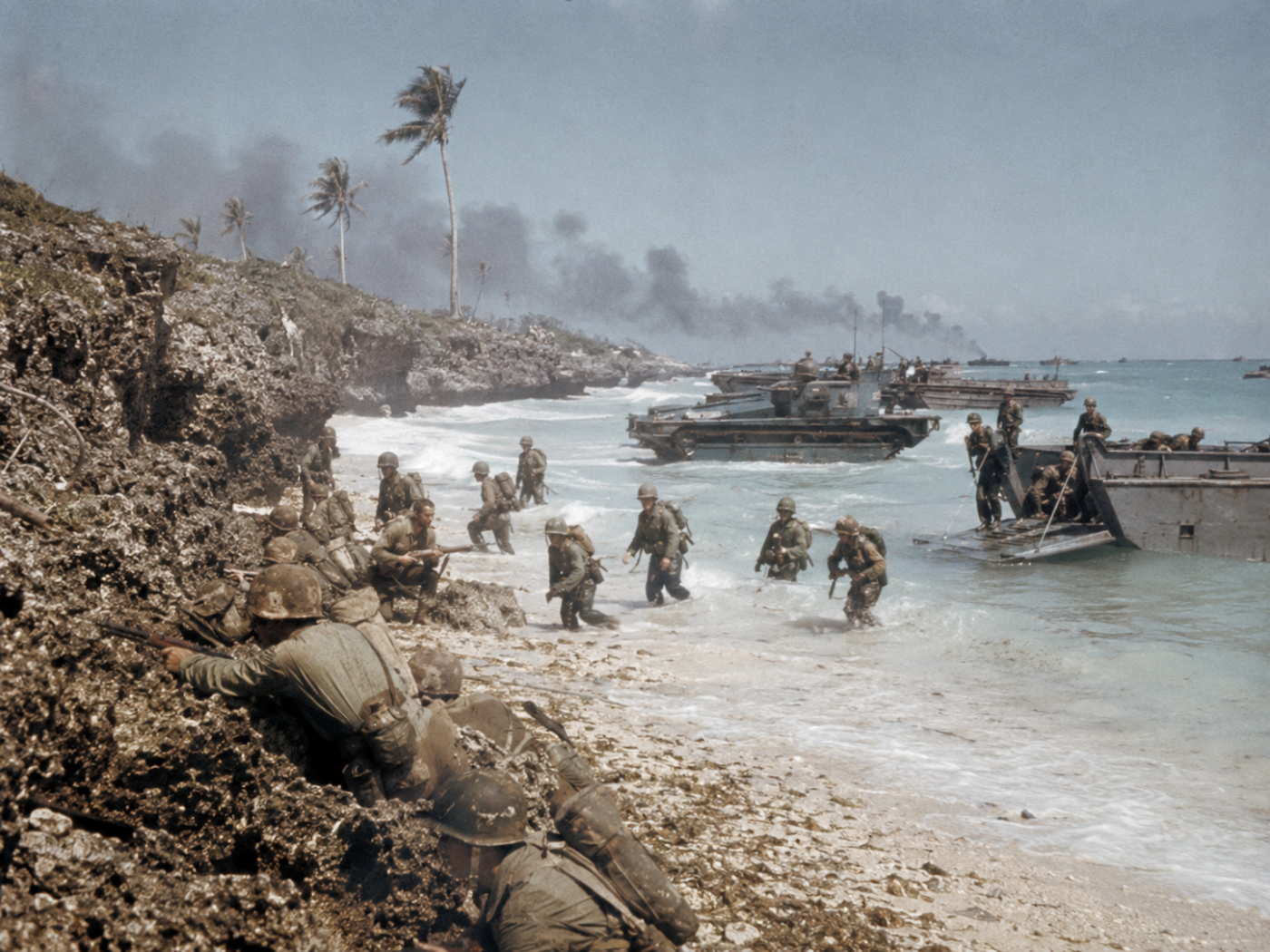
The real assault was launched against two narrow beaches on the north-western coast, known to the Americans as White Beach 1 and White Beach 2. These beaches were considered difficult landing sites because of their limited width, but this also meant that the Japanese had not defended them as heavily as the more obvious approaches.
Before the landings, Tinian had been subjected to extensive naval bombardment and air attacks. American artillery positioned on nearby Saipan was also able to fire across the narrow channel separating the two islands, providing unusually close land-based artillery support for an amphibious invasion.
The 4th Marine Division spearheaded the landings, with Marines moving towards the beaches aboard amphibious tractors. Naval gunfire continued to strike suspected Japanese positions as the assault force approached the shore. Despite the confined landing area, the Marines successfully established a foothold and began pushing inland.
The Japanese response was swift. During the first night, defenders launched determined counter-attacks against the Marine beachhead. Japanese troops attempted to penetrate the American lines in darkness, resulting in fierce close-range fighting. Machine guns, artillery, mortars and small arms inflicted heavy losses on the attacking forces, and by morning the main counter-attacks had been broken.
With the beachhead secure, additional American troops, tanks, artillery and supplies were brought ashore. Elements of the veteran 2nd Marine Division joined the advance, and the Marines began steadily moving southwards across the island.
Tinian's terrain was generally more favourable for mobile operations than some of the mountainous and heavily forested islands encountered elsewhere in the Pacific. Roads and relatively open areas allowed American tanks and supporting vehicles greater freedom of movement, while the Marines used overwhelming artillery, naval gunfire and air support to reduce Japanese defensive positions.
Nevertheless, resistance remained fierce. Japanese soldiers used caves, trenches, fortified positions and areas of difficult terrain to delay the advance. Snipers and small groups of defenders continued to fight even after larger defensive formations had been destroyed.
As the Marines pushed south, Japanese forces were increasingly compressed into the southern end of the island. Their ability to manoeuvre or receive reinforcements was virtually nonexistent. American naval and air superiority isolated Tinian completely, while the loss of Saipan meant there was little prospect of outside assistance.
By the end of July, organised Japanese resistance was concentrated around the rugged southern areas of the island. American forces continued their advance, overcoming pockets of opposition and forcing surviving defenders towards cliffs and caves.
On 1 August 1944, Tinian was officially declared secured, although Japanese soldiers continued to hide in caves and isolated positions for some time afterwards. The battle had lasted just nine days, making it one of the relatively swift major amphibious victories of the American campaign across the Pacific.
The human cost remained considerable. Hundreds of American servicemen were killed and more than a thousand wounded during the fighting. The Japanese garrison was almost completely destroyed, with only a relatively small number of defenders surrendering or being captured. Civilians living on the island also suffered terribly, caught between the opposing forces during the battle.
The capture of Tinian, however, represented far more than another island taken from the Japanese Empire. Almost immediately, American engineers and naval construction units began transforming the island into an enormous military air base.
Its relatively flat terrain made it particularly suitable for the construction of long runways capable of handling the huge B-29 Superfortress. North Field and West Field were developed into major air installations, with Tinian eventually becoming one of the most important American bomber bases in the Pacific.
Thousands of military personnel arrived, and an extraordinary network of runways, taxiways, maintenance facilities, fuel storage areas and accommodation was created. North Field grew into one of the largest airfield complexes of the war.
From Tinian, B-29 bombers flew missions against industrial centres, military installations and cities throughout the Japanese home islands. The island became a vital base for the American strategic bombing offensive that intensified during the final months of the conflict.
Tinian would also become associated with two of the most consequential missions in military history.
On 6 August 1945, the B-29 Enola Gay took off from North Field carrying the atomic bomb known as Little Boy. Its target was the Japanese city of Hiroshima. Three days later, another B-29, Bockscar, departed Tinian carrying the Fat Man atomic bomb, which was dropped on Nagasaki.
Within days, Japan announced its intention to surrender, bringing the Second World War to an end.
The invasion that began on 24 July 1944 therefore had consequences far beyond the nine days of fighting required to capture the island. What appeared on a map to be a relatively small piece of land in the Pacific became an enormous forward air base positioned within striking distance of Japan.
The battle also demonstrated the increasing sophistication of American amphibious warfare. The use of deception, carefully selected landing beaches, overwhelming naval and air support, artillery firing from neighbouring Saipan and the rapid movement of troops inland combined to produce one of the most efficiently executed amphibious operations of the Pacific campaign.
Today, the abandoned runways and surviving wartime remains on Tinian stand as reminders of the island's remarkable role in history. On 24 July 1944, American Marines came ashore on two narrow beaches to begin what would become a short but strategically decisive battle. Within little more than a year, aircraft departing from the island they captured would take part in the missions that helped bring the most destructive conflict in human history to its final conclusion.