On this day in military history…
On 12 August 2000 one of the most powerful submarines in the Russian Navy was taking part in a major exercise in the Barents Sea when two enormous underwater explosions sent it crashing to the seabed. The nuclear-powered submarine K-141 Kursk carried 118 officers and sailors. None would survive. What followed became one of the worst naval disasters of the post-Cold War era and exposed serious weaknesses in Russia's submarine rescue capability at a time when the country was attempting to rebuild the strength and prestige of its navy.
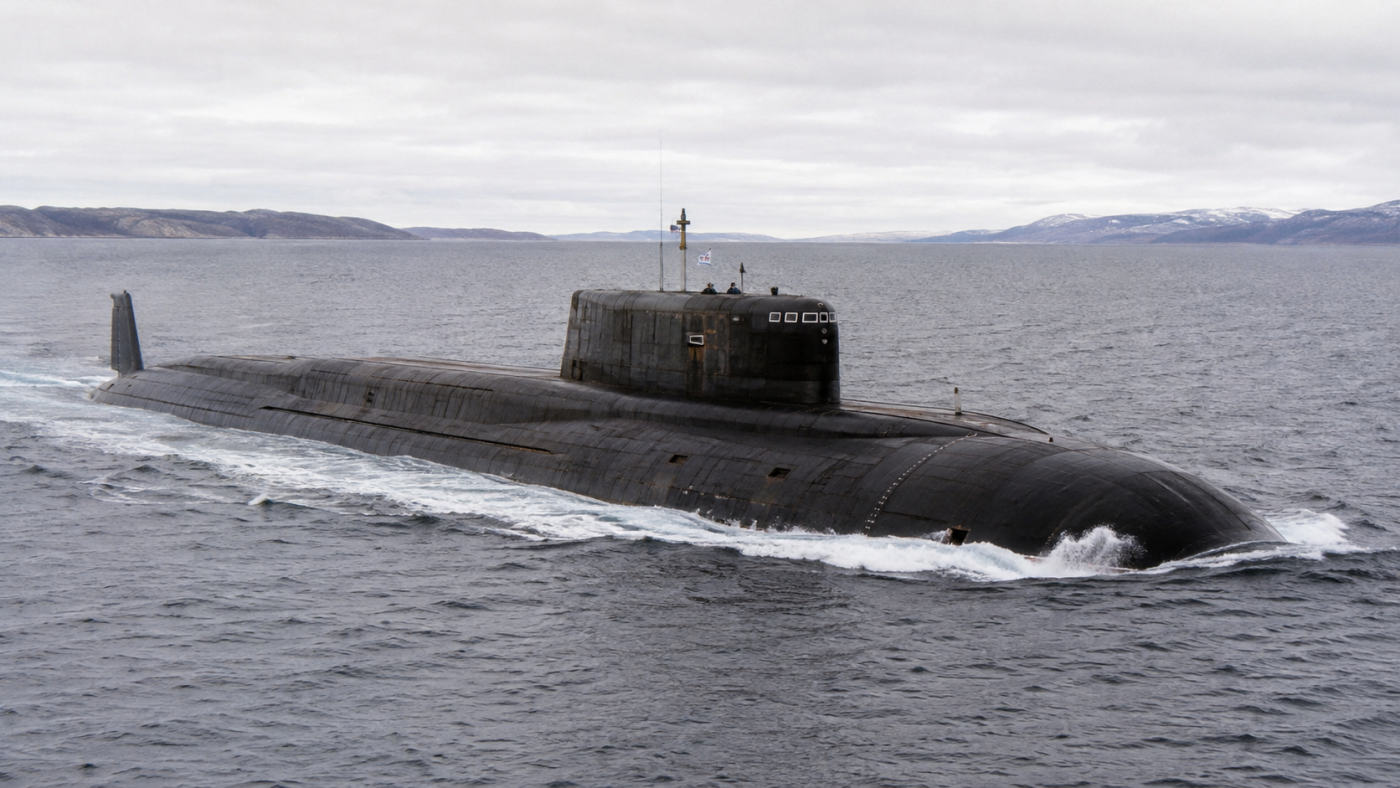
Kursk was a Project 949A Antey submarine, known to NATO as the Oscar II class. Commissioned in 1994 and serving with Russia's Northern Fleet, it was an enormous vessel approximately 154 metres long and weighing around 18,000 tonnes when submerged. The design had originally been developed during the Cold War to attack NATO carrier battle groups. Twenty-four P-700 Granit anti-ship missiles could be carried in launch tubes positioned along the sides of the hull, while torpedo tubes in the bow allowed the submarine to attack enemy ships and submarines at closer range. Its size, double-hull construction and extensive internal compartmentalisation had contributed to a belief amongst many Russian sailors that vessels of this type were exceptionally difficult to sink.
During August 2000 the Northern Fleet was conducting one of its largest exercises since the collapse of the Soviet Union. Around thirty ships and submarines were involved as Russia attempted to demonstrate that its navy was recovering from the financial difficulties of the 1990s. Kursk was commanded by Captain First Rank Gennady Lyachin and was expected to carry out simulated attacks against the surface fleet.
At approximately 11:28 local time on 12 August, disaster struck as the submarine prepared to launch a practice torpedo. The investigation that followed concluded that highly concentrated hydrogen peroxide used as an oxidiser in a Type 65 torpedo probably leaked inside the weapon. When high-test peroxide comes into contact with certain metals or contaminants it can rapidly decompose, producing intense heat and large quantities of oxygen and steam. Inside the confined space of a torpedo tube the resulting reaction became catastrophic.
The first explosion ripped through the forward torpedo compartment. It was powerful enough to be detected by seismic monitoring stations hundreds of kilometres away. Men inside the first compartments would have had virtually no chance of survival. Fire spread through the bow as Kursk began falling towards the seabed.
Approximately two minutes and fifteen seconds later came a second, vastly more powerful explosion. The fire had reached additional torpedoes stored in the forward section and several detonated together. The explosion tore open the submarine's bow and destroyed or devastated several of its forward compartments. Seismic stations recorded the second blast much more strongly than the first.
Kursk struck the seabed of the Barents Sea at a depth of roughly 108 metres. Its bow had been catastrophically damaged, but much of the enormous hull remained intact. The submarine was resting in water actually shallower than its own length, yet reaching the men inside would prove extraordinarily difficult.
For many years one of the most haunting aspects of the Kursk disaster was the discovery that not everybody had died during the explosions. Twenty-three men from the rear sections of the submarine survived the initial catastrophe and gathered in the ninth compartment near the stern. Among them was Captain-Lieutenant Dmitri Kolesnikov, an officer responsible for part of the submarine's turbine machinery.
The men were in almost complete darkness. Electrical power had largely disappeared, temperatures were falling and water was gradually entering parts of the vessel. Their submarine had suffered catastrophic damage and they had no reliable means of knowing whether rescuers had located them.
Kolesnikov began writing a note. When his body was recovered later, the note provided terrible confirmation that men had remained alive after Kursk reached the seabed. He recorded that 23 men from the sixth, seventh and eighth compartments had gathered in the ninth and that they were unable to reach the surface. He also left a personal message for his wife.
Exactly how long the final survivors remained alive has never been established with certainty. Evidence recovered from the compartment suggested that they attempted to maintain breathable air using emergency chemical oxygen cartridges. These devices could absorb carbon dioxide while generating oxygen, but they could become extremely dangerous if contaminated with seawater. Investigators concluded that one cartridge probably came into contact with water, causing an intense chemical reaction and flash fire. In an already oxygen-starved and partially flooded compartment the consequences were disastrous. Some of the remaining sailors appear to have been badly burned, while others eventually died from smoke inhalation, carbon monoxide poisoning or lack of oxygen.
Above them the Russian Navy was struggling to understand what had happened.
When Kursk failed to communicate as expected, concern gradually increased, but valuable hours were lost before the emergency was fully recognised. Search vessels eventually detected the submarine lying on the seabed. Russian rescue submersibles were sent down in repeated attempts to connect with Kursk's escape hatch, but equipment problems, poor weather and difficulty obtaining a seal prevented them from entering the submarine.
The disaster rapidly became international news. Britain and Norway were amongst the countries offering specialist assistance. Britain had the LR5 submarine rescue vehicle available, while Norway possessed highly experienced deep-sea divers familiar with operations in the Barents Sea. Russian authorities initially declined foreign help, maintaining that their own rescue forces could deal with the situation.
This decision later became one of the most controversial aspects of the disaster. Every hour mattered if men remained alive inside the submarine. Russian officials also issued confusing and sometimes contradictory statements about the condition of Kursk and the progress of the rescue operation. At various points there were suggestions that rescuers had established contact or detected signals from inside the submarine, although these reports were never conclusively proved.
President Vladimir Putin was only months into his first presidential term when the disaster occurred. His decision to remain on holiday during the early stages of the emergency caused widespread criticism in Russia. Families of the submariners demanded information while frustration grew over the inability of the Russian Navy to reach a submarine lying little more than one hundred metres beneath the surface.
Foreign assistance was eventually accepted. Norwegian divers arrived aboard the specialist vessel Seaway Eagle and began examining Kursk's stern escape hatch. Their work quickly demonstrated that the situation was worse than Russian authorities had publicly suggested.
On 21 August Norwegian divers succeeded in opening the outer escape hatch. Tests showed that the compartment behind it was flooded. Russian divers subsequently entered the wreck. There could now be no possibility of survivors.
All 118 men aboard Kursk were declared dead.
The recovery operation provided investigators with increasingly clear evidence of what had happened. The bow had suffered enormous internal destruction consistent with torpedo explosions rather than an external attack. Nevertheless, numerous alternative theories circulated in Russia, including suggestions that Kursk had collided with a NATO submarine or had been struck accidentally during the exercise.
Russian investigators eventually concluded that the disaster began inside Kursk itself with the failure of a peroxide-fuelled torpedo. The initial explosion started a fire in the forward torpedo compartment, which then caused additional weapons to detonate.
One potentially catastrophic consequence did not occur. Kursk was powered by two nuclear reactors, but the reactors shut down and there was no major release of radioactive material. Radiation monitoring during later recovery work found no significant leakage from the submarine.
The scale of the wreck created another extraordinary engineering challenge. Leaving a nuclear-powered submarine containing weapons and the remains of many of its crew on the seabed was politically and environmentally unacceptable. Russia therefore decided to raise most of Kursk.
During 2001 an international salvage operation involving Dutch companies Mammoet and SMIT developed a remarkable method of lifting the wreck. Because the devastated bow was considered too badly damaged and unstable to raise safely, it was cut away underwater. Twenty-six lifting holes were created through the submarine's pressure hull and powerful cables were connected to hydraulic lifting equipment aboard the specially modified barge Giant 4.
On 8 October 2001 the main section of Kursk was slowly pulled from the seabed. Approximately 9,000 tonnes of initial lifting force was required to break the suction of the mud surrounding the hull. After more than a year underwater the submarine rose beneath the barge and was transported towards Murmansk. It was eventually placed inside a Russian naval dry dock where investigators and recovery teams could examine the wreck.
The remains of most of the crew were recovered and returned to their families. The destroyed bow section, where the original explosions had occurred, remained on the seabed until parts of it were later recovered or destroyed.
The loss of Kursk forced uncomfortable questions upon the Russian Navy. Years of declining budgets following the collapse of the Soviet Union had left parts of its submarine rescue organisation with outdated or poorly maintained equipment. The reluctance to accept foreign assistance also became a major subject of criticism, particularly after it became known that 23 sailors had initially survived the explosions.
The disaster contributed to changes far beyond Russia. Submarine-operating nations increasingly recognised that rescue from a disabled submarine could require international cooperation rather than relying entirely upon national equipment. In 2003 the International Submarine Escape and Rescue Liaison Office was created to improve cooperation and coordinate submarine rescue resources around the world.
Kursk itself has become one of the most remembered submarines in modern naval history. Memorials to the 118 sailors can be found across Russia, including the preserved section of the submarine's sail incorporated into a memorial at Murmansk.
The tragedy remains particularly haunting because the sinking itself was not necessarily the end for everyone aboard. After two enormous explosions, catastrophic flooding and the submarine's impact with the seabed, 23 men were still alive deep inside the stern. In darkness they waited for a rescue effort taking place little more than one hundred metres above them.
Their handwritten notes eventually provided the clearest evidence of those final hours. They transformed the loss of Kursk from simply the destruction of a submarine into a human story of sailors who survived an almost unimaginable catastrophe, gathered together in the final compartment of their vessel and waited for rescuers who could not reach them in time.