Massacre at Bloody Gulch
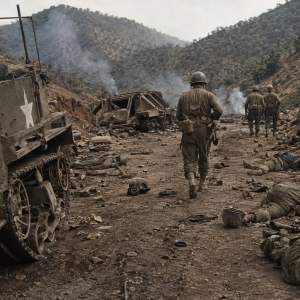
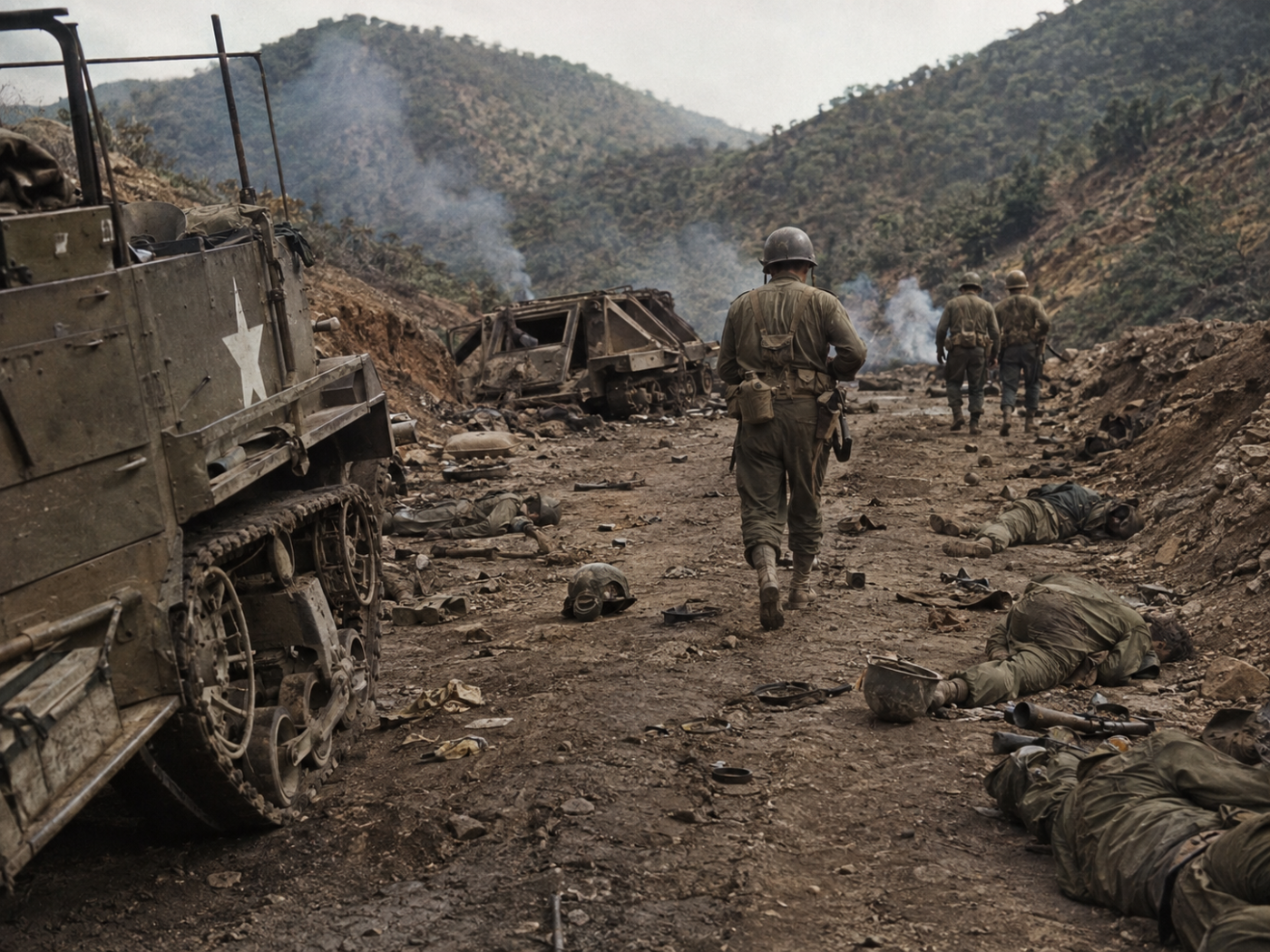
On 12 August 1950, during some of the most desperate fighting of the opening weeks of the Korean War, a quiet valley west of Masan in South Korea became the scene of one of the conflict’s earliest notorious atrocities against American prisoners of war. The place would become known to the soldiers who survived as “Bloody Gulch”, after North Korean troops overran American artillery positions and captured scores of men who were subsequently killed. The massacre took place during the Battle of the Pusan Perimeter, when United Nations forces were fighting desperately to prevent the complete collapse of South Korea.
The Korean War had begun less than two months earlier, on 25 June 1950, when the North Korean People’s Army crossed the 38th Parallel and invaded South Korea. The attack achieved extraordinary early success. South Korean forces were driven southwards while American troops, hurriedly sent from occupation duties in Japan, discovered that they were facing a determined and experienced enemy equipped with Soviet tanks, artillery and automatic weapons. By August the surviving South Korean and United Nations forces had been compressed into a relatively small defensive area surrounding the port of Pusan, today known as Busan. If this perimeter collapsed, there was a genuine possibility that the whole Korean peninsula would fall under North Korean control.
One of the most threatened sections of the perimeter lay around Masan in the south-west. Holding this area was essential because an enemy breakthrough towards Pusan could threaten the supply port upon which virtually the entire United Nations war effort depended. American commanders therefore positioned infantry and artillery units throughout the valleys and ridges surrounding the approaches to Masan. Among them were the 555th Field Artillery Battalion, commonly known as the “Triple Nickel”, and the 90th Field Artillery Battalion. Their gun crews were supporting American infantry attempting to hold back repeated North Korean attacks.
The terrain presented serious difficulties. Korea was dominated by steep ridges, narrow roads and valleys that restricted movement and created excellent opportunities for infiltration. North Korean soldiers frequently moved through hills and gaps in American positions during darkness, appearing unexpectedly behind supposedly secure defensive lines. Artillery units were particularly vulnerable. Their guns were positioned behind the infantry and their crews were trained primarily to operate howitzers rather than fight sustained close-quarter infantry battles.
During the night of 11–12 August North Korean troops infiltrated the American lines around the artillery positions near Pongam-ni. The attackers belonged to elements of the North Korean People’s Army operating against the American positions west of Masan. By the early hours the situation had become increasingly confused as enemy soldiers appeared around roads, gun positions and command posts. Communications became difficult and some American units were effectively isolated before commanders fully understood how deeply the North Koreans had penetrated.
The artillerymen suddenly found themselves fighting for their lives. The 555th Field Artillery Battalion had eight 105mm howitzers in its two firing batteries positioned in the area. These weapons could deliver devastating indirect fire against distant targets, but once enemy infantry had reached the gun lines the crews were extremely exposed. Men grabbed rifles, carbines and whatever weapons were available and attempted to defend their positions while others tried to withdraw through the surrounding hills.
The fighting rapidly became chaotic. North Korean troops attacked the gun positions while American soldiers attempted to escape along roads and through fields under small-arms and machine-gun fire. Vehicles were abandoned, communications equipment was lost and wounded men were left behind as organised resistance collapsed. The 555th eventually lost all eight of its 105mm howitzers positioned there. Nearby, Battery A of the 90th Field Artillery Battalion lost all six of its 155mm howitzers. It was an enormous loss of artillery equipment at a time when every available gun was desperately needed to defend the Pusan Perimeter.
For many of the artillerymen, however, the loss of their guns would soon become insignificant compared with what followed. Groups of American soldiers were captured during the collapse of the positions. Some were wounded, others had been cut off before they could escape. Under the laws of war, soldiers who surrendered or were otherwise taken prisoner were supposed to be protected from violence. Instead, a number of the captives were deliberately killed.
Approximately 75 American prisoners are generally recorded as having been murdered during what became known as the Bloody Gulch Massacre. The victims came principally from the artillery units caught in the North Korean attack. In the confusion surrounding the battle, determining precisely who had been killed in combat, who had escaped and who had been executed was extremely difficult. Some bodies were discovered immediately while others were not recovered until American forces retook the area weeks later.
The scale of the destruction suffered by the 555th Field Artillery Battalion illustrates how completely the position had been overrun. On the day after the attack only around 20 per cent of the battalion’s personnel were immediately available for duty. Contemporary estimates suggested that somewhere between 75 and 100 artillerymen may have been killed around the positions and around 80 wounded, although later investigations demonstrated how difficult it was to distinguish battlefield deaths from executions and men temporarily listed as missing. Five weeks later, when the area around Taejong-ni was retaken, American troops discovered the bodies of 55 men from the 555th Field Artillery Battalion inside a house.
For the survivors the discovery confirmed some of the worst rumours circulating through American units. Men who had disappeared during the battle had not simply been marched north as prisoners. Some had been deliberately murdered after falling into enemy hands. Bloody Gulch therefore became more than another battlefield defeat. It became one of the incidents that shaped American attitudes towards surrender and captivity during the Korean War.
The massacre also occurred during a period when the North Korean advance was beginning to lose momentum. The North Korean army had achieved remarkable success since June, but its supply lines were becoming dangerously stretched. American aircraft continually attacked roads, bridges, vehicles and troop concentrations while increasing numbers of United Nations reinforcements arrived through Pusan. Nevertheless, in August 1950 the outcome remained far from certain. Battles around places such as Masan, the Naktong River and Taegu were fought with extraordinary intensity because commanders on both sides understood that the survival of the entire perimeter could depend upon individual hills, roads and valleys.
Bloody Gulch was followed only five days later by another infamous incident. On 17 August, during fighting near Waegwan, North Korean soldiers executed American prisoners on Hill 303. Forty-one captured members of a mortar platoon from the US 5th Cavalry Regiment were found dead after American forces retook the position. Many had been bound before being shot. Together the Bloody Gulch and Hill 303 killings became two of the best-known early prisoner-of-war massacres involving American servicemen during the Korean War.
Despite the catastrophe at the gun positions, the attack around Masan did not produce the decisive breakthrough the North Koreans needed. American and South Korean forces continued to hold the Pusan Perimeter while reinforcements and equipment poured into the country. Just over a month later, on 15 September 1950, United Nations forces launched the amphibious landing at Inchon far behind the North Korean lines. The operation transformed the war. North Korean forces surrounding the Pusan Perimeter were forced to retreat rapidly towards the north while United Nations troops broke out from their defensive positions.
As territory was recovered, graves registration teams began the grim work of searching former battlefields for missing servicemen. Identifying those killed around Bloody Gulch was particularly difficult. Some men remained officially missing for decades. Modern forensic techniques have continued to provide answers long after the fighting ended. Sergeant First Class Edris A. Viers of Battery A, 555th Field Artillery Battalion, for example, disappeared during the fighting on 12 August 1950. Remains connected with the battlefield were eventually examined using modern identification methods and Viers was formally identified decades later. Sergeant Bobby R. King of Battery A, 90th Field Artillery Battalion, who had also been listed as missing following Bloody Gulch, was similarly identified many years after the war and returned to his family for burial with full military honours.
The exact circumstances surrounding every death at Bloody Gulch may never be completely reconstructed. The battle took place during confused close-range fighting, units were scattered and many records were produced only after survivors had returned to friendly lines. What is clear is that American soldiers who had fallen into North Korean hands were deliberately killed, turning what had already been a disastrous battlefield defeat into a massacre.
Today Bloody Gulch remains a relatively little-known episode outside those who study the Korean War, overshadowed by later battles such as Inchon, the Chosin Reservoir and Heartbreak Ridge. Yet the events of 12 August 1950 reveal just how desperate the first months of the war had become. Artillerymen who only hours earlier had been firing their howitzers in support of infantry suddenly found enemy soldiers among their gun positions and were forced into a battle for survival.
For the men of the 555th and 90th Field Artillery Battalions, Bloody Gulch became a name associated with destroyed guns, missing comrades and the discovery that surrender offered no guarantee of survival. Seventy-five years later, it remains one of the darkest episodes of the struggle to hold the Pusan Perimeter and a reminder of the brutality faced by soldiers during the opening months of the Korean War.