On this day in military history…
On 29 September 1918, British, Australian and American troops launched a major assault on the St Quentin Canal, one of the strongest sections of Germany’s Hindenburg Line. The attack came during the final months of the First World War, as Allied forces pressed eastwards across France. Germany’s armies had been forced back, but the defences ahead of them were deep, heavily wired and protected by machine guns. Breaking through them would demand far more than a single charge.
The canal made this stretch of the line especially difficult. In places, its steep banks formed a formidable obstacle for attacking infantry. Between Bellicourt and Vendhuile, however, the waterway disappeared into a long tunnel. The ground above it offered a route forward, but the Germans had anticipated that possibility and fortified it with trenches, strongpoints and belts of barbed wire. Lieutenant General Sir John Monash planned for two American divisions to break into these positions, allowing Australian troops to pass through and continue the advance. Further south, British troops would attack across the canal itself.
The assault began under an intense artillery barrage, with tanks and aircraft supporting the infantry. Above the tunnel, the American 27th and 30th Divisions met fierce resistance. Some German positions had survived the bombardment, and troops advancing through smoke and confusion found that sections of trench behind them had not been cleared. In the north, the 3rd Australian Division became drawn into fighting for ground the Americans had been expected to secure. The 30th American Division made better progress further south, enabling the 5th Australian Division to advance towards the heavily defended village of Bellicourt. What had been planned as a rapid advance became a succession of close fights for trenches, dugouts and machine-gun posts.
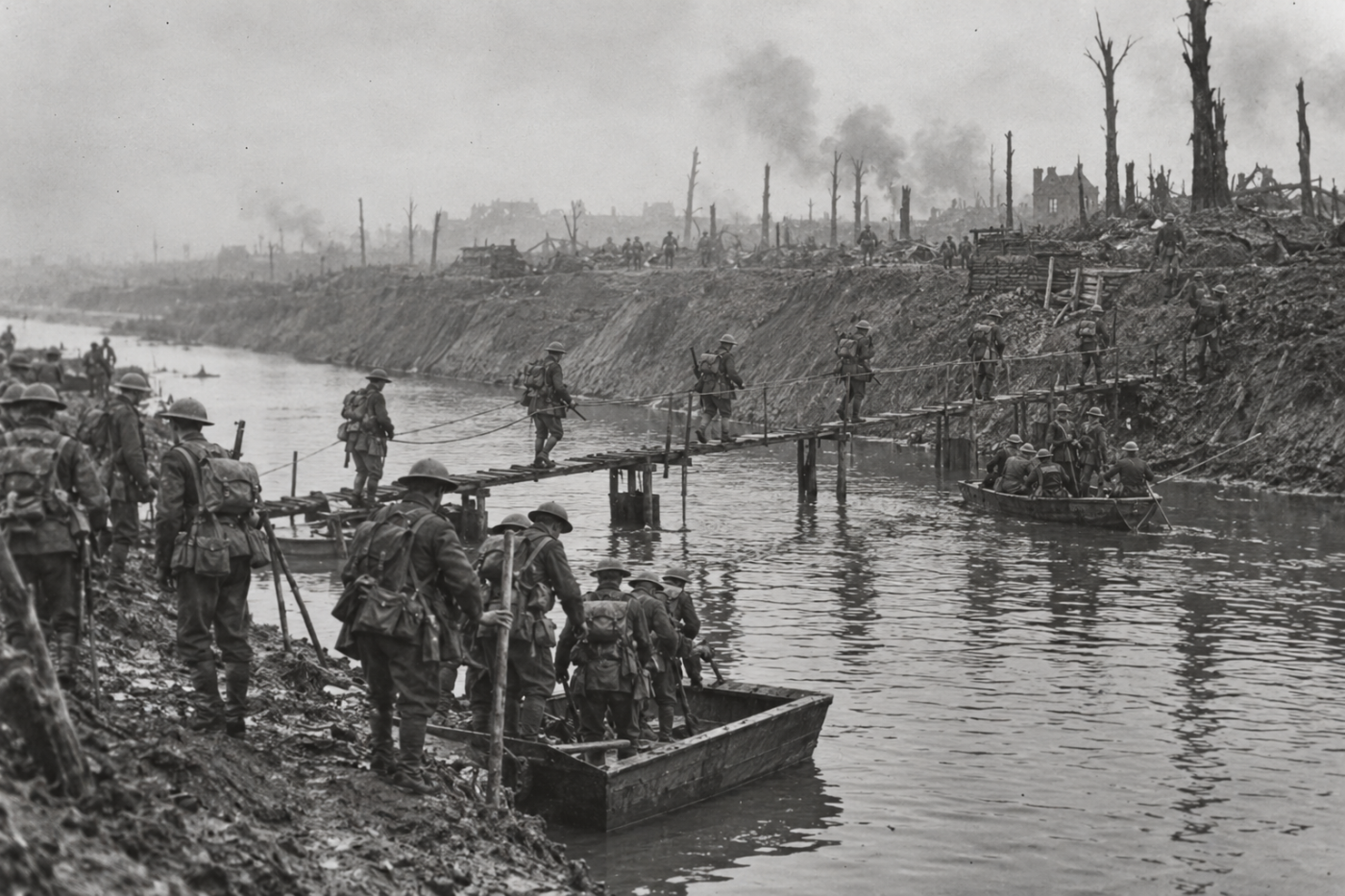
To the south, the British 46th Division faced the canal at its most imposing. Its men crossed under fire, using boats and improvised means to get infantry onto the far bank and attack the German positions beyond. They also prevented the destruction of the Riqueval Bridge, leaving a vital crossing intact. The division captured more than 4,000 prisoners. Its success put pressure on German troops defending the tunnel sector and helped turn a hard-won foothold into a wider breach.
The battle did not end when the first positions fell. German troops fought on from strongpoints beyond the canal, while the attackers struggled to bring up guns and supplies across the damaged ground. Fighting continued over the following days, and the Australian divisions alone suffered more than 2,500 casualties. By 2 October, Allied forces had opened a gap of roughly 17 kilometres in the Hindenburg Line. The achievement had come at a heavy cost, but a defence on which Germany had placed great hopes was giving way.
The Battle of the St Quentin Canal was part of the Allied advance known as the Hundred Days Offensive. It showed both how far the Allies had developed their ability to combine infantry, artillery, tanks and aircraft, and how stubbornly German soldiers could still defend prepared ground. Six weeks later, the war ended. For the men who crossed the canal or fought their way over the tunnel on 29 September, that outcome was still uncertain; all they could see was the next trench ahead.