On this day in military history…
On 17 October 1967, a small force of American infantrymen moved through the dense woodland of South Vietnam towards an enemy position discovered the previous day. Within hours, their advance had become a desperate struggle for survival. The Battle of Ong Thanh would leave more than fifty American soldiers dead, scores wounded and two rifle companies shattered. It was a stark demonstration of how quickly overwhelming military strength could lose its advantage when men on the ground encountered a determined enemy they could barely see.
The troops belonged to the 2nd Battalion, 28th Infantry Regiment, part of the US Army’s 1st Infantry Division, the celebrated “Big Red One”. Known as the Black Lions, they were operating in the Long Nguyen Secret Zone north-west of Saigon during Operation Shenandoah II. This was an area of concealed camps, supply routes and thick vegetation where Viet Cong formations could shelter between operations. Opposing them were troops of the 271st Regiment, 9th Viet Cong Division, commanded by Võ Minh Triết. These were organised main-force soldiers capable of preparing and fighting a substantial engagement, rather than a handful of guerrillas making a brief attack before disappearing.
The American battalion commander, Lieutenant Colonel Terry de la Mesa Allen Jr., carried a distinguished military name. His father had commanded the 1st Infantry Division during the Second World War, and the younger Allen now led men of the same division in a very different conflict. American commanders were under pressure to locate enemy formations and bring them to battle. After contact with a bunker system on 16 October, he decided to return the following morning with Alpha and Delta Companies, accompanying the force himself.
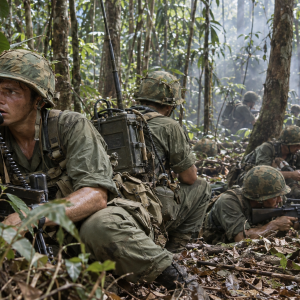
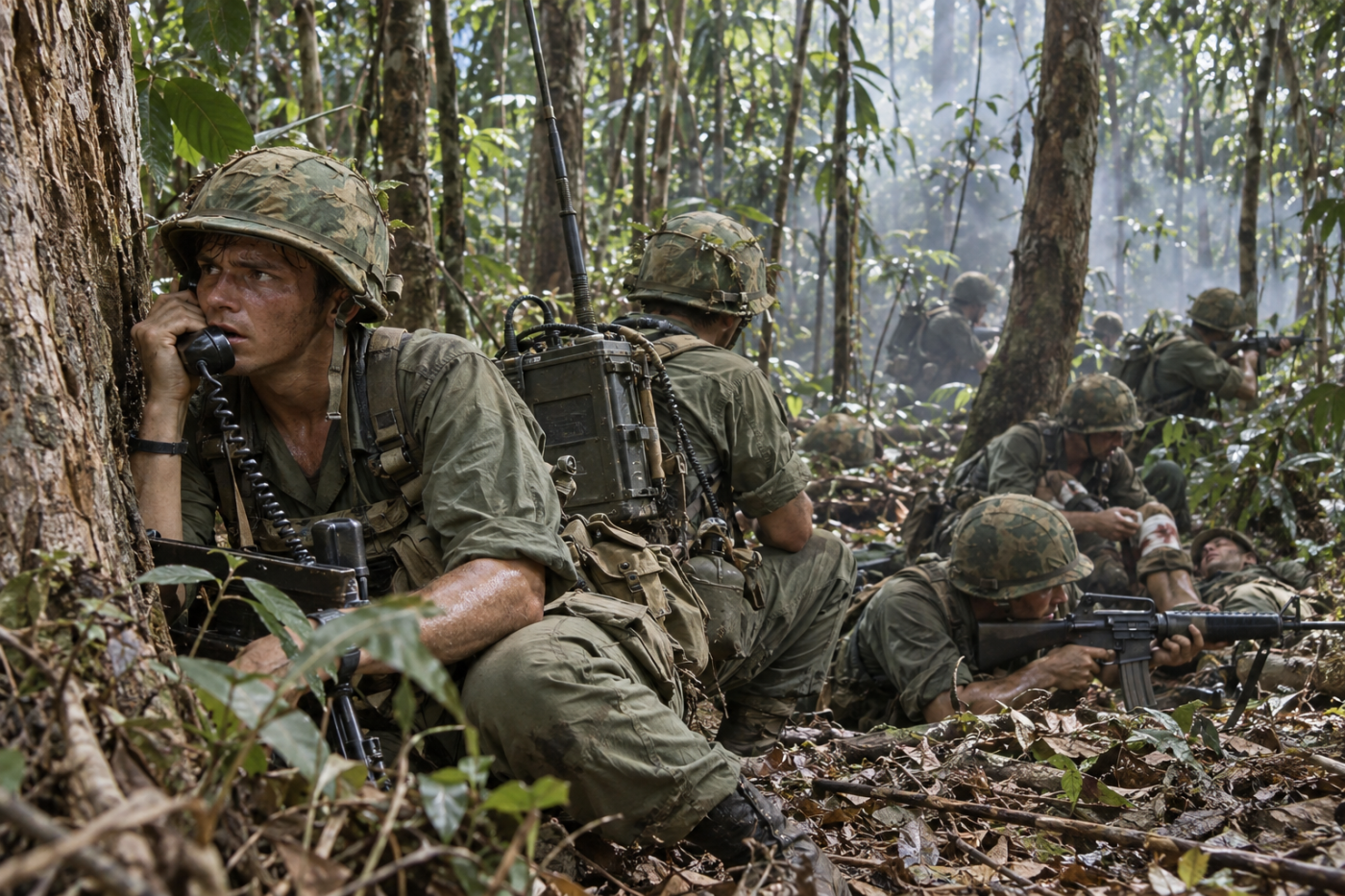
The column numbered roughly 150 men, with Alpha Company leading and Delta following behind the battalion command group. Progress was slow beneath the jungle canopy, where visibility was restricted and maintaining contact between soldiers required constant care. Point men and flank patrols searched ahead, while supporting artillery was intended to protect the movement. Nevertheless, the enemy’s concealed positions allowed the Americans to approach dangerously close before the main engagement opened. When Alpha encountered Viet Cong soldiers ahead, the situation rapidly escalated into a storm of automatic fire and directional mine explosions.
Officers and platoon leaders were hit early, disrupting control at the moment it was most needed. Alpha’s commander, Captain James George, was severely wounded, and the company rapidly ceased to function as a coherent fighting force. Lieutenant Clark Welch brought men of Delta forward, encountering casualties where he had expected to find an organised defence. Survivors and wounded soldiers were drawn back towards a shrinking perimeter around the command group. The close fighting complicated the use of supporting fire, while the battalion’s leadership suffered further losses as Allen was killed.
Among those trying to prevent the position being overwhelmed was Second Lieutenant Harold Bascom “Pinky” Durham Jr., an artillery forward observer attached to Delta Company. Just five days past his twenty-fifth birthday, he had returned to Vietnam the previous month after volunteering for another tour. His task was to direct artillery onto enemy positions, and he repeatedly exposed himself to obtain a clearer view of the fighting. During a lull he helped wounded men, then continued coordinating supporting fire as the attack intensified.
A mine explosion severely wounded Durham in the head and impaired his sight, but he continued directing artillery and fighting with his own weapon. As the enemy pressed closer, he called fire almost onto his own position. Although moved back to another defensive location, he again sought a place from which he could observe and adjust the guns, until machine-gun fire mortally wounded him. Even then, he warned a nearby soldier of approaching enemy troops threatening the wounded. His courage earned a posthumous Medal of Honor, presented to his mother in October 1969.
When the Viet Cong withdrew, American troops returned to recover the dead and wounded. Senior officers subsequently portrayed the engagement as a success, an interpretation bitterly at odds with the experience of many survivors. Ong Thanh exposed the distance between optimistic assessments of the war and the realities of jungle combat. For the Black Lions, its lasting significance lay in the men who never returned, the wounded carried out by their comrades and the determination of soldiers who continued fighting as their position collapsed around them.