The Liberation of Arnhem, April 1945
On 17 September 1944, Allied airborne troops landed near Arnhem as part of Operation Market Garden. The plan was to capture bridges across the Netherlands, enabling British ground forces to cross the Lower Rhine and advance towards Germany. Men of the British 1st Airborne Division reached the northern end of Arnhem's road bridge, but most of the division was stopped farther west. German resistance was stronger than expected, and the armoured column advancing from the south could not reach the bridge in time. During the night of 25–26 September, the remaining British troops withdrew across the river near Oosterbeek. Arnhem remained in German hands.
For the inhabitants, the defeat brought another ordeal. On 23–24 September, while fighting continued, the German authorities ordered the evacuation of Arnhem. At least 90,000 people were driven from Arnhem, many expecting to return within days. Instead, the city became a front-line area. German personnel systematically removed furniture, machinery and other possessions from abandoned buildings, while shelling and bombing caused further damage. The road bridge fought over in September was destroyed by American bombers on 7 October to prevent the Germans from using it. By the spring of 1945, Arnhem was largely empty and extensively damaged.
The Allied advance had slowed during the winter. Nijmegen remained in Allied hands, but German forces held the territory north of the Lower Rhine, and rivers, flooding and winter conditions complicated further attacks. The port of Antwerp had been opened after the battle for the Scheldt, and the subsequent Rhineland offensive weakened the German position. Yet substantial German forces still occupied the western Netherlands, where shortages had developed into the famine known as the Hunger Winter. The Allies needed to open routes into the remaining occupied territory while limiting further danger to its civilian population.
The advance towards Arnhem fell to I Canadian Corps, commanded by Lieutenant-General Charles Foulkes within General Harry Crerar's First Canadian Army. Its British 49th (West Riding) Infantry Division, known as the Polar Bears from its shoulder insignia, would lead the assault under Major-General Stuart Rawlins. Canadian tanks, artillery and engineers would support the infantry, while the 5th Canadian Armoured Division would exploit any breakthrough. Unlike the airborne operation of September, the new attack relied on a carefully prepared river crossing followed by a coordinated advance through the city.
On 2 and 3 April, Operation Destroyer cleared German positions in the low-lying area between Arnhem and Nijmegen, known as the Island. The first plan for Arnhem envisaged crossing the Lower Rhine west of the city. Foulkes changed the approach on 7 April because the Germans appeared prepared for an attack from that direction. The 49th Division would instead cross the IJssel near Westervoort and enter Arnhem from the east. This required troops and bridging equipment to be repositioned, but reduced the risk of attacking the strongest German defences directly.
On 12 April, RAF Spitfires and Typhoons attacked German positions, followed by artillery fire. A diversionary bombardment west of Arnhem helped draw attention away from the crossing. At 10.40 that evening, Operation Anger began. Infantry of the 56th Brigade crossed the IJssel in landing craft and amphibious vehicles known as Buffaloes. Some boats arrived late and obstacles on the far bank delayed the landings. Nevertheless, British troops gained a foothold before midnight. During the early hours of 13 April, they overcame German strongpoints while engineers worked to establish a bridge across the river.
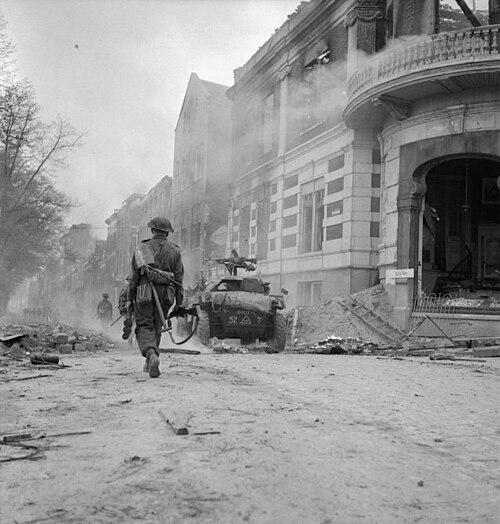
Later on 13 April, the 146th Brigade and tanks of the Canadian Ontario Regiment advanced into Arnhem. Progress through the built-up districts was slow. Machine-gun positions and snipers had to be cleared from buildings, and a factory complex on the eastern side of the city was strongly defended. British infantry eventually overcame the position with Canadian tank support.
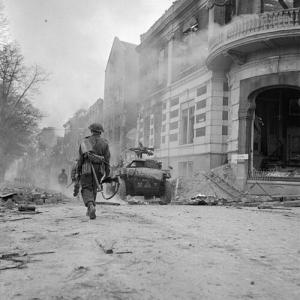
By that evening, organised German resistance was weakening. The 147th Brigade crossed the IJssel overnight and joined the advance on 14 April. By the afternoon the British had reached their objectives in Arnhem and taken approximately 600 German prisoners, although operations in the surrounding area continued. The defenders included troops of the German 346th Infantry Division and other formations. Arnhem was now in Allied hands, but its liberation differed markedly from the scenes of public celebration elsewhere in the Netherlands.
Most inhabitants were still living as evacuees. Soldiers entered streets lined with damaged buildings and houses stripped of their contents. A small civilian population remained, but there were no large crowds to greet the liberators. Much of the destruction had accumulated since September through fighting, neglect and organised German looting. Capturing the city was one achievement; making it habitable again would be another.
The victory opened the route for the 5th Canadian Armoured Division to advance north towards Otterlo and the IJsselmeer. This movement helped force German troops out of Apeldoorn, which was liberated on 17 April. Large German forces still held territory farther west, where further fighting threatened an already starving population. On 5 May, German forces in the Netherlands surrendered, bringing the occupation to an end.
For the people of Arnhem, recovery was much slower. Damaged houses had to be inspected, streets cleared and water and electricity restored. In June, the authorities were still arranging the return of evacuees in stages, and many families could not go home until later that summer or autumn. Arnhem is mainly remembered for the airborne battle of September 1944, but it was the British 49th Division and its Canadian allies who liberated the city in April 1945. Their victory ended German control; restoring ordinary life took considerably longer.
Author: Tom Dankers, Historian - Arnhems Oorlogsmuseum 40-45
Picture: No 5 Army Film & Photographic Unit, Hewitt (Sgt), Public domain, via Wikimedia Commons