On this day in military history…
On the night of 19–20 October 1917, eleven German naval Zeppelins set out to attack Britain’s industrial centres in what became known as the “Silent Raid”. Powerful winds scattered the formation, carrying the airships far from their intended targets and sending bombs falling across English counties and London. The attack killed 36 people and injured 55, but the return journey became a disaster for the Germans. Five airships were ultimately lost, making this the last great Zeppelin raid of the First World War.
By 1917, British fighters, searchlights and anti-aircraft guns had steadily eroded the advantage once enjoyed by German airships. Germany responded with newer “height climbers”, designed to operate above the effective reach of many defending aircraft. Greater altitude offered protection, but exposed crews to intense cold, oxygen shortage and powerful winds. As the raiders approached England that October night, they encountered winds reaching around 50 miles an hour. Commanders found their enormous vessels being pushed southwards, while darkness and poor visibility made navigation increasingly uncertain. Many bombs fell harmlessly in fields, and damage at the Austin works at Longbridge failed to interrupt production.
Among the attackers was L45, commanded by Kapitänleutnant Waldemar Kölle. Initially heading towards Sheffield, it crossed the Yorkshire coast before being carried south. At approximately 19,000 feet, the crew struggled with freezing temperatures and altitude sickness as they tried to establish their position. Instead of reaching Sheffield, the airship arrived over Northampton, dropped bombs and continued towards London. A raid intended to strike Britain’s industrial heart was becoming an attack on streets and homes far from its original objectives.
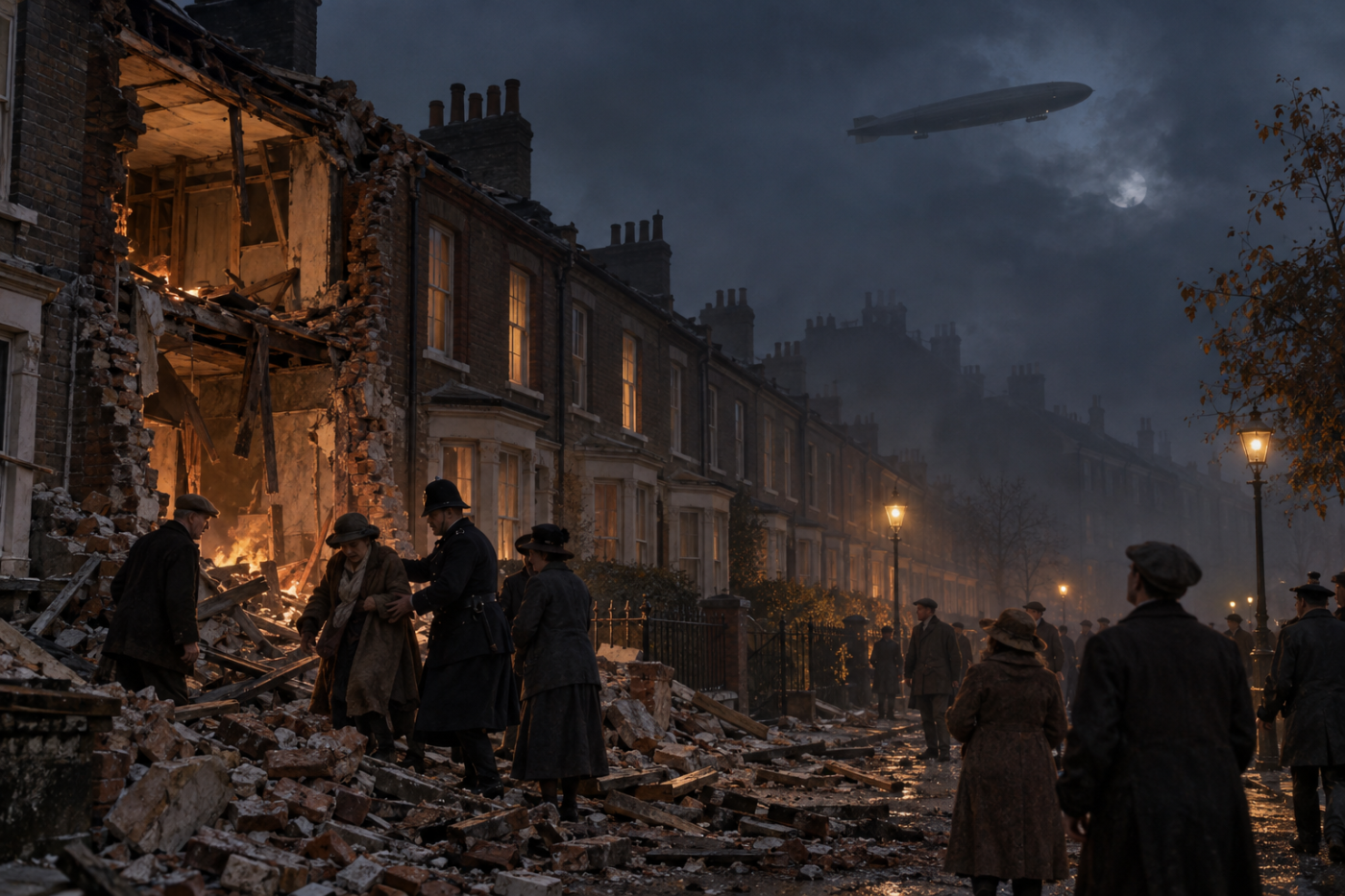
The name “Silent Raid” reflected the unsettling conditions in which the attack reached the capital. Flying at such heights, the Zeppelins’ engines were difficult to hear, while mist prevented effective observation. Searchlights were held back unless an airship could be heard, as illuminating the sky without a visible target risked revealing London’s position. With little of the familiar warning from approaching engines or defensive activity, bombs seemed to arrive from an unseen enemy. L45 struck the north-western suburbs before passing over central London and districts south of the Thames. Piccadilly, Camberwell and Hither Green were hit, and a 300-kilogram bomb at the junction of Albany Road and Calmington Road killed ten people and injured 23. This would be the last Zeppelin attack on London.
For the German crews, releasing their bombs did not end the ordeal. Several airships were swept across the Channel into France, where exhausted men faced failing engines, dwindling fuel and Allied defences. French anti-aircraft fire brought down L44 in flames, killing everyone aboard. L49 landed on French territory and was captured before its crew could destroy it, providing the Allies with a valuable example of the latest German airship design. L45 eventually came down in southern France, where its crew burnt the vessel and became prisoners.
The fate of L50 was particularly grim. During a forced landing in France, damage tore away gondolas and most of the crew escaped, but the lightened airship rose again with four men still aboard. It drifted away and disappeared over the Mediterranean. L55 reached Germany after a desperate journey, only to be wrecked following an emergency landing. Just six of the eleven raiders returned safely, leaving Germany with losses far greater than the military damage inflicted on Britain.
The Silent Raid exposed the limits of the Zeppelin as a strategic bomber. Greater altitude helped evade British defences but made navigation, accurate bombing and survival increasingly dependent on conditions the crews could barely control. Smaller attacks continued in 1918, but the great October operation was never repeated on the same scale. For those beneath its flight path, it demonstrated how the war could reach ordinary homes and streets without warning, bringing death hundreds of miles from the battlefields.