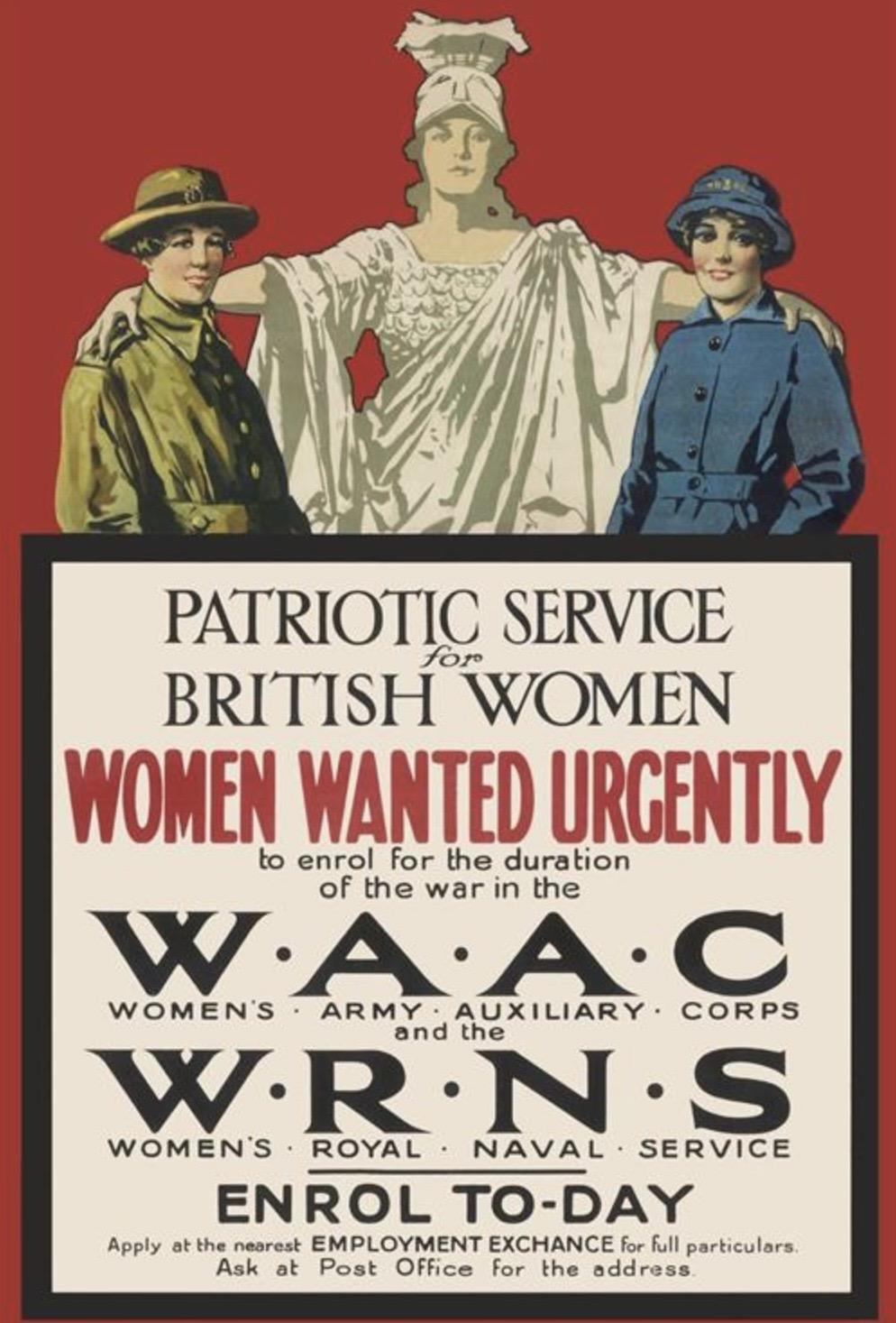
Woman’s recruitment into British Forces .
When Britain went to war in August 1914, women were largely excluded from military service apart from nursing. Yet as casualties mounted and the armed forces expanded, thousands of men were still employed cooking meals, typing orders, answering telephones and managing stores. These jobs were essential, but many could be undertaken by women, releasing soldiers and sailors for front-line duty. From this need emerged the Women’s Army Auxiliary Corps, the Women’s Royal Naval Service and, later, the Auxiliary Territorial Service. The ATS carried forward the Army’s experience of employing women, while the Wrens remained a separate naval organisation.
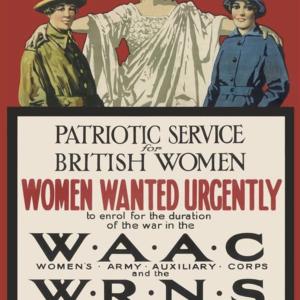
The Women’s Army Auxiliary Corps, generally known as the WAAC, began taking shape early in 1917 and was formally instituted on 7 July that year. Its creation followed the enormous losses of 1916, particularly on the Somme, which had intensified the Army’s shortage of men. Dr Mona Chalmers Watson became its first Chief Controller, helping establish a women’s organisation capable of working within the Army’s vast support system. Although its formal foundation came in July, recruitment and deployment were already under way, with the first small party reaching France on 31 March 1917.
Recruitment relied on volunteers, encouraged through posters, publicity and recruiting offices. Women already serving in organisations such as the Women’s Legion provided an experienced foundation. Applicants underwent interviews and medical examinations, and their civilian skills helped determine their employment. Typists could become clerks, while women experienced in catering, transport or stores could continue similar work in uniform. Patriotism encouraged many to join, but service also offered wages, independence, travel and an escape from the narrow choices available to women before the war. Some volunteered despite strong objections from their families.
The WAAC was organised differently from the male Army. Its members enrolled rather than enlisted, and their position resembled that of civilians in uniform. Instead of conventional military ranks, women could be designated officials, forewomen or workers. Wearing khaki tunics and skirts, they served as cooks, waitresses, clerks, telephonists, drivers, printers, bakers and storekeepers. Others tended military cemetery gardens, performing a quiet but deeply significant duty among the graves of those killed in the fighting.
Support work offered no guarantee of safety. Camps, railway centres and supply depots behind the Western Front were vulnerable to German aircraft. On the night of 29–30 May 1918, a bombing raid on the women’s camp at Abbeville killed nine members when a bomb struck their shelter trench. Their courage during the German Spring Offensive had already helped earn royal recognition, and on 9 April 1918 the organisation was renamed Queen Mary’s Army Auxiliary Corps. After the Armistice, some remained overseas to assist with the Army’s work, but the corps was finally disbanded in September 1921.
The Royal Navy faced a similar shortage of manpower. On 29 November 1917, King George V approved the formation of the Women’s Royal Naval Service, soon universally known as the Wrens. Its first Director was Dame Katharine Furse, an experienced organiser of wartime voluntary work. The purpose was straightforward: women would undertake duties ashore so that more sailors could serve at sea. Recruiting posters made the appeal directly, urging women to release men for sea service.
Early Wrens worked as cooks, clerks, telephonists and storekeepers, with opportunities expanding into aircraft handling and mechanical work. Naval terminology became part of their everyday lives: clerical staff were known as writers, while enlisted personnel were ratings. More than 6,000 women served during the organisation’s first existence. Despite their shore-based employment, travelling on wartime seas could be fatal. Wren Josephine Carr died when the passenger ship RMS Leinster was torpedoed in October 1918. The service was disbanded in 1919, but former members maintained their connections through the Association of Wrens.
As another European war approached, Britain again began organising women for military support duties. The Auxiliary Territorial Service was established in September 1938, with former WAAC officer Dame Helen Gwynne-Vaughan as its first Chief Controller. Its ancestry lay in the women’s Army service of the previous war, and veterans returned to help a new generation. Recruitment generally targeted women aged between 18 and 43, with the upper limit extended to 50 for former servicewomen. Applicants received initial training and trade assessments, although civilian experience often strongly influenced their eventual posting.
Life could be a shock for early recruits. Accommodation was sometimes basic, uniforms were scarce or poorly fitting, and the first jobs were largely cooking, clerical work, driving and managing stores. The ATS also struggled against prejudice and an image of being less glamorous than the naval and air services. Recruiting campaigns therefore promoted both useful service and the appeal of life in uniform. In 1941, Abram Games produced his famous “blonde bombshell” poster showing an attractive ATS woman. It provoked arguments in Parliament over whether glamour was a suitable recruiting tool and was eventually withdrawn.
Meanwhile, the Wrens had reformed in 1939 under Vera Laughton Mathews, herself a veteran of the original service. Their recruiting message, “Free a Man for the Fleet”, echoed the earlier war. Women entered an increasingly broad range of naval occupations, and the organisation eventually grew to roughly 75,000 personnel. Overseas postings also brought danger: in August 1941, the sinking of SS Aguila killed 21 Wrens and a naval nursing sister travelling to Gibraltar.
The ATS acquired full military status in 1941, and December brought a major change when conscription was extended to women. Initially applying to single women aged 20 to 30, the system directed women towards essential national work, which could mean industry, agriculture or one of the women’s auxiliary services. It did not mean every woman called up had to enter the Army. Alongside the ATS and Wrens stood the Women’s Auxiliary Air Force, providing another route into uniformed service.
As the war continued, ATS duties expanded into vehicle maintenance, communications, ammunition inspection, military policing and anti-aircraft defence. Around 56,000 women were serving with anti-aircraft units by 1943. They operated searchlights, radar and range-finding equipment, helping locate enemy aircraft and calculate firing information. Regulations prevented them from firing the guns themselves, but their work placed them directly within Britain’s air defences. Across the service, 335 women were killed by enemy action.
Women joined from across the Empire, although recruitment was marked by discrimination. Black Caribbean applicants initially faced rejection from the War Office, and it was not until 1943 that black West Indian women were accepted into the ATS. Women also received lower pay than male soldiers of equivalent standing. Alongside the demands of military work, they had to overcome assumptions about their abilities and behaviour.
The most famous ATS recruit was Princess Elizabeth, who joined in February 1945 and trained as a driver and mechanic. Photographs of the future Queen working on military vehicles became an enduring image of women’s wartime service. By the end of the conflict, around 250,000 women had served in the ATS. This time, their contribution secured a lasting place in the Army: in 1949, its remaining personnel transferred into the newly formed Women’s Royal Army Corps. The Wrens also survived the war and continued until their integration into the Royal Navy in 1993. What had begun as an emergency response to manpower shortages had become a permanent part of Britain’s armed forces.