On this day in military history…
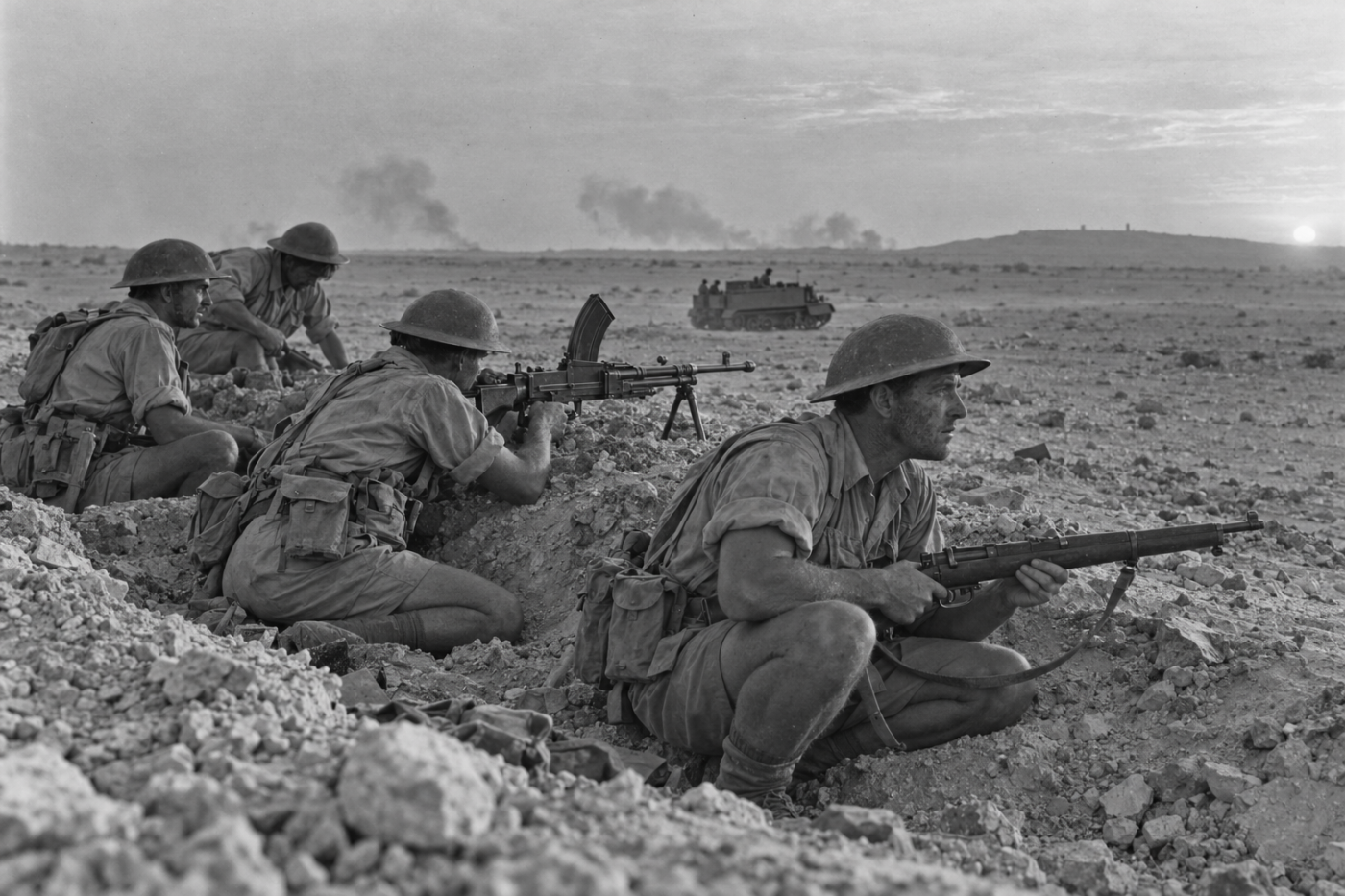
On 26 October 1942, Australian soldiers captured Trig 29, a modest rise in the Egyptian desert that became one of the most fiercely contested positions in the Second Battle of El Alamein. Its height was unremarkable, but across the surrounding flat ground it offered valuable observation over the battlefield. Taking and holding it formed part of the Australian 9th Division’s crucial contribution to the Allied victory over Field Marshal Erwin Rommel’s German and Italian army. The struggle had begun months earlier, when Axis forces advanced into Egypt, threatening Alexandria and the approaches to the Suez Canal. Between the Mediterranean coast and the difficult terrain of the Qattara Depression, the British Eighth Army established a defensive line that Rommel could not easily outflank. Australian troops fought costly actions there during July, helping prevent a further advance. By October, the Eighth Army, now commanded by Lieutenant-General Bernard Montgomery, had prepared a major offensive to drive the Axis forces back.
Commanded by Lieutenant-General Leslie Morshead, the 9th Division brought experience gained during the defence of Tobruk. Its men knew the demands of desert warfare, where minefields, concealed guns and exposed approaches could turn a short advance into a costly struggle. Their position in the northern sector placed them at the centre of some of the battle’s hardest fighting. The offensive opened on the night of 23 October with a tremendous artillery bombardment. Infantry advanced into the Axis defensive belt while engineers cleared routes through the minefields, but although ground was gained, the hoped-for armoured breakthrough failed to develop. Montgomery’s army faced a grinding battle in which enemy positions had to be worn down through repeated attacks. The Australians received a particularly demanding task: to press towards the coast, threatening German positions around the railway and coastal road.
On the night of 25–26 October, the Australian 26th Brigade attacked again. The 2/48th Battalion advanced towards Trig 29, while the 2/24th attacked on its right. In a carefully timed move, C Company of the 2/48th rode forward in Bren gun carriers, reaching the rise as the supporting artillery barrage lifted. Their sudden arrival surprised the defenders, but securing the position still demanded fierce close-quarter fighting. Elsewhere along the advance, enemy strongpoints continued firing into the infantry. Among those moving forward was Private Percival Eric “Percy” Gratwick, a Western Australian who had turned forty only a week earlier. Before the war he had worked as a prospector, drover and blacksmith. Now his platoon was being torn apart by enemy fire. Its commander and sergeant were casualties, and only a handful of men remained to carry the attack forward.
With his comrades pinned down, Gratwick charged an enemy post, using grenades before attacking with his rifle and bayonet. He destroyed the position, including a mortar crew, then turned towards a second post from which heavy fire was still coming. Charging again, he inflicted further casualties before a burst of machine-gun fire killed him close to the position. His actions helped the surviving Australians continue their advance. He was posthumously awarded the Victoria Cross and buried in El Alamein War Cemetery, where his headstone bears the words “Rest in the Lord.” Behind the movement of battalions and brigades, his death represented the intensely personal cost of taking a few hundred yards of desert.
Capturing Trig 29 was only the beginning. The Germans recognised its importance and repeatedly tried to recover it. Over the following days, the Australians endured around twenty-five counter-attacks. The 2/48th, and subsequently the 2/17th Battalion, held the ground under severe pressure. Artillery observers used the position to direct fire against approaching troops, while anti-tank guns helped protect the infantry from armoured assaults. One Australian signaller described it as the worst place he had experienced during the war. The continuing attacks towards the coast drew German reserves into the northern sector, helping create the conditions for Montgomery’s next breakthrough attempt. Operation Supercharge began on 2 November, and by 4 November the Axis position was collapsing. Victory came at a heavy price: the Australian 9th Division lost 620 men killed and nearly 2,000 wounded during the October–November battle. The capture of Trig 29 was one part of that wider victory, won through the combined efforts of infantry, engineers, gunners and armour, and held by men who endured repeated attacks on ground they could scarcely afford to surrender.