WW1 German Marching Boots
When German infantry marched to war in August 1914, their heavy leather boots were as much a part of their appearance as the spiked Pickelhaube helmet and the long Mauser rifle. Known as the Marschstiefel, or marching boot, this practical piece of equipment belonged to a military tradition stretching back decades. It would accompany the Kaiser’s soldiers from the roads of Belgium and France into the mud of the Western Front, where even the toughest footwear faced conditions its designers could scarcely have imagined.
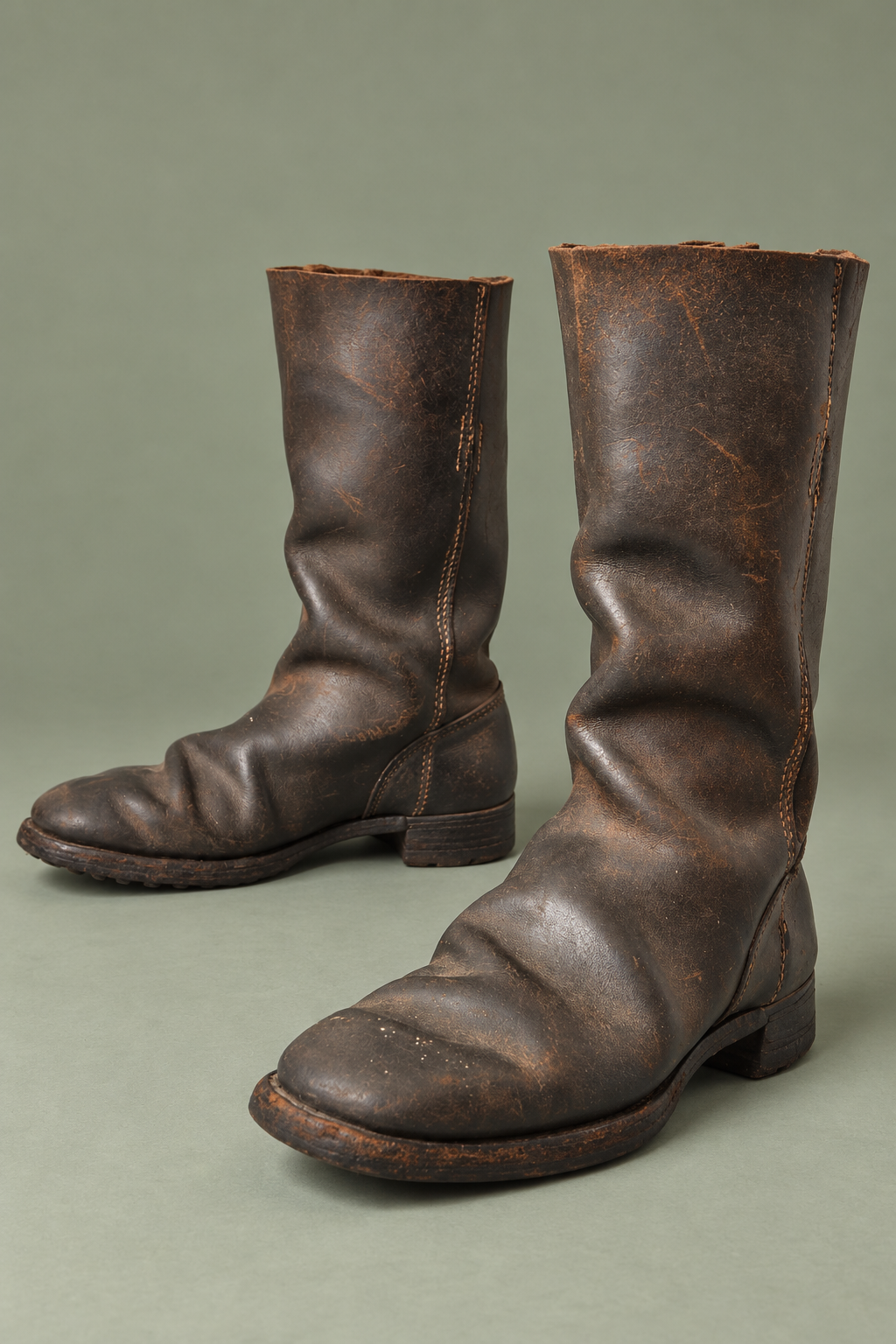
The familiar infantry marching boot traced its origins to the Prussian pattern introduced in 1866. Rather than fastening with laces, it had a broad leather shaft through which the soldier pulled his foot, with his trouser legs tucked inside. Its plain shape made it instantly recognisable, while the tall upper offered protection against dirt, undergrowth and splashes. German soldiers nicknamed these boots Knobelbecher, meaning dice cups, a humorous reference to their hollow, cylindrical shape.
Built for hard service, the boots combined substantial leather uppers with thick leather soles. Hobnails driven into the underside helped protect against wear, while an iron reinforcement guarded the heel. Surviving wartime examples retain zinc-plated hobnails and steel heel fittings, showing how leather and metal worked together to withstand repeated marching. On hard roads, these fittings produced the distinctive clatter associated with columns of infantry.
Although the German jackboot is often imagined as black, many soldiers entered the First World War wearing brown leather boots. With the introduction of field-grey uniform before the conflict, marching boots were supplied in a natural brown finish. Wartime regulations in 1915 required them to be blackened, although wear, maintenance and differences in supply meant their appearance was far from uniform. An old pair might show darkened surfaces, lighter creases and patches where the original leather colour remained visible.
The pull-on design had clear advantages: there were no laces to break, and a soldier could put his boots on without fastening separate gaiters. However, the shaft had to be wide enough to admit the foot, limiting how closely it could fit around the ankle. Internal loops helped the wearer pull the boots into place, while some soldiers used additional straps around the ankle and beneath the instep to hold them more securely. A comfortable fit mattered enormously when a man was expected to march carrying his rifle, ammunition, pack and other equipment.
Trench warfare exposed the limitations of the tall leather boot. Its upper could keep out shallow splashes, but water entering over the top remained a serious problem. Prolonged soaking softened leather, while mud added weight and worked its way into every crease. No ordinary marching boot could reliably keep a soldier’s feet dry through days spent in flooded positions. Across the armies of the Western Front, maintaining footwear and finding opportunities to dry feet and change socks became essential parts of survival.
As the war continued, the German soldier’s footwear became more varied. Short lace-up boots, known as Schnürschuhe, were also worn, often with cloth puttees wrapped around the lower leg. These were established military footwear rather than an entirely new wartime invention: a surviving German pair collected at Vaire Wood in July 1918 follows an earlier side-laced pattern. Their presence illustrates how older equipment continued in service alongside newer issues.
Material shortages increasingly affected manufacture. A German ankle boot taken from a wounded soldier at Morlancourt in June 1918 had a heel built from layers of wood and an inner lining made from woven reed. Preserved by the Australian War Memorial, it provides striking evidence of the substitute materials used as supplies dwindled. Later examples of German lace-up footwear even featured woven-paper uppers, a considerable departure from the substantial leather boots associated with the army of 1914.
The marching boot nevertheless remained one of the enduring symbols of the German infantryman. Its importance lay in the ordinary work it performed: carrying men along roads, through communication trenches and across broken ground. Surviving examples, with their worn heels, cracked leather and deeply folded insteps, offer a direct connection to that experience. Behind every pair was a soldier whose ability to keep moving depended on the condition of his feet and the boots protecting them.