On this day in military history…
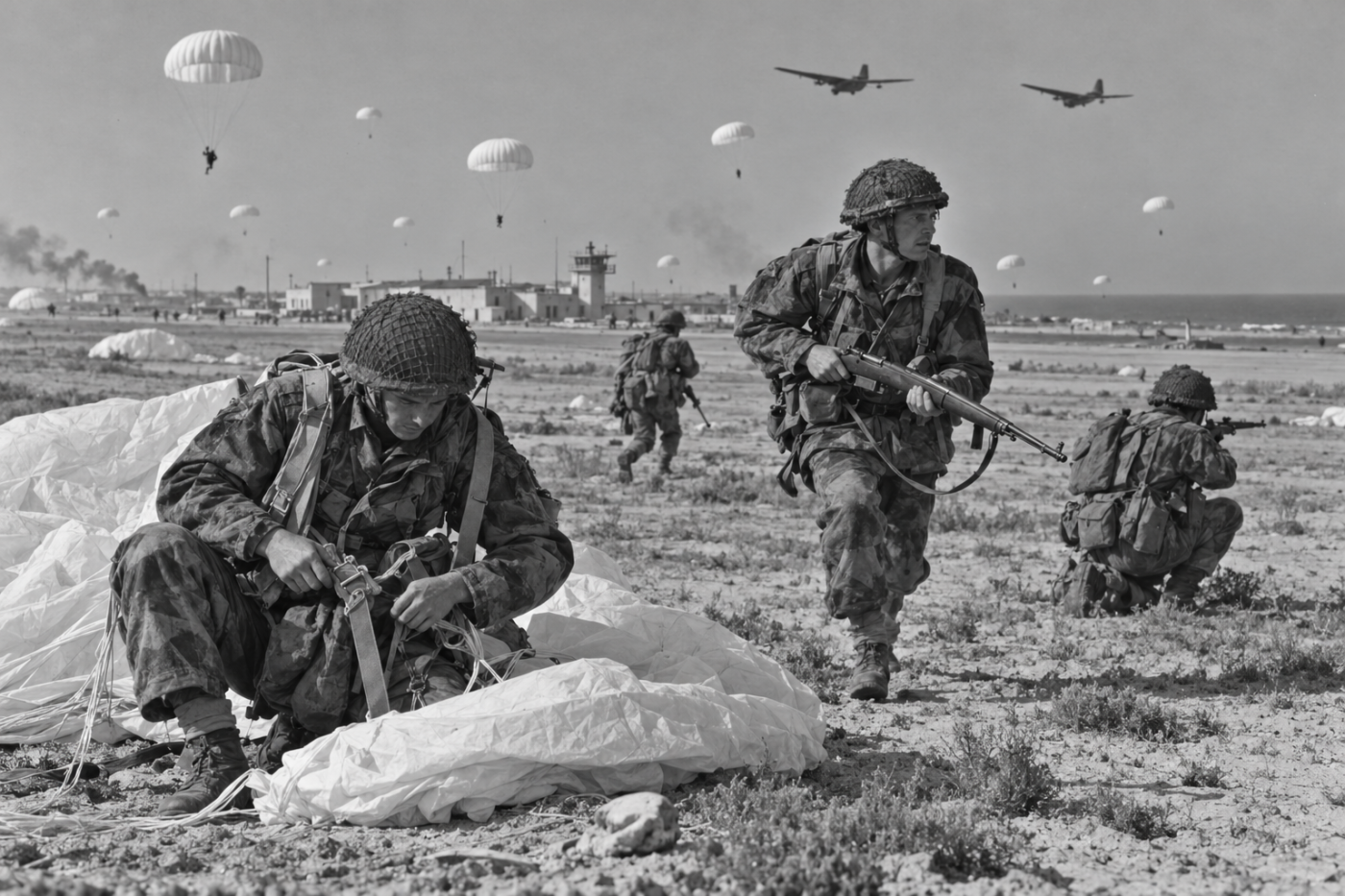
On 5 November 1956, men of the 3rd Battalion, The Parachute Regiment, jumped into Egyptian gunfire above El Gamil airfield, west of Port Said. Their task was to seize the airfield and begin clearing the coastal defences ahead of an Anglo-French invasion from the sea. The operation would become the last British battalion-scale parachute assault in combat.
The Suez Crisis had begun that July when Egyptian president Gamal Abdel Nasser nationalised the Suez Canal Company. Britain and France regarded this as a threat to their interests and secretly agreed a plan with Israel: an Israeli invasion of Sinai would provide the pretext for Anglo-French intervention, presented publicly as an operation to separate the combatants and protect the canal. Israel attacked on 29 October, followed by Anglo-French air strikes against Egypt.
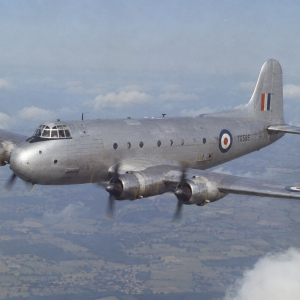
For Lieutenant Colonel Paul Crook’s 3 PARA, the immediate problem was a demanding landing area. El Gamil occupied a narrow coastal strip, with the Mediterranean on one side and Lake El Manzala on the other. RAF Valetta and Hastings transports carried the battalion from Cyprus, while additional aircraft brought jeeps, recoilless anti-tank guns and other heavy equipment. Accurate flying and rapid exits were essential: there was little room for men to drift beyond the drop zone.
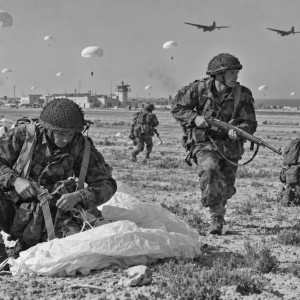
The paratroopers carried heavy weapons, ammunition and signals equipment as well as their personal kit. Inside the Valettas, some men had to manoeuvre their equipment over the wing spar before reaching the door. They jumped without reserve parachutes, which had only recently been introduced into British airborne service.
Egyptian defenders opened fire as the soldiers descended. Once down, the Paras had to release their parachutes, recover their weapons and form fighting groups while the assault continued around them. Aircraft were still delivering men and equipment as the first troops moved against the airfield’s defenders.
A Company attacked the western end, taking the control tower and silencing a bunker covering the landing area. B Company secured the eastern end before encountering determined resistance around a sewage farm. C Company initially formed the battalion reserve, while D Company arrived later with further ammunition.
The airfield was captured in approximately half an hour, although clearing it for aircraft and fighting towards Port Said took longer. Within seven hours, the battalion group had secured and cleared the airfield and advanced roughly two miles towards the town. The assault and subsequent fighting cost 3 PARA four men killed and 32 wounded.
On 6 November, Royal Marine Commandos landed by sea, supported by tanks, while other Marines were carried ashore by helicopter. Further reinforcements included 2 PARA. The airborne assault had secured an important foothold before the main landings, but the campaign was already being overtaken by events beyond the battlefield.
International opposition, particularly American diplomatic and financial pressure, forced Britain and France to halt. A ceasefire came into effect at midnight on 6–7 November, followed by withdrawal and the arrival of a United Nations force. Nasser remained in power, and the intervention became a major political humiliation for the British government.
For the men of 3 PARA, El Gamil remained a hard-fought battalion achievement within that failed campaign. They had landed under fire, captured their objective and opened the way for the forces following them. The events of 5 November 1956 secured their place in Airborne history as the soldiers who carried out Britain’s last battalion-scale combat parachute drop.