On this day in military history…
By November 1917, the Belgian village of Passchendaele had become little more than a name on a map. Its houses had been smashed, its roads torn apart and the surrounding fields reduced to a wilderness of mud and water-filled shell holes. On 6 November, Canadian soldiers fought their way into these ruins, capturing an objective that had come to symbolise the suffering of the Western Front.
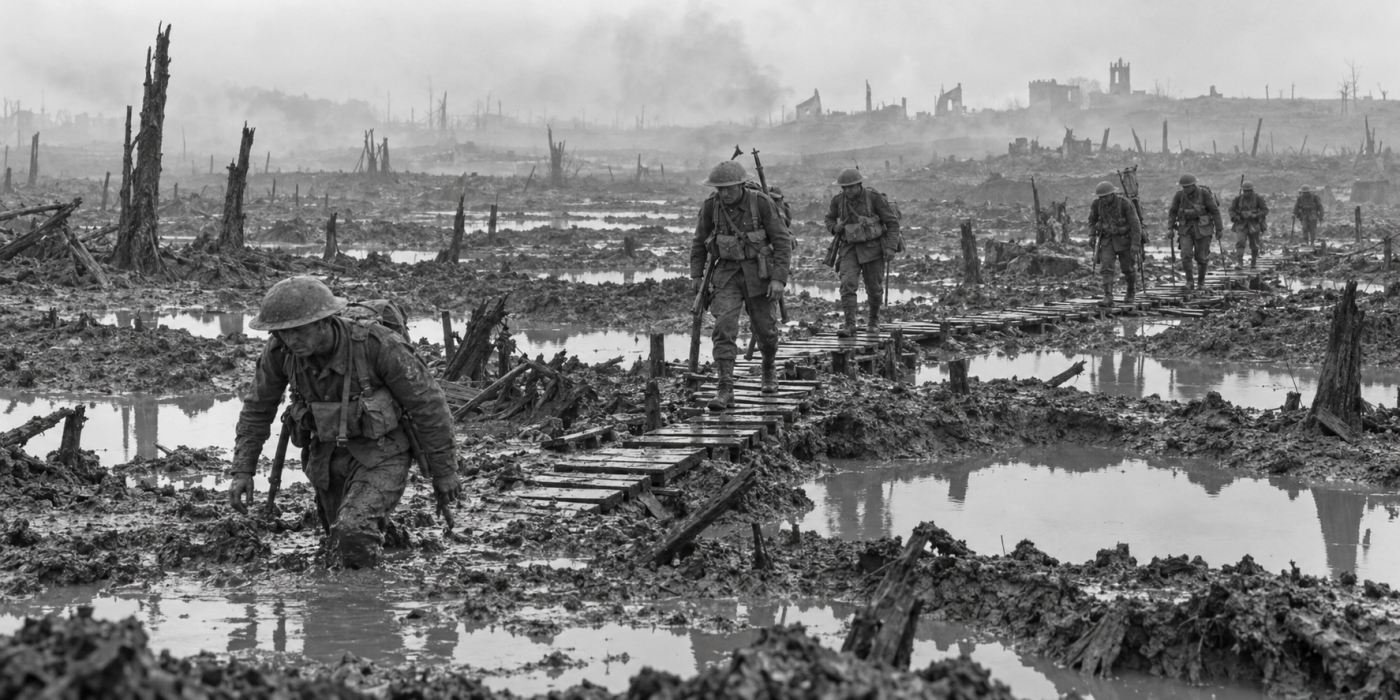
The assault formed part of the Third Battle of Ypres, which had begun on 31 July. The British-led offensive had sought a breakthrough in Flanders, with the longer-term aim of reaching the Belgian coast and threatening German submarine bases. Instead, repeated attacks had brought enormous losses for limited gains. Shellfire had destroyed drainage systems, while rain turned the battlefield into a quagmire. Moving ammunition, bringing up guns and carrying wounded men to safety became exhausting and dangerous tasks.
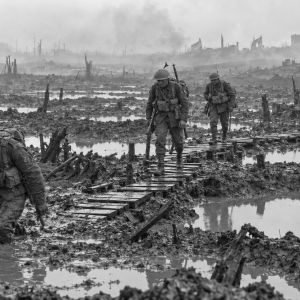
For the infantry, simply reaching the front line could be an ordeal. Wooden duckboard tracks provided narrow routes across the devastated ground, but leaving them could mean sinking into deep mud. Men struggled forward carrying rifles, ammunition, grenades and equipment, often already exhausted before an attack began. Wounded soldiers faced the frightening prospect of lying exposed in flooded shell holes until stretcher-bearers could reach them.
The Canadian Corps, commanded by Lieutenant-General Sir Arthur Currie, entered the battle in October. Its soldiers inherited a battlefield already fought over by British, Australian and New Zealand troops. Currie insisted on careful preparation before committing his men, organising a series of limited attacks supported by artillery. Progress would depend on taking ground in stages and holding it against German counterattacks.
The Canadians attacked on 26 October and again on 30 October, gradually closing on Passchendaele. German concrete pillboxes and machine-gun positions remained formidable obstacles. Often, small groups of infantry had to work their way forward through the mud to overcome strongpoints that had survived the bombardment. Capturing one position did not necessarily make the surrounding ground safe, as neighbouring machine guns could continue firing across the approaches.
At 6 a.m. on 6 November, the next assault began beneath a heavy artillery barrage. The 1st and 2nd Canadian Divisions advanced, with the 2nd Division responsible for capturing Passchendaele itself. Following closely behind the barrage, Canadian infantry reached some German positions before their defenders could properly organise resistance. Elsewhere, machine guns and surviving pillboxes forced them into fierce fighting among the wreckage.
The task of taking the village fell to the 27th Battalion, the City of Winnipeg Battalion. Its men fought into the ruins and secured Passchendaele that day. To the north and north-west, other Canadian units fought towards their objectives around Mosselmarkt and the neighbouring high ground. The success depended on these supporting advances as well as the capture of the village itself.
After months of fighting towards the ridge, Allied troops finally occupied the shattered settlement. There was scarcely a recognisable village left to capture, and its name carried far greater significance than its ruined buildings. The higher ground offered an advantage, but the exhausted attackers now had to prepare for German attempts to recover it.
The battle was still not over. The Canadians withstood counterattacks, and a further assault on 10 November secured additional ground along the ridge. Their achievement required courage and endurance under conditions that pushed men to their physical limits. Nine Canadians received the Victoria Cross during the Canadian fighting at Passchendaele.
The capture was a hard-won battlefield success, but the wider breakthrough sought in Flanders had never materialised. Passchendaele became remembered for the immense human cost of gaining a relatively small stretch of ground. For the Canadian soldiers who reached its ruins on 6 November, it was the end of a terrible advance—and the beginning of the struggle to hold what they had won.