Mefo System
Germany’s rearmament under Adolf Hitler required vast sums of money that the German government did not officially possess. The solution was an ingenious but ultimately dangerous financial device known as the MEFO bill. It allowed the Nazi regime to order aircraft, tanks, weapons and ammunition on an enormous scale while concealing much of the spending from the German public, foreign governments and the normal state budget.
The name MEFO came from Metallurgische Forschungsgesellschaft, meaning Metallurgical Research Company. Despite its impressive title, MEFO was not a genuine industrial concern. It was a small dummy company created in 1934 with nominal capital supplied by several major German armaments firms, including Krupp, Siemens, Rheinmetall and Gutehoffnungshütte. It had no factories and produced nothing. Its real purpose was to issue promissory notes that could be used to pay companies carrying out secret rearmament contracts.
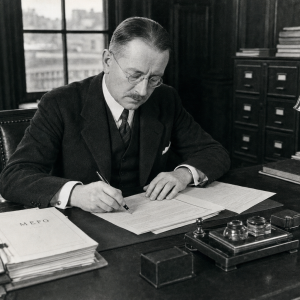
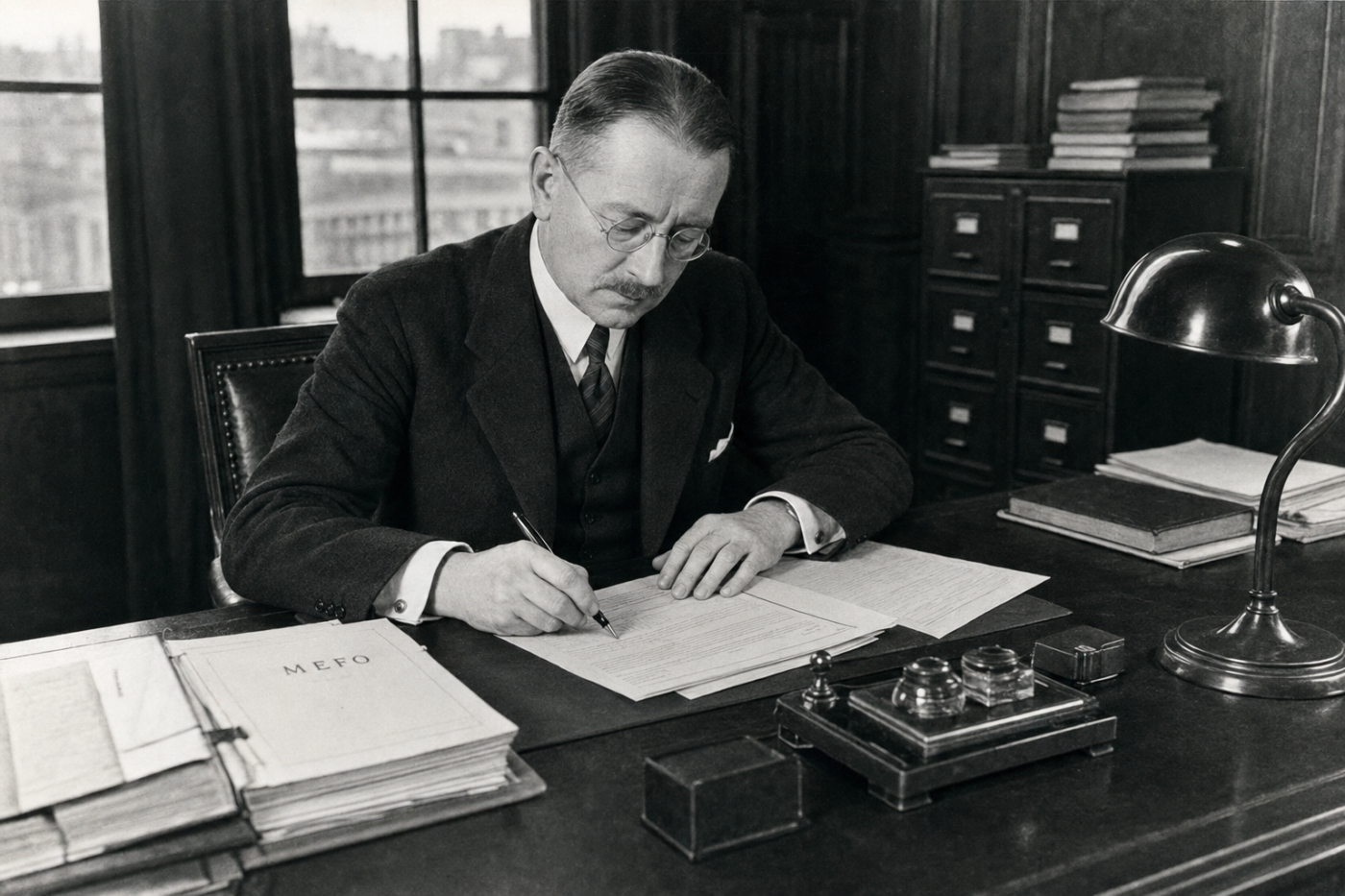
The central figure behind the system was Dr Hjalmar Schacht, one of the most influential financial officials in Germany. Schacht had previously helped stabilise the German currency after the catastrophic hyperinflation of 1923. Hitler reappointed him president of the Reichsbank in 1933, and in 1934 he also became Minister of Economics. Although Schacht was not originally a committed Nazi ideologue, he believed that rearmament and large public works programmes could revive the German economy, reduce unemployment and restore Germany’s position as a major power.
Schacht worked closely with Hitler, who demanded rapid rearmament regardless of the financial consequences. Other important figures included Finance Minister Count Lutz Schwerin von Krosigk, who had responsibility for the official national budget, and Hermann Göring, whose influence increased after he took control of the Four Year Plan in 1936. The armaments companies that formally established MEFO also played an essential part because their involvement gave the paper notes the appearance of commercial transactions rather than direct government borrowing.
The system worked by placing a financial intermediary between the German government and its arms manufacturers. A company such as Krupp might receive an order to manufacture artillery pieces for the armed forces. Instead of being paid immediately in ordinary Reichsmarks from the government budget, the company received a MEFO bill. This was effectively an official promise that the money would be paid later.
The bills were issued in the name of the dummy MEFO company, but they were guaranteed by the German government and accepted by the Reichsbank. They normally had an initial maturity of six months and paid interest of approximately four per cent. They could be repeatedly extended, eventually allowing repayment to be delayed for as long as five years. This made them attractive to arms manufacturers, commercial banks and other financial institutions.
A manufacturer receiving a MEFO bill had several choices. It could keep the bill and collect the interest, use it to settle debts with another business or sell it to a commercial bank in exchange for ordinary currency. The commercial bank could then hold the bill or rediscount it at the Reichsbank. The Reichsbank’s guarantee meant that the bills were treated almost like money, even though they did not appear in the ordinary budget as direct government expenditure.
This gave Hitler’s government several important advantages. It allowed the regime to spend far beyond the income raised through taxation, disguised the true scale of rearmament and delayed the immediate inflationary effects of creating additional money. It also kept official government borrowing figures artificially low. Foreign observers knew Germany was rearming, but the MEFO system made it much more difficult to calculate the true speed and cost of the programme.
The system was particularly useful because Germany still faced restrictions and financial weaknesses following the First World War, the Great Depression and the international banking crisis of 1931. Openly printing billions of Reichsmarks risked causing another collapse in confidence. Memories of the 1923 hyperinflation remained extremely powerful among the German population. MEFO bills enabled the government to create credit quietly and direct it almost entirely towards selected industries.
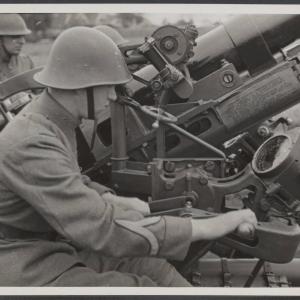
Between 1934 and 1938, approximately 12 billion Reichsmarks’ worth of MEFO bills were issued. At their height, they financed a very large proportion of German rearmament. The money helped pay for the expansion of the Luftwaffe, the construction of tanks and warships, the production of artillery and ammunition and the rapid enlargement of the German armed forces. Alongside direct government spending and special tax certificates, MEFO bills helped transform Germany from a restricted post-war state into a heavily armed military power.
The system also stimulated the wider economy. Arms manufacturers expanded their factories, purchased raw materials and employed hundreds of thousands of workers. Steel, chemicals, engineering, vehicle production and construction all benefited. Unemployment fell dramatically, although the improvement was not solely the result of Nazi economic policy. Military conscription, labour schemes, the removal of many women and Jewish people from recorded employment, and the gradual international recovery also affected the figures.
MEFO bills did not provide Germany with *blocked text*. They postponed payment rather than removing it. Every bill represented a future claim against the German government. As more bills were issued and their maturity dates approached, the hidden debt became increasingly difficult to manage. By 1938, the regime faced the prospect of having to redeem billions of Reichsmarks’ worth of paper.
Schacht understood the danger. Germany was already suffering from shortages of foreign currency and important imported materials such as oil, rubber and certain metals. Rapid military expenditure was placing increasing pressure on wages, prices and industrial capacity. Schacht feared that continued uncontrolled rearmament would produce inflation and a serious financial crisis. He attempted to slow military spending and resisted further expansion of the MEFO system.
Hitler had no intention of reducing rearmament. In 1936, he placed Göring in charge of the Four Year Plan, whose purpose was to prepare the German economy and armed forces for war within four years. Göring favoured even greater state direction, synthetic fuel production, substitute materials and massive military expenditure. His growing authority weakened Schacht’s control of German economic policy.
Schacht resigned as Minister of Economics in November 1937, although he remained president of the Reichsbank for a time. In January 1939, after he and other Reichsbank officials warned Hitler about excessive government spending and the danger of inflation, Schacht was dismissed from that position as well. The MEFO bills were gradually replaced by other forms of compulsory credit, government debt and financial controls.
The immediate repayment crisis was managed through extensions, refinancing and pressure on banks and financial institutions to hold government paper. The regime tightly controlled prices, wages, imports and access to foreign currency. Savings deposited by ordinary Germans were increasingly channelled through banks and insurance organisations into government debt. In effect, the state was absorbing the country’s available financial resources to keep the military programme moving.
Germany also used more direct and aggressive methods of raising money. Jewish citizens were subjected to discriminatory taxes, confiscation and the forced transfer of their businesses and property. After the annexation of Austria and the occupation of Czechoslovakia, the Nazis seized gold reserves, foreign currency, industrial assets and other resources. Once the war began, occupied countries were forced to pay enormous occupation costs, supply goods at controlled prices and accept financial arrangements that transferred wealth to Germany.
The conquest of other countries therefore became connected to the survival of the German war economy. Germany entered the war with a powerful military-industrial system but with severe weaknesses in raw materials, foreign currency and long-term finance. Victories in the early years provided captured equipment, food, oil, labour and money. Instead of resolving the underlying financial problem, expansion and conquest temporarily transferred its cost to the occupied nations.
MEFO bills were an exceptionally clever method of disguised credit creation, but they were never a sustainable economic foundation. They succeeded because businesses and banks believed that the German government and Reichsbank stood behind them. They gave Hitler several crucial years in which to rearm faster than Germany’s visible finances appeared to permit. At the same time, they created a mountain of hidden debt and helped push the German economy towards dependence on continued expansion, strict state control and eventually plunder.
The MEFO system demonstrated how financial engineering could be used as a weapon of preparation long before the first shots were fired. Schacht supplied the technical knowledge, Germany’s industrial firms provided the machinery, and Hitler supplied the political demand for rearmament at almost any cost. It was one of the most important financial devices behind Germany’s preparation for the Second World War—and one whose bills were ultimately paid not only in money, but through conquest, confiscation and the devastation of Europe.