Volkssturm Formed
On 18 October 1944, Nazi Germany publicly launched the Volkssturm, a militia intended to bring millions of civilians into the defence of the country as Allied armies approached from east and west. Its creation had been ordered in Hitler’s decree dated 25 September 1944, which called upon German men aged between 16 and 60 who were capable of bearing arms and were not already serving. The October launch was deliberately timed to coincide with the anniversary of the Battle of Leipzig in 1813, allowing Nazi propaganda to draw comparisons with the struggle against Napoleon.
By the autumn of 1944, Germany faced a military crisis on both major fronts. In the west, Allied forces had advanced through France towards the German frontier, while the Red Army threatened the Reich from the east. Years of fighting had depleted the armed forces, and the leadership sought another source of manpower to reinforce resistance. The Volkssturm was intended to relieve regular troops by providing men to construct fortifications, guard important locations and defend their own towns and villages. The regime envisaged recruiting six million men, although this ambition did not mean that six million trained and properly equipped soldiers became available.
Organisation rested heavily with the Nazi Party. Martin Bormann oversaw recruitment and political arrangements, with regional party leaders responsible for raising units locally. Heinrich Himmler, as commander of the Replacement Army, held responsibility for military training and equipment. This structure placed the mobilisation of civilians firmly within the party’s machinery, while presenting service as a national obligation in Germany’s moment of danger.
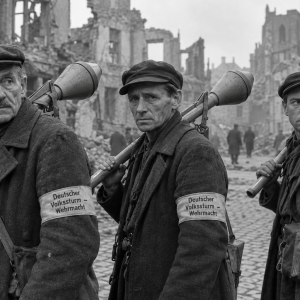
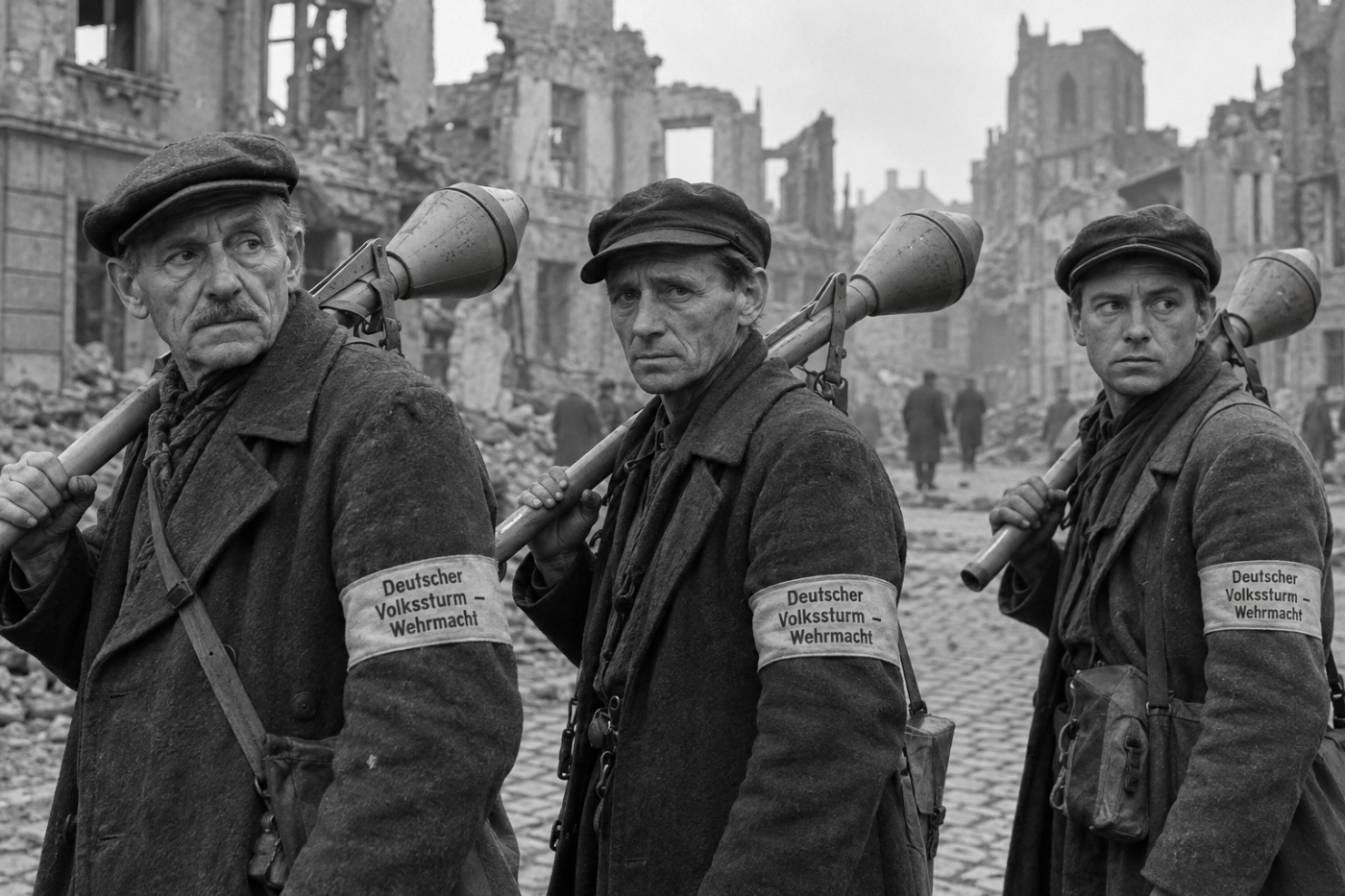
The men assembled for duty were a mixture of teenagers, older civilians and men who had previously remained outside the fighting forces. Many lacked recent military experience, and hurried instruction could provide little preparation for facing experienced Allied formations. Clothing reflected the shortages: civilian coats and assorted garments often took the place of army uniforms. An armband bearing the words “Deutscher Volkssturm – Wehrmacht” identified their military role, producing the familiar photographs of apparently ordinary townsmen carrying weapons through German streets.
Weapons and training were inadequate for the task imposed upon them. Rifles and machine guns required instruction that often had to be compressed into short courses. The Panzerfaust became particularly associated with the militia because it was portable, relatively straightforward to operate and capable of penetrating tank armour. Possessing an effective anti-tank weapon, however, could not compensate for the wider disadvantages of poorly prepared units confronting an enemy with superior military resources.
Propaganda portrayed the Volkssturm as a reserve capable of helping secure victory, but its battlefield performance varied. Some formations surrendered or broke up when confronted by Allied troops; others fought desperately, particularly in the east, where fear of the approaching Red Army strengthened resistance. Thousands were drawn into the final battles, and tens of thousands died. Launched as an answer to Germany’s dwindling manpower, the Volkssturm became one of the clearest symbols of the regime’s determination to continue the war by committing its youngest and oldest available men to a struggle it could no longer win.