Argyll & Sutherland Highlanders Regiment
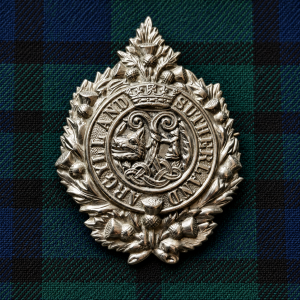
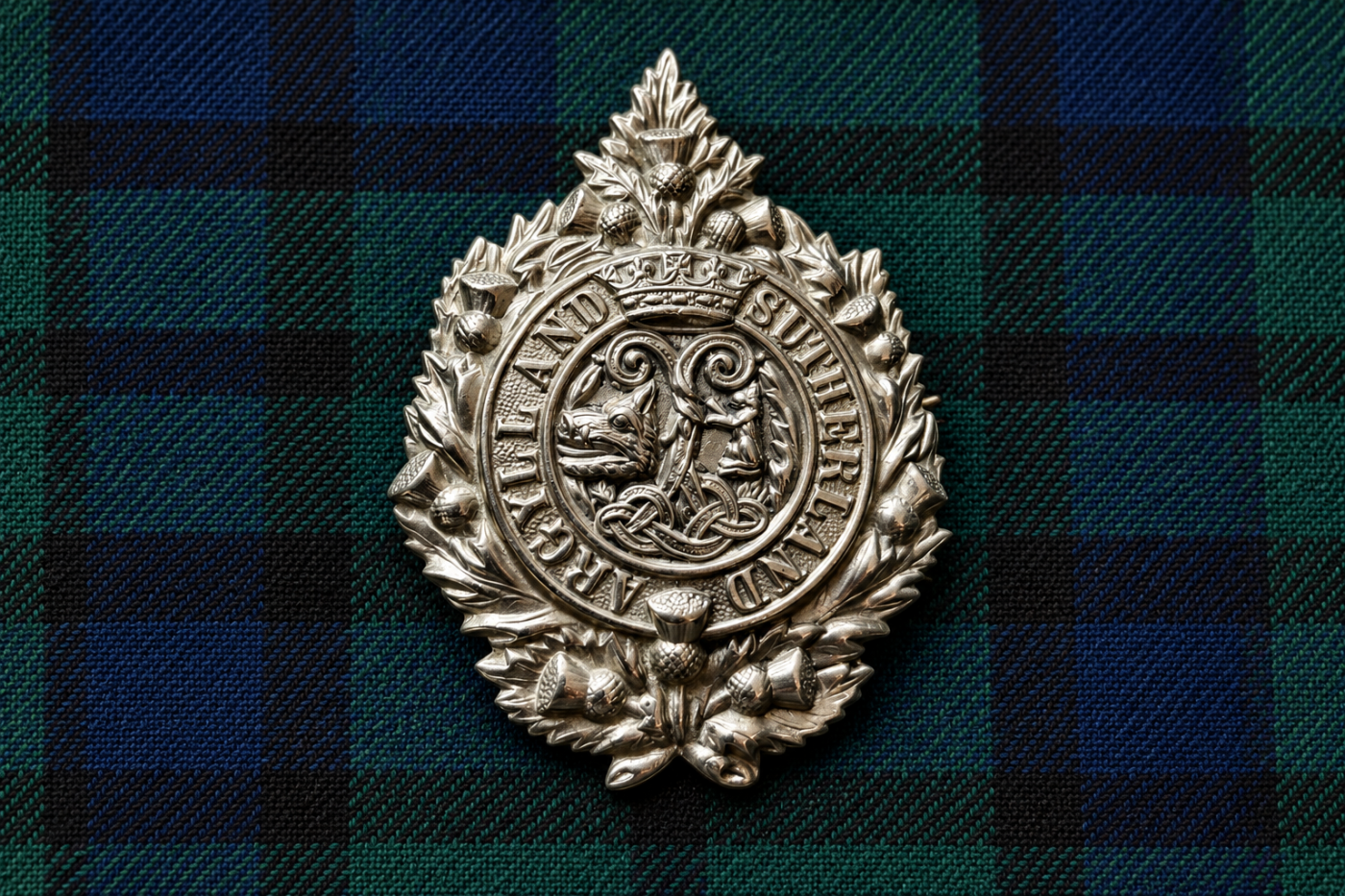
The Argyll and Sutherland Highlanders occupy a distinguished place in British military history, with service stretching from the campaigns against Napoleon to the world wars, Korea and modern overseas operations. Known affectionately as the Argylls, they combined strong Scottish traditions with discipline and determination under fire. They also possessed a striking distinction in military dress: their traditional cap badge is widely described as the largest in the British Army, standing around three inches tall, although dimensions vary between patterns. Its silver-coloured design combined the Argyll boar’s head and Sutherland wildcat within a wreath of thistles, alongside Princess Louise’s coronet and interlaced “L” cypher. Worn on the dark glengarry, it made the regiment immediately recognisable.
The regiment was formed on 1 July 1881 under the Childers Reforms by amalgamating the 91st Argyllshire Highlanders and the 93rd Sutherland Highlanders, which became its 1st and 2nd Battalions respectively. Initially called Princess Louise’s (Argyll and Sutherland) Highlanders, it adopted the title The Argyll and Sutherland Highlanders (Princess Louise’s) in 1921. The Argyllshire regiment had been raised in 1794 by Duncan Campbell of Lochnell, initially numbered the 98th before becoming the 91st in 1796. Its early service included the capture of the Cape of Good Hope and the Peninsular War, fighting at Roliça, Corunna, Vitoria, Nivelle, Orthes and Toulouse. During the Waterloo campaign it guarded Wellington’s flank at Halle rather than fighting in the battle itself.
The Sutherland Highlanders were raised in 1799, but their most celebrated achievement came at Balaklava on 25 October 1854 during the Crimean War. Under Sir Colin Campbell, men of the 93rd stood between advancing Russian cavalry and the British base, forming a line only two ranks deep instead of the infantry square normally used against horsemen. Their disciplined volleys turned the cavalry back, while war correspondent William Howard Russell’s description of the slender scarlet formation gave rise to the enduring name “The Thin Red Line”. Further distinction followed during the Indian uprising of 1857, when six men of the 93rd earned the Victoria Cross in a single day at the storming of the Secundra Bagh in Lucknow on 16 November.
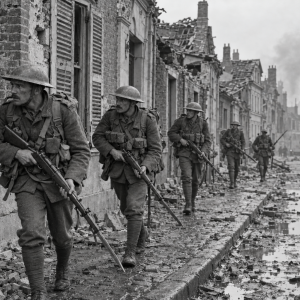
During the South African War of 1899–1902, the 1st Battalion fought at Modder River, Magersfontein and Paardeberg. The First World War brought a much greater expansion, with 27 battalions raised across the regiment’s fighting, reserve and training formations. The Argylls served on the Western Front, at Gallipoli and in Salonika, earning 78 battle honours and six Victoria Crosses. More than 6,900 men lost their lives, leaving a lasting absence in the Scottish communities from which they had been recruited. The Second World War again scattered the battalions across distant battlefields: the 1st served in Africa, Crete, Sicily and Italy, while the 2nd fought in Malaya and Singapore. A replacement 2nd Battalion later campaigned from Normandy to the River Elbe during 1944–45.
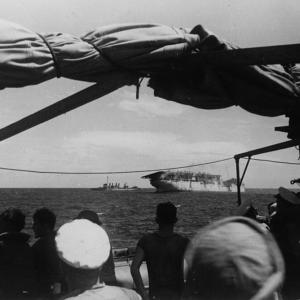
Malaya became one of the regiment’s most poignant chapters. As British forces retreated towards Singapore, the 2nd Battalion fought costly delaying actions against the Japanese. Its depleted ranks were reinforced by Royal Marines who had survived the sinking of HMS Prince of Wales and HMS Repulse, creating the formation remembered as the “Plymouth Argylls”. Highlanders and Marines fought together during the defence of Singapore, but surrender in February 1942 brought captivity for many survivors. Some were forced to labour on the Burma–Thailand Railway, while others were transported towards Japan. Their shared fighting and suffering established an enduring bond between the regiment and the Royal Marines.
In August 1950, the 1st Battalion landed at Pusan among the first British infantry units committed to the Korean War. At Hill 282 on 23 September, the Argylls faced North Korean counter-attacks and a devastating mistaken American air strike. Major Kenneth Muir, the battalion’s second-in-command, organised the defence, distributed ammunition and helped protect the wounded before leading a counter-attack. He was killed during the fighting and awarded a posthumous Victoria Cross. By the end of the battalion’s Korean service, 43 Argylls had been killed and 179 wounded.
Another famous episode came in Aden in 1967, when Lieutenant-Colonel Colin Mitchell led the Argylls back into the Crater district after a mutiny and deadly ambushes had forced British troops to withdraw. The operation attracted enormous publicity and made Mitchell, popularly known as “Mad Mitch”, a household name, although the wider campaign ended with Britain’s withdrawal later that year. Subsequent service included Northern Ireland, Germany, Bosnia, Kosovo and Iraq. In 2006, the regiment became the 5th Battalion of the Royal Regiment of Scotland, before being reduced to Balaklava Company in 2013. Its name preserved the memory of the Thin Red Line, while other traditions, including the Argylls’ tartan and the lineage of their Shetland pony mascot, Cruachan, passed into the new regiment.
Today, the regimental museum at Stirling Castle preserves this history through uniforms, medals, colours and the personal possessions of generations of soldiers. The oversized cap badge remains a distinctive reminder of the Argylls, but behind its thistles, boar’s head and wildcat lies far more than an unusual piece of military dress. It represents more than two centuries of service, sacrifice and regimental pride, with the stand at Balaklava still at the heart of their identity.