On this day in military history…
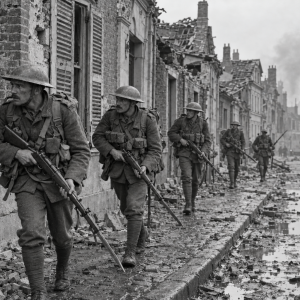
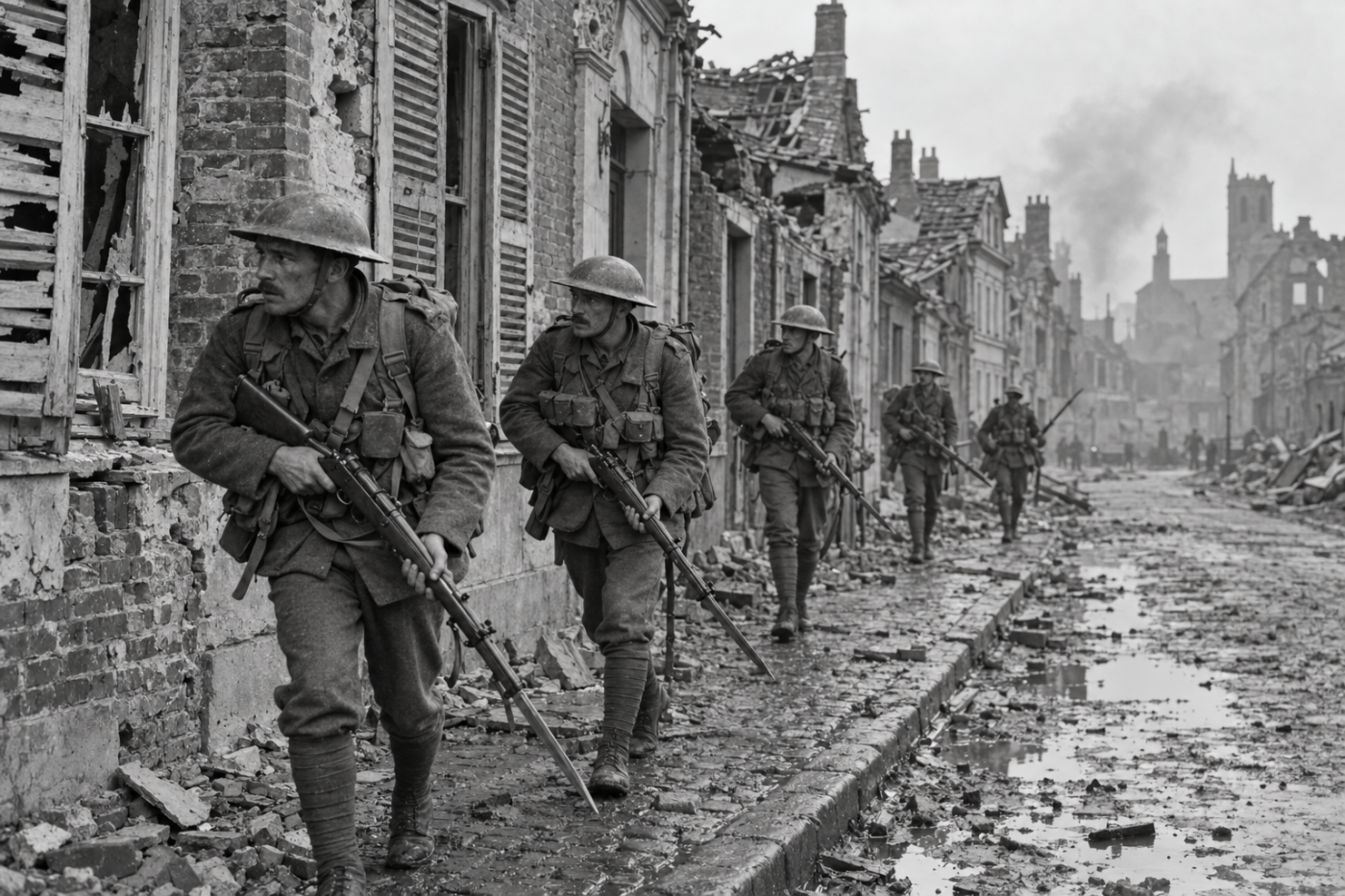
On 10 October 1918, soldiers of the 5th Battalion, Connaught Rangers stormed into Le Cateau in northern France, returning British troops to a town whose name had been etched into the Army’s memory during the desperate retreat of 1914. Four years earlier, British soldiers had fought a costly defensive battle there against the advancing Germans. Now the situation had reversed, and British infantry were pursuing an enemy struggling to contain the final Allied offensive.
On 26 August 1914, Lieutenant-General Sir Horace Smith-Dorrien’s II Corps had made its stand at Le Cateau following the retreat from Mons. Exhausted infantrymen and artillery crews fought against superior German forces, buying precious time for the withdrawal to continue. Thousands were killed, wounded or captured, but their resistance helped prevent the retreat from becoming a disaster. Afterwards, the town remained under German occupation, serving as a railway supply centre and an important location for military hospitals.
By October 1918, Germany’s spring offensives had failed to secure victory, and the Allies were advancing during the Hundred Days Offensive. The breaking of the Hindenburg Line, followed by fighting around Beaurevoir and Cambrai, forced German troops back towards the River Selle. British formations pressed eastwards, keeping pressure on the retreating forces before they could establish another secure defensive line. Despite their withdrawal, German machine-gunners and artillery continued to defend villages, railway cuttings and river crossings with considerable determination.
The Connaught Rangers were an Irish infantry regiment of the British Army, traditionally associated with the west of Ireland. Their 5th Battalion had already served at Gallipoli, in the Balkans and in Palestine before arriving in France in June 1918. During the final campaign it fought with the 66th Division, bringing experienced soldiers into an offensive that demanded rapid advances followed by sharp, costly encounters with German rearguards.
On 10 October, the Rangers attacked into Le Cateau as part of the division’s advance, with the 18th Battalion, King’s Liverpool Regiment also fighting in the sector. The Irish infantry pushed through the town towards the railway cutting beyond, but neighbouring troops could not make sufficient progress to secure their flanks. With their forward position exposed, the Rangers were drawn back after dusk, retaining positions along the western bank of the Selle. Their assault had established a foothold, but German resistance beyond the river prevented an immediate breakthrough.
The storming of Le Cateau did not mean that every part of the town had been secured that evening. Fighting continued during the following week, while the wider Battle of the Selle began on 17 October. The river and the German positions beyond it required further organised attacks before the advance could continue. For the inhabitants, the arrival of British troops brought the prospect of freedom after more than four years of occupation, although shellfire and nearby enemy positions prolonged the danger.
For the British Army, returning to Le Cateau carried a particular poignancy. The advancing soldiers were reaching ground where their predecessors had fought and fallen during the opening weeks of the war. In August 1914, British troops had stood there to protect a retreat; in October 1918, the Connaught Rangers fought their way back as the German armies withdrew. Just over a month later, the Armistice ended the fighting on the Western Front, leaving Le Cateau connected to both the opening ordeal and the final advance of Britain’s war.