The Japanese invasion of the Dutch East Indies, 1941-1942
In 1941, the Dutch East Indies encompassed most of present-day Indonesia. The colony’s considerable wealth largely served Dutch economic interests, while Europeans enjoyed privileges that were denied to much of the local population. Indonesian nationalist movements had long demanded greater political rights and, increasingly, independence. The colonial authorities responded by restricting their activities and imprisoning or exiling prominent opponents. Some Indonesians regarded Japan as a possible liberator from Dutch rule, although others distrusted Japanese intentions or remained loyal to the colonial government. The colony’s extensive oil reserves also made it an important target for Japan, whose expanding armed forces depended heavily on imported fuel.
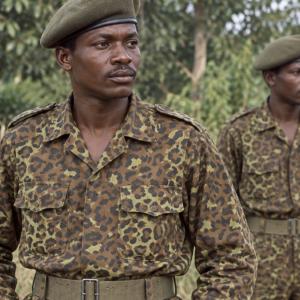
The colony’s principal military force was the Koninklijk Nederlandsch-Indisch Leger, or Royal Netherlands East Indies Army, commonly known as the KNIL. It was a separate organisation from the Royal Netherlands Army in Europe. Most of its professional soldiers were Indonesian recruits. They served alongside European volunteers, although the officer corps remained predominantly European. Lieutenant-General Hein ter Poorten commanded the army. As the threat of war increased, conscripts, reservists and local defence units were mobilised to reinforce the regular troops. This expansion increased the army’s strength on paper, but standards of training and equipment varied considerably.
The KNIL was primarily organised and trained for internal security and colonial warfare rather than large-scale conventional operations. The main concentration of troops was stationed on Java, organised under divisional commands, while smaller garrisons protected strategically important locations elsewhere in the archipelago. The enormous distances between the islands complicated the movement of troops, equipment and supplies. Isolated garrisons could offer little support to one another, and the KNIL lacked sufficient manpower to defend the numerous possible landing sites.
From 1936 onwards, the KNIL undertook a programme of modernisation, acquiring additional machine guns, mortars, armoured vehicles and aircraft. However, the German conquest of the Netherlands in May 1940 severely disrupted the flow of reinforcements and military supplies from Europe. The colonial government became increasingly dependent on arms purchased from other countries, many of which failed to arrive before the Japanese invasion. Consequently, some units possessed relatively modern weapons, while others suffered from shortages of transport, equipment or adequately trained personnel. The KNIL also maintained its own air arm, equipped with fighters and bombers intended partly to strike enemy invasion fleets. Despite these preparations, the available land, sea and air forces were insufficient to defend the entire archipelago.
Japan was already engaged in a prolonged war in China and had extended its military presence into French Indochina. In response, Britain, the United States and the Netherlands imposed economic restrictions during 1941, effectively cutting off much of Japan’s access to imported oil. Rather than abandon their territorial ambitions, Japanese leaders decided to secure the resources they required through military conquest. The attacks on Pearl Harbour, Malaya and the Philippines in December 1941 formed part of this wider offensive. The Netherlands declared war on Japan on 8 December, bringing the Dutch East Indies directly into the conflict.
The Japanese offensive against the colony began with air raids, followed by amphibious landings at strategically important locations. On 11 January 1942, Japanese troops landed on Tarakan, an oil-producing island off Borneo, and attacked Menado in northern Celebes, now Sulawesi. At Menado, naval parachutists supported the troops advancing from the coast. Dutch forces
offered resistance and demolished important installations to prevent their capture intact, but both garrisons were eventually overwhelmed. The captured airfields enabled Japanese aircraft to operate closer to subsequent objectives, while seized ports provided valuable supply bases. With each Japanese advance, the remaining Dutch positions became increasingly isolated.
The Allies attempted to coordinate their defence through the newly established American-British-Dutch-Australian Command, or ABDA. It became operational on 15 January under General Sir Archibald Wavell, who was given authority over the combined land, naval and air forces. Nevertheless, the participating countries faced different strategic priorities. Britain concentrated on defending Singapore, American forces were engaged in the Philippines, and Australia was increasingly concerned about threats to its own territory. The Dutch, meanwhile, regarded the preservation of their colony as essential. Shortages of reinforcements, inadequate communications and differing national interests made effective cooperation extremely difficult.
Japanese forces continued their advance through Borneo and Celebes during January. At Balikpapan on 24 January, American destroyers launched a night attack against Japanese troop transports, sinking several vessels. Although the attack inflicted significant losses, it failed to prevent the landing or the capture of the strategically valuable oil port. Dutch troops had already destroyed much of the local oil infrastructure to deny it to the invaders. Japanese forces also seized the airfield at Kendari in southeastern Celebes, extending the reach of their aircraft. At the end of January, Japanese troops attacked Ambon, where KNIL soldiers and the Australian Gull Force mounted a determined defence. Despite their resistance, organised fighting ended on 3 February.
On 14 February, Japanese army parachutists descended near the airfield and oil refineries at Palembang in southern Sumatra. Their assault was followed by the arrival of additional troops by sea. Dutch and British forces attempted to defend these strategically important installations, but were eventually forced to withdraw. The following day, Singapore surrendered to Japan, dealing a devastating blow to the wider Allied defence of Southeast Asia. Japanese landings on Bali on 19 February and Timor on 20 February further threatened the approaches to Java and disrupted potential reinforcement routes from Australia. By this stage, ABDA had lost much of the territory it had been established to protect. The command was dissolved on 25 February, leaving Java increasingly exposed to invasion.
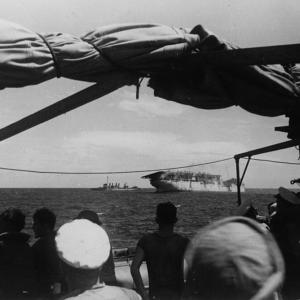
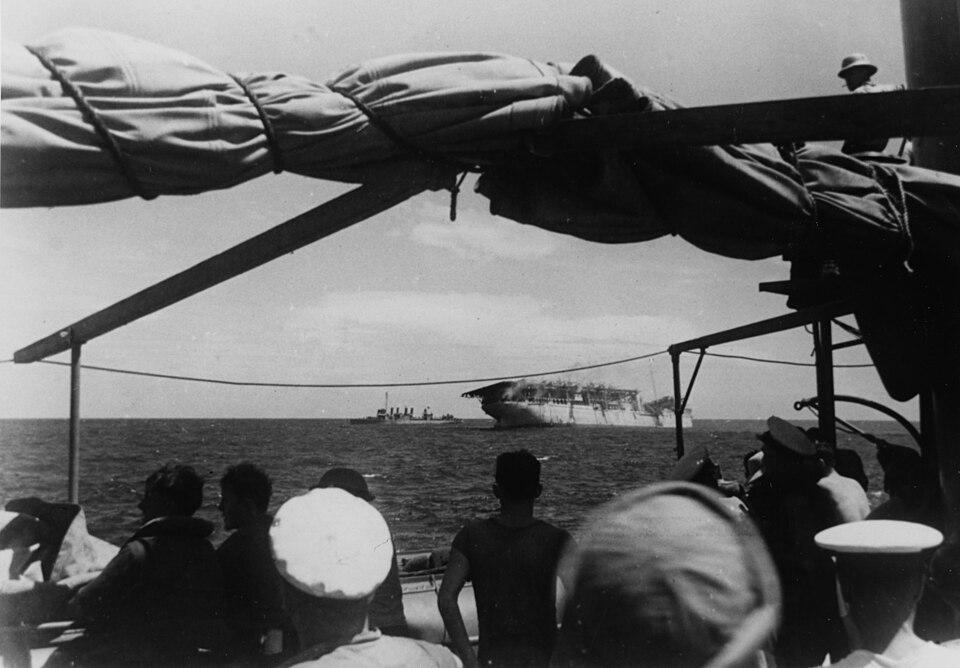
Rear-Admiral Karel Doorman nevertheless attempted to intercept the Japanese invasion convoys approaching Java. On 27 February, he led a combined force of Dutch, British, American and Australian warships into the Battle of the Java Sea. Japanese cruisers and destroyers were escorting the troop transports, and the Allied fleet struggled to coordinate its movements and attacks. Differences in communication procedures and limited opportunities for joint training further weakened its effectiveness. During the afternoon, HMS Exeter sustained serious damage. Later in the battle, Japanese torpedoes struck and sank the Dutch cruisers Java and De Ruyter. Doorman was killed aboard his flagship, De Ruyter. The defeat, followed by further Allied naval losses, effectively eliminated the remaining possibility of preventing the main Japanese landings on Java.
Japanese troops came ashore on Java on 1 March. In the west, forces landing at Merak and Bantam Bay advanced towards Batavia, now Jakarta, and Buitenzorg, now Bogor. From these positions, they could threaten the important military centre of Bandung. Another Japanese force landed at Eretan Wetan on the northern coast and captured Kalidjati airfield the same day. Japanese aircraft began operating from the captured airfield on 2 March, bringing air support
much closer to the Dutch defensive positions. KNIL counterattacks failed to recapture Kalidjati, allowing Japanese aircraft to maintain pressure on the troops defending the approaches to Bandung.
In eastern Java, Japanese forces landing at Kragan advanced towards Surabaya, one of the colony’s principal naval bases. Another formation crossed central Java towards Cilacap, an important port on the southern coast. These simultaneous advances compelled the defenders to divide their already limited forces, while threatening vital supply lines and possible evacuation routes. In western Java, Brigadier Arthur Blackburn’s Australian Blackforce temporarily delayed the Japanese advance at Leuwiliang, supported by American artillery. The destruction of bridges created additional obstacles for the attacking troops. Although such actions demonstrated that the Allied forces could still mount effective local resistance, they could not reverse the overall course of the campaign. The defenders continued to lose territory and were gradually forced into retreat.
Ter Poorten withdrew his forces in western Java towards Bandung, abandoning Batavia and Buitenzorg. Supported by air attacks, Japanese troops broke through the northern defensive positions near Ciater on 6–7 March, placing Bandung under immediate threat. With his forces weakened, communications deteriorating and little prospect of successful continued resistance, Ter Poorten accepted Lieutenant-General Hitoshi Imamura’s demand for unconditional surrender at Kalidjati on 8 March. A general surrender order was broadcast on 9 March, when further arrangements were agreed. Other Allied formations surrendered separately, although some KNIL detachments continued to resist in more remote parts of the archipelago.
European KNIL personnel and soldiers of mixed Dutch and Indonesian ancestry were taken prisoner alongside other captured Allied servicemen. Many Indonesian soldiers were subsequently released, while others remained in captivity or entered Japanese military service. Prisoners of war endured forced labour, severe deprivation, disease and frequently brutal treatment. The civilian population also suffered under Japanese occupation, as food and other resources were requisitioned for military purposes and opposition was harshly suppressed. The rapid Dutch defeat demonstrated that European colonial authority was far more vulnerable than many had previously believed. Yet Japanese occupation did not bring the independence that some Indonesians had anticipated. Instead, the experience of war and occupation profoundly altered Indonesia’s political landscape and strengthened the struggle for national independence. When the war ended, the Dutch would discover that restoring their former colonial authority was considerably more difficult than it had been before 1942.
Author: Tom Dankers, Historian - Arnhems Oorlogsmuseum 40-45
Photograph: Naval History & Heritage Command, Public domain, via Wikimedia Commons