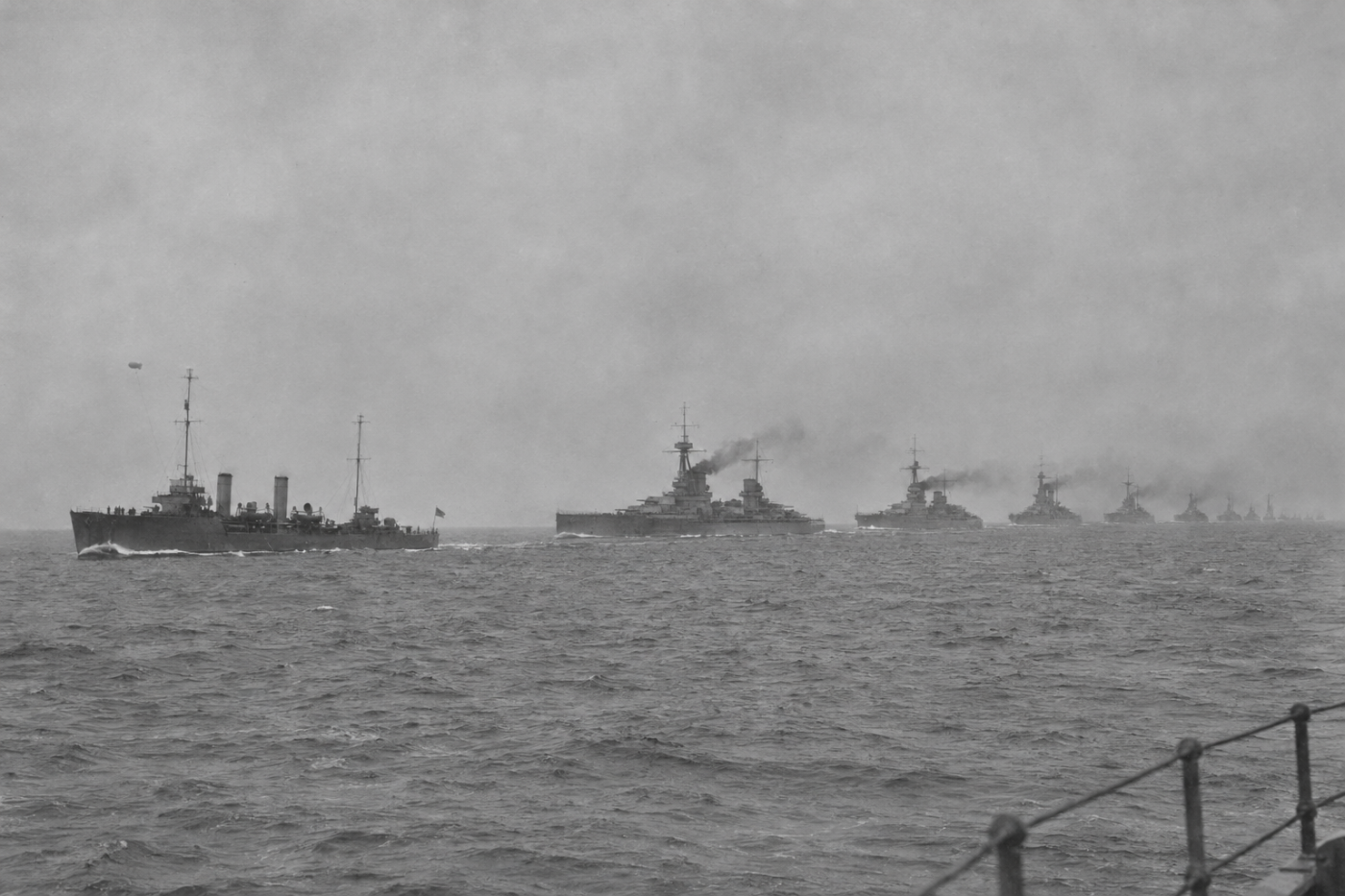
German Fleet Surrenders
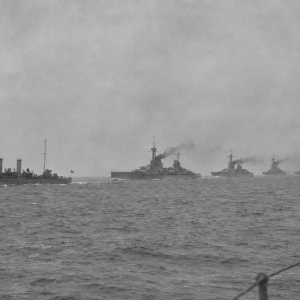
Ten days after the Armistice, a line of German warships appeared in the North Sea off the Scottish coast. Five battlecruisers, nine battleships and dozens of smaller vessels were heading for a rendezvous with Admiral Sir David Beatty’s Grand Fleet. At the head of the German column was the Royal Navy light cruiser HMS Cardiff, leading into captivity some of the most powerful warships Germany had ever built.
Only weeks earlier, Germany’s naval commanders had planned one last battle against the Royal Navy. With the army retreating and the government seeking an armistice, sailors refused to risk their lives on a sortie they believed could no longer change the outcome of the war. The operation was abandoned. Arrests helped spark the revolt at Kiel in early November, and the unrest spread across Germany. By 9 November the Kaiser’s abdication had been announced. Two days later, Germany signed the Armistice.
The naval terms dealt with two very different fleets. German U-boats were to be surrendered outright and began arriving at Harwich in a separate operation. The designated surface warships were to be disarmed and held under Allied supervision while the peace negotiators decided their fate. Admiral Franz von Hipper, commander-in-chief of the High Seas Fleet, refused to take part in the handover. The duty fell to Rear-Admiral Ludwig von Reuter, who flew his flag in the battleship SMS Friedrich der Grosse.
Beatty’s operation was codenamed Operation ZZ. On the morning of 21 November, roughly 40 miles east of the Isle of May, more than 350 Allied vessels assembled for the handover. The Grand Fleet formed two long lines, with American battleships and the Australian battlecruiser HMAS Australia among them. HMS Cardiff met the Germans and led their roughly 70 ships between the Allied columns before turning towards the Firth of Forth. Among the German warships were Seydlitz and Derfflinger, veterans of the Battle of Jutland just two and a half years earlier.
Once the German ships were at anchor, Beatty ordered their ensigns lowered at 3.57 pm. The flags could be raised again only with his permission. British officers inspected the warships to check that the disarmament terms had been obeyed. Over the following days, the ships were escorted north in groups to Scapa Flow, in Orkney. Later arrivals brought the number of interned vessels to 74.
For months, German crews remained aboard while the Allies debated what to do with the ships. On 21 June 1919, believing the Armistice was about to expire and fearing the British would seize the fleet, von Reuter ordered it scuttled. Fifty-two vessels sank. Many were later salvaged, but seven wrecks still lie in Scapa Flow.
At Jutland in 1916, the German High Seas Fleet had fought its way home. On 21 November 1918, many of those same ships passed between the lines of their old adversary without firing a shot. For the men aboard, the lowering of the ensigns marked the end of Germany’s battle fleet as a fighting force.